Views: 5
In the automotive, electrical, and structural engineering sectors, traditional engineering thermoplastics such as Polybutylene Terephthalate (PBT), Polyamide 6 (PA6), and Polycarbonate (PC) are widely utilized for under-the-hood components, power tool housings, and structural brackets. However, under intensifying corporate decarbonization targets and Extended Producer Responsibility (EPR) mandates, compounders face increasing pressure to introduce sustainable alternatives.
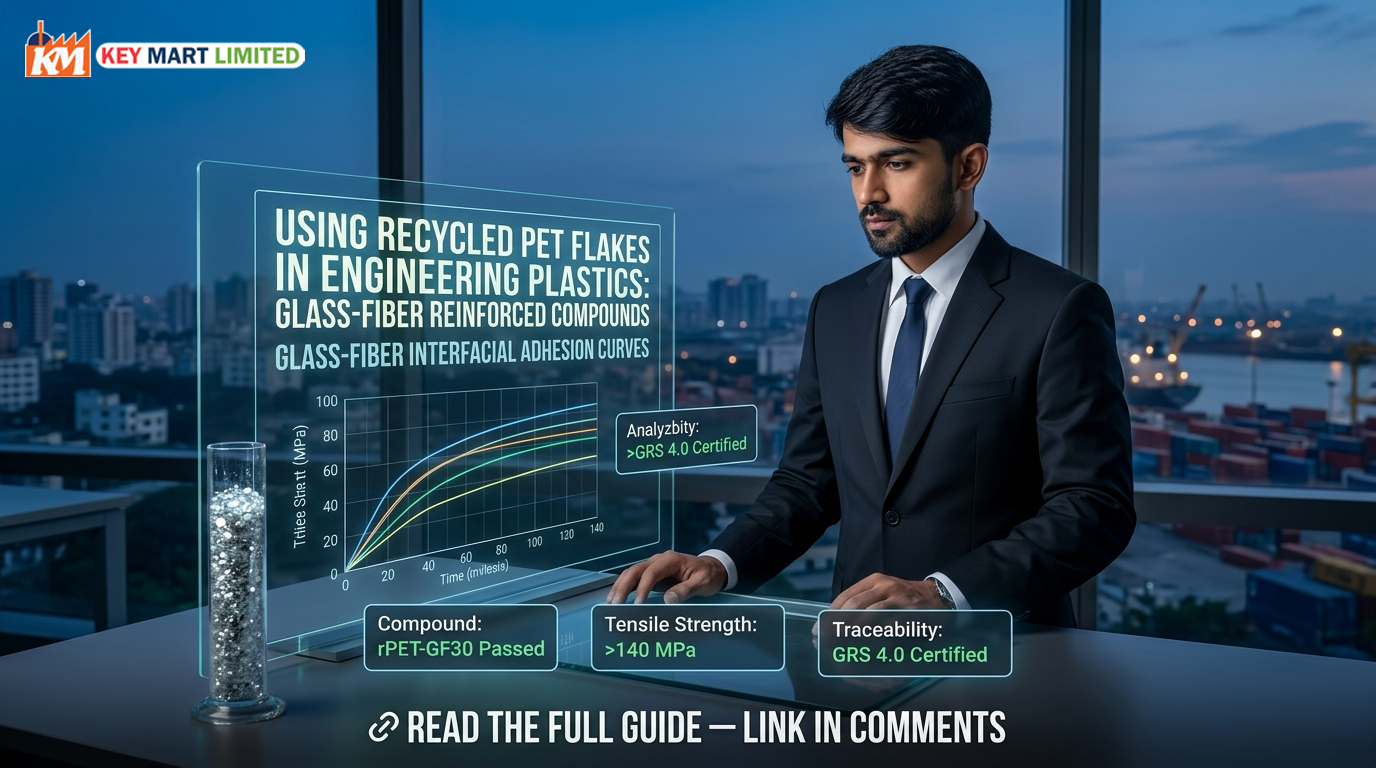
Compounding post-consumer recycled Polyethylene Terephthalate (pet flakes) with chopped glass fibers ($15\%\text{–}45\%$ loading) yields a high-performance engineering thermoplastic. Glass-reinforced rPET (rPET-GF) matches or exceeds virgin PBT in tensile modulus, heat deflection temperature (HDT), and dimensional stability—at a significantly lower raw material cost.
Achieving superior mechanical strength in rPET-GF compounds requires overcoming critical processing challenges: interfacial fiber-matrix adhesion, hydrolytic Intrinsic Viscosity (IV) scission, and PVC-induced polymer degradation.
This engineering guide examines the chemistry of glass-fiber reinforced rPET compounding, outlines structural property benchmarks, and demonstrates how Key Mart Limited delivers technical-grade feedstock to global engineering plastic compounders.
1. The Chemistry and Mechanics of Glass-Fiber Reinforced rPET
Polyethylene Terephthalate possesses a rigid, semi-aromatic molecular backbone that provides exceptional thermal resistance and stiffness when reinforced with E-glass fibers:
De-Dusted High-IV rPET Flakes + Silane-Sized Chopped Glass Fibers + Epoxy Chain Extender ➔ High-Shear Twin-Screw Compounding ➔ High-Strength rPET-GF30 Pellets ➔ Injection Molded Engineering Components
A. Interfacial Adhesion and Silane Sizing
Virgin glass fibers are chemically inert and do not bond directly to molten PET. To ensure stress transfer from the polymer matrix to the load-bearing fibers, compounders utilize chopped glass strands coated with specialized organosilane sizing agents (such as $\gamma$-aminopropyltriethoxysilane). The amine groups react covalently with the carboxyl ($-\text{COOH}$) and hydroxyl ($-\text{OH}$) end-groups of PET, establishing robust interfacial shear strength.
B. The Critical Role of Intrinsic Viscosity (IV) Retention
-
Molecular Entanglement: If incoming pet flakes undergo hydrolytic degradation due to residual moisture ($> 50\text{ PPM}$), the average molecular chain length shortens drastically ($IV < 0.70\text{ dL/g}$).
-
Impact on Tenacity: Shortened polymer chains fail to wrap effectively around the silane-functionalized glass fibers, leading to fiber pull-out defects, reduced notched Izod impact resistance, and premature component fracture under dynamic load.
Read More: A Step-by-Step Guide to Importing PET Flakes from Bangladesh via Chittagong Port
C. Thermal Performance (HDT Elevation)
While unreinforced PET exhibits a Heat Deflection Temperature (HDT) of approximately $75^\circ\text{C}\text{–}80^\circ\text{C}$, the addition of $30\%$ glass fibers elevates the HDT under heavy load ($1.80\text{ MPa}$) to $215^\circ\text{C}\text{–}225^\circ\text{C}$, allowing rPET-GF compounds to replace metal castings and expensive virgin polyamides in high-temperature engine compartments.
Engineering Properties & Material Benchmark Table
| Mechanical & Physical Property | Virgin PBT-GF30 (Benchmark) | Unreinforced rPET | Key Mart rPET-GF30 Compound Standard |
| Tensile Strength (MPa) | $130\text{–}140\text{ MPa}$ | $50\text{–}60\text{ MPa}$ | 135 – 150 MPa (High Tenacity) |
| Flexural Modulus (GPa) | $8.5\text{–}9.5\text{ GPa}$ | $2.5\text{–}3.0\text{ GPa}$ | 9.0 – 10.5 GPa (High Rigidity) |
| Heat Deflection Temp (1.8 MPa) | $\approx 210^\circ\text{C}$ | $\approx 75^\circ\text{C}$ | 215°C – 225°C (High Thermal Stability) |
| Notched Izod Impact (kJ/m²) | $8.0\text{–}9.5\text{ kJ/m²}$ | $2.5\text{–}3.5\text{ kJ/m²}$ | 8.5 – 10.0 kJ/m² (Impact Modified) |
| PVC Contamination | $0\text{ PPM}$ | $< 150\text{–}300\text{ PPM}$ | < 25 – 50 PPM (Eliminates Matrix Char) |
| Residual Moisture (Pre-Dryer) | $< 0.05\%$ | $> 1.0\%$ | < 0.5% (Pre-Dryer Target) |
| Traceability & Audits | Fossil Baseline | Unverified | GRS 4.0 Transaction Certified (TC) |
2. Overcoming Contamination Bottlenecks in rPET-GF Compounding
Compounding high-modulus engineering plastics from post-consumer flakes on co-rotating twin-screw extruders requires strict feedstock quality controls:
-
Sub-50 PPM PVC Purity: Polyvinyl Chloride decomposes into corrosive hydrochloric acid ($\text{HCl}$) at compounding temperatures ($270^\circ\text{C}\text{–}290^\circ\text{C}$). Acidic degradation attacks silane sizing, de-bonds glass fibers from the PET matrix, and corrodes twin-screw barrel liners. Sourcing feedstock sorted below $25\text{–}50\text{ PPM}$ PVC is non-negotiable.
-
De-Dusting and Bulk Density Stability: Fines and dust ($< 500\,\mu\text{m}$) cause feed-throat bridging and erratic gravimetric feeder dosing. Sourcing de-dusted flakes ($< 0.3\%$ fines) ensures uniform polymer-to-glass loading ratios ($30\%\pm 0.5\%$).
-
Reactive Chain Extension: Dosing multi-functional epoxy or carbodiimide-based chain extenders during melt compounding recombines cleaved ester bonds, restoring Intrinsic Viscosity ($0.78\text{–}0.84\text{ dL/g}$) and ensuring high ductile strength.
3. How Key Mart Limited Meets Global Demand for Engineering-Grade Feedstock
Producing rPET feedstock suitable for high-stress engineering compounds requires an established bangladesh pet flakes manufacturer with precision washing and sorting technology.
As a premier pet flakes company bangladesh and trusted pet flakes exporter, Key Mart Limited delivers technical-grade rPET flakes engineered specifically for compounding and reinforcement:
-
Automated Processing Infrastructure in Dhaka: Operating as a leading pet flakes manufacturer dhaka, Key Mart Limited utilizes continuous hot-caustic washing lines ($85^\circ\text{C}-95^\circ\text{C}$), multi-stage friction washers, and automated NIR optical sorting to eliminate adhesives, polyolefins, and PVC.
-
Guaranteed Sub-50 PPM Purity: As an established bangladesh pet flakes manufacturer, our facility guarantees $\text{PVC} < 25\text{–}50\text{ PPM}$, moisture $< 0.5\%$, and uniform $8\text{–}12\text{ mm}$ flake geometry, verified batch-by-batch in our Dhaka laboratory and documented with official Certificates of Analysis (CoA).
-
GRS 4.0 Certified Chain of Custody: Serving as an experienced pet flakes exporter, Key Mart Limited provides complete chain-of-custody documentation and shipment-specific GRS 4.0 Transaction Certificates (TCs), ensuring your compounds fulfill OEM automotive and electrical ESG mandates.
-
Maximized 25–26 MT Container Payloads: We load 25–26 Metric Tons into every 40ft High Cube container with heavy-duty 100-micron PE moisture-barrier inner liners to preserve feedstock dryness during ocean transit under FOB Chittagong, CFR, or CIF shipping terms.
Partner with Key Mart Limited Today
Elevate your engineering compounds, prevent fiber de-bonding, and secure high-purity rPET flakes from Bangladesh. Contact our Dhaka export management team today to request Technical Data Sheets, order compounding trial samples, or reserve monthly container allocations.
-
Company Name: Key Mart Limited
-
Head Office & Factory Address: Plot #31, Road #N-1, Block #K, Eastern Housing, Pallabi 2nd Phase, Rupnagar, Dhaka-1216, Bangladesh.
-
Official Website: www.keymartbd.com
-
Corporate Email: keymartltd@gmail.com | info@keymartbd.com
-
Direct Phone / WhatsApp: +8801760774499, +8801864935478
Join our community today and stay connected with the future of PET recycling.
 Visit our YouTube channel: Key Mart Limited on YouTube
Visit our Facebook Page: Key Mart Limited on Facebook
Subscribe to see our latest factory tours, production updates, and export success stories.