Views: 14
In the mechanical recycling of post-consumer Polyethylene Terephthalate (pet flakes), surface decontamination is the primary operational step that dictates finished product purity. While optical sorting eliminates foreign polymers like PVC and polyolefins, the chemical removal of stubborn contaminants—such as hot-melt label adhesives, water-resistant glues, organic beverage residues, and surface oils—relies entirely on alkaline hot-washing chemistry.
If label adhesives are not completely removed, residual glue chars at standard PET extrusion temperatures ($260^\circ\text{C}\text{–}280^\circ\text{C}$), generating black specks, cross-linked gel fisheyes, and severe yellowing ($b^*$-value drift) across bottle preforms, strapping, and high-clarity packaging sheets.
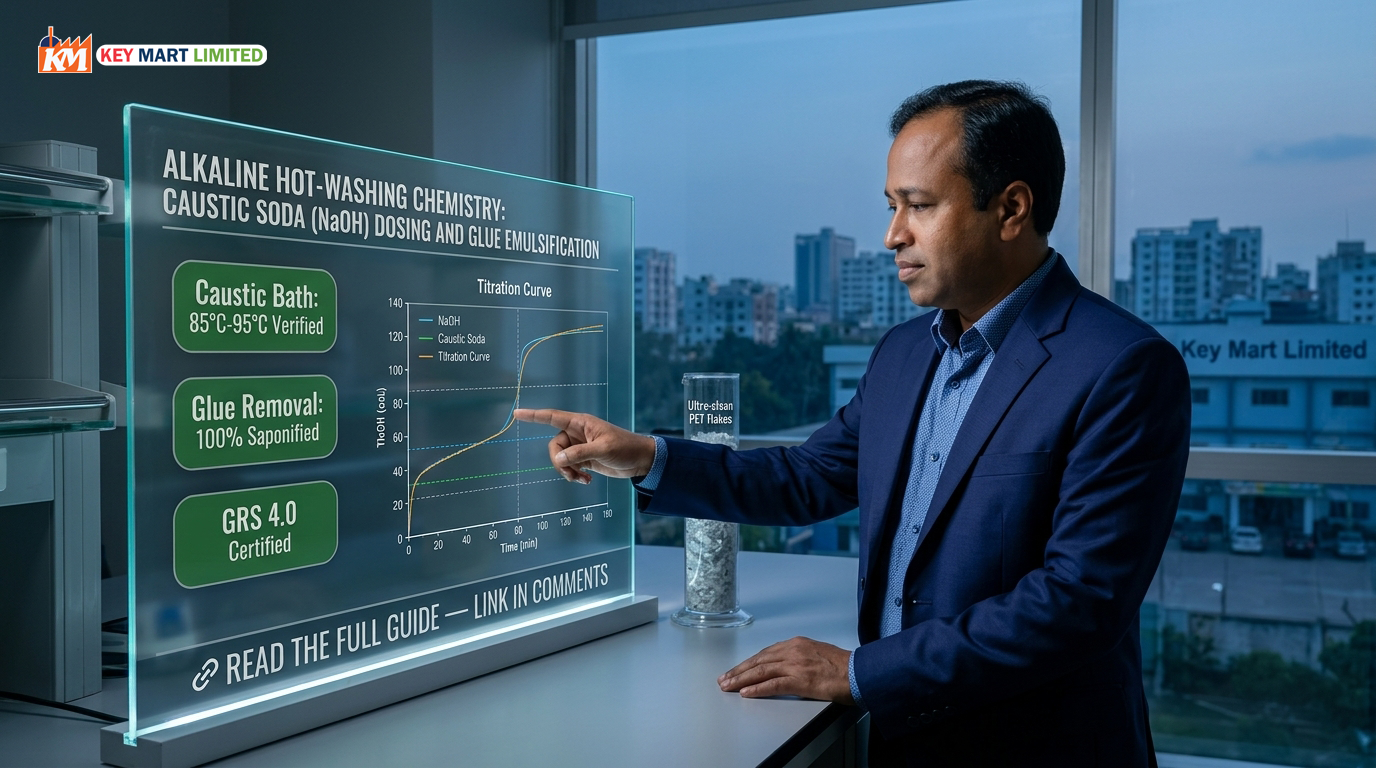
Achieving complete glue emulsification without damaging the PET matrix requires precise chemical equilibrium: balancing Sodium Hydroxide ($\text{NaOH}$) concentration, surfactant selection, bath temperature, and residence kinetics.
This technical guide analyzes the chemical mechanics of alkaline saponification, outlines dosing and wash-tank parameters, and illustrates how Key Mart Limited applies continuous hot-caustic washing to deliver ultra-pure feedstock to global convertors.
1. The Chemical Mechanics of Caustic Soda ($\text{NaOH}$) and Surfactant Action
Alkaline hot-washing combines saponification, detergency, and controlled micro-etching to lift contaminants from the flake surface:
Caustic Soda (NaOH) + Surfactant + Thermal Energy (85°C–95°C) ➔ Adhesive Saponification & Glue Emulsification ➔ High-Speed Friction Rinse ➔ High-Purity Decontaminated Flakes
A. Saponification of Hot-Melt Adhesives
Most bottle labels use pressure-sensitive adhesives (PSAs) based on ethylene-vinyl acetate (EVA), synthetic rubbers, or acrylic esters. In an alkaline bath, Sodium Hydroxide ($\text{NaOH}$) dissociates into $\text{Na}^+$ and $\text{OH}^-$ ions. The highly reactive hydroxyl ions attack the ester linkages in the adhesive formulation, breaking them down into water-soluble carboxylate salts and alcohols (saponification).
B. Glue Emulsification and Dispersion via Surfactants
Saponification alone leaves hydrophobic adhesive fragments suspended in water, which can redeposit onto clean flakes. Non-ionic and anionic surfactant packages lower interfacial surface tension, encapsulating the softened glue particles into stable micelle structures (emulsification) that stay suspended in the wash water and wash away during the subsequent friction rinse stage.
C. Controlled Surface Micro-Etching
Caustic soda mildly reacts with the outermost sub-micron layer of the PET polymer chain via alkaline hydrolysis. This controlled micro-etching strips away oxidized surface contaminants, organic beverage stains, and volatile organic compounds (VOCs) without degrading the core Intrinsic Viscosity (IV) of the flake.
Read More: A Step-by-Step Guide to Importing PET Flakes from Bangladesh via Chittagong Port
Technical Purity and Hot-Washing Process Benchmark Table
| Washing & Purity Parameter | Cold Wash / Basic Agitation | Industrial Caustic Wash Standard | Key Mart High-Intensity Wash Standard |
| Washing Temperature | Ambient ($25^\circ\text{C}\text{–}35^\circ\text{C}$) | $75^\circ\text{C}\text{–}80^\circ\text{C}$ | 85°C – 95°C (Optimized Thermal Activation) |
| Caustic Soda ($\text{NaOH}$) Dosing | $0\%$ (Water only) | $1.0\%\text{–}1.5\%$ Concentration | 1.8% – 2.5% Controlled Concentration |
| Surfactant Package | None / Generic detergent | Standard non-ionic surfactant | Specialized Low-Foam Emulsifier Package |
| Residual Glue & Adhesives | $> 500\text{ PPM}$ (High glue risk) | $< 100\text{ PPM}$ | < 10 – 25 PPM (Zero Charring Risk) |
| PVC Contamination | $< 150\text{–}300\text{ PPM}$ | $< 100\text{ PPM}$ | < 25 – 50 PPM (NIR Sorted) |
| Optical Yellowness ($b^*$-Value) | $+3.5\text{ to }+6.0$ | $+2.0\text{ to }+3.0$ | ≤ +1.0 to +1.5 (Crystal Clear Baseline) |
| Moisture Content (Pre-Dryer) | $> 1.5\%$ | $< 1.0\%$ | < 0.5% (Centrifugal & Hot-Air Dried) |
| Traceability & Compliance | Unverified | Standard declaration | GRS 4.0 Transaction Certified (TC) |
2. Process Optimization: Dosing, Temperature, and Residence Dynamics
To maximize glue removal while avoiding excess chemical consumption or polymer degradation, hot-wash systems are engineered with four interdependent control variables:
-
Optimal Caustic Concentration ($1.8\%\text{–}2.5\%$): Maintaining a constant $\text{pH}$ of $12.5\text{–}13.5$ ensures rapid adhesive breakdown. Under-dosing ($< 1.0\%$) leaves sticky residues, while over-dosing ($> 3.5\%$) causes excessive PET matrix loss without improving cleaning efficiency.
-
Thermal Activation Window ($85^\circ\text{C}\text{–}95^\circ\text{C}$): Hot-melt glues require high temperatures to soften and lower their mechanical bond strength, enabling caustic chemical penetration.
-
Residence Time & Mechanical Shear (12–15 Minutes): Continuous friction washers combine chemical baths with intense mechanical agitation, peeling softened adhesives off flake surfaces before the wash cycle ends.
-
Multi-Stage Clean Water Cascading Rinses: Following caustic washing, flakes must pass through multi-stage counter-current clean water friction rinses to neutralize $\text{pH}$ back to $7.0\text{–}7.5$, removing all residual sodium ions before the drying stage.
3. How Key Mart Limited Meets Global Demand for Ultra-Clean Feedstock
Supplying chemically clean, glue-free feedstock requires an established bangladesh pet flakes manufacturer with advanced hot-washing and automated water-treatment infrastructure.
As a premier pet flakes company bangladesh and trusted pet flakes exporter, Key Mart Limited delivers premium rPET flakes engineered for the most demanding packaging and fiber extrusion lines:
-
Continuous Automated Hot-Washing in Dhaka: Operating as a leading pet flakes manufacturer dhaka, Key Mart Limited runs multi-stage continuous hot-caustic washing lines with automated $\text{NaOH}$ dosing ($1.8\%\text{–}2.5\%$) and specialized low-foam surfactants at sustained temperatures of $85^\circ\text{C}\text{–}95^\circ\text{C}$.
-
Complete De-Gluation & Optical Purity: As an established bangladesh pet flakes manufacturer, our facility guarantees zero adhesive residues, low yellowness ($b^* \le +1.5$), high $L^*$-value brightness, and $\text{PVC} < 25\text{–}50\text{ PPM}$, verified batch-by-batch in our Dhaka laboratory.
-
Controlled Centrifugal Drying & De-Dusting: Serving as an experienced pet flakes exporter, Key Mart Limited uses centrifugal dewatering and thermal air drying to ensure moisture $< 0.5\%$ and fines $< 0.3\%$ ($8\text{–}12\text{ mm}$ sizing), accompanied by official Certificates of Analysis (CoA).
-
Full Chain-of-Custody GRS 4.0 Certification: Every export shipment is backed by Global Recycled Standard (GRS 4.0) Transaction Certificates (TCs), ensuring full compliance with European PPWR and North American EPR statutory mandates.
-
Maximized 25–26 MT Container Logistics: We pack 25–26 Metric Tons into every 40ft High Cube container with heavy-duty 100-micron PE moisture-barrier inner liners to preserve feedstock dryness during transit under FOB Chittagong, CFR, or CIF shipping terms.
Partner with Key Mart Limited Today
Eliminate glue charring and black specks, protect your melt screens, and secure hot-caustic washed rPET flakes from Bangladesh. Contact our Dhaka export management team today to request Technical Data Sheets, order commercial samples, or reserve container allocation schedules.
-
Company Name: Key Mart Limited
-
Head Office & Factory Address: Plot #31, Road #N-1, Block #K, Eastern Housing, Pallabi 2nd Phase, Rupnagar, Dhaka-1216, Bangladesh.
-
Official Website: www.keymartbd.com
-
Corporate Email: keymartltd@gmail.com | info@keymartbd.com
-
Direct Phone / WhatsApp: +8801760774499, +8801864935478
Join our community today and stay connected with the future of PET recycling.
 Visit our YouTube channel: Key Mart Limited on YouTube
Visit our Facebook Page: Key Mart Limited on Facebook
Subscribe to see our latest factory tours, production updates, and export success stories.