Views: 4
If you direct quality assurance, oversee packaging engineering, or manage materials compliance for a food and beverage brand in North America, incorporating recycled content into direct food-contact packaging is a high-stakes undertaking. You aren’t just looking at structural strength, optical clarity, or cycle times—chemical safety and toxicological compliance are the primary gatekeepers.
Under Title 21 of the US Code of Federal Regulations (21 CFR § 177.1630), virgin PET is well understood and widely approved. But secondary materials like recycled Polyethylene Terephthalate (pet flakes) come with a catch: post-consumer collection streams inherently risk contamination from consumer misuse. Whether someone used an empty beverage bottle to hold paint thinner, motor oil, or garden pesticides, those chemical residues cannot be allowed anywhere near food products.
To address this risk, the US Food and Drug Administration (FDA), through its Center for Food Safety and Applied Nutrition (CFSAN), established a rigorous evaluation pathway.
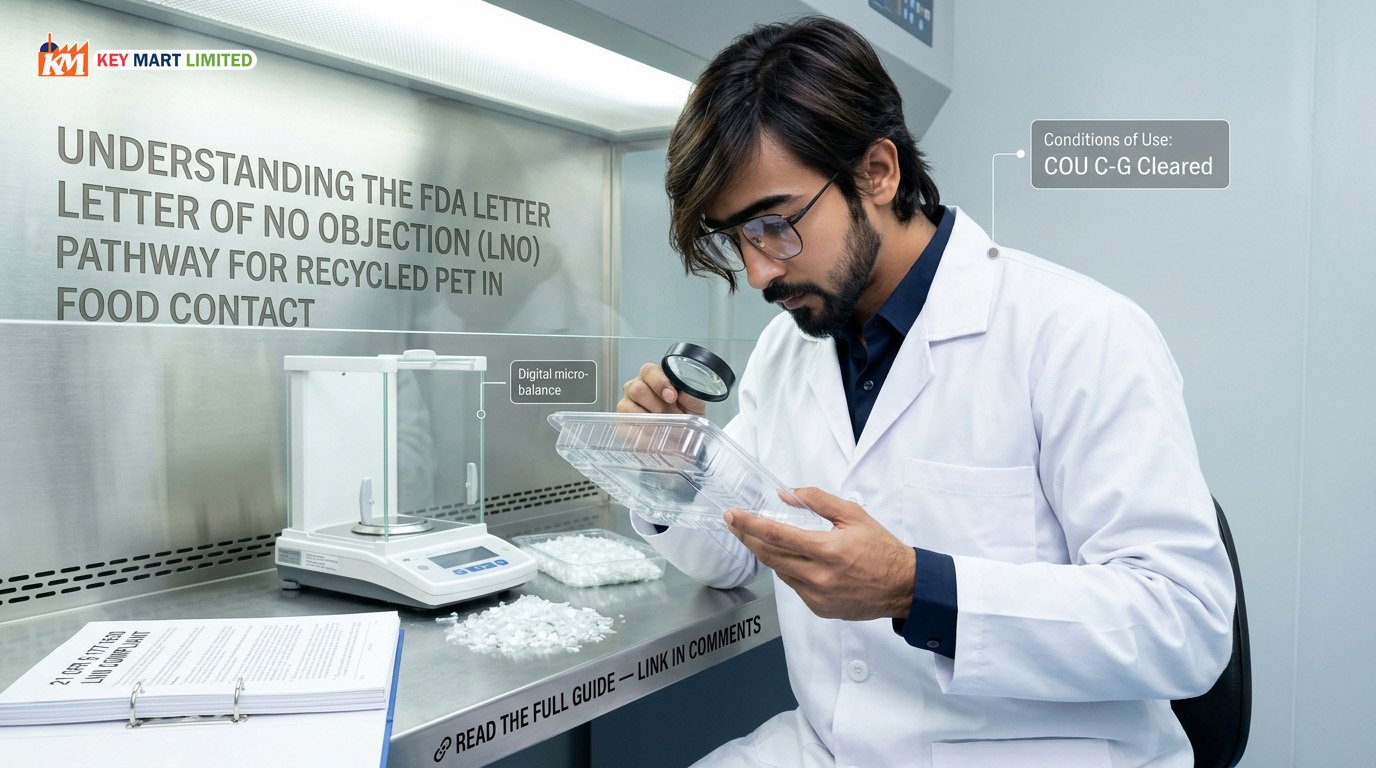
Securing an FDA LNO recycled PET food contact determination confirms that the agency has vetted a recycler’s decontamination process, audited surrogate challenge tests, and concluded that the finished resin will not adulterate food under specified Conditions of Use (COU).
Navigating this clearance process requires knowing how CFSAN evaluates secondary recycling plants, what surrogate challenge testing entails, and why starting with clean, single-origin post-consumer bottle flakes is essential.
This guide outlines CFSAN’s review criteria, explains surrogate testing, and shows how Key Mart Limited delivers the clean, low-contaminant rPET flakes needed to feed food-grade conversion lines.
1. How CFSAN Reviews rPET: The Three Pillars of Food-Contact Safety
The FDA’s Guidance for Industry: Use of Recycled Plastics in Food Packaging takes a toxicological risk-assessment approach to evaluate whether recycling operations can decontaminate post-consumer polymers safely:
Clear Post-Consumer Bottle Feed ➔ Continuous Hot-Caustic Decontamination ➔ Vacuum Stripping / SSP ➔ Surrogate Challenge Test (GC-MS / LC-MS) ➔ CFSAN Toxicological Review ➔ Issued FDA Letter of No Objection (LNO)
A. Strict Feedstock Source Control
CFSAN does not allow general mixed plastic scrap into food-contact recycling streams. To pass muster:
-
Inbound bales must consist strictly of source-segregated post-consumer beverage bottles and food-grade containers.
-
Non-food packaging, automotive containers, and chemical bottles must be eliminated at the intake gate before reaching the wash line.
B. Mechanical and Chemical Decontamination Efficacy
Surface contaminants like label adhesives, printing inks, and dirt must be removed during the primary wash:
-
Continuous hot-caustic friction washing at temperatures between $85^\circ\text{C}$ and $95^\circ\text{C}$ saponifies pressure-sensitive adhesives, cleans fatty residues, and strips surface-level organic chemicals.
-
Float-sink hydro-cyclones remove polyolefin caps and labels (polypropylene and polyethylene), keeping non-PET fractions out of the melt stream.
C. Thermal Diffusion and Deep Vacuum Extraction
Because volatile and semi-volatile compounds can slowly diffuse into the outer layers of the polyester matrix, the secondary reclamation process (such as solid-state polycondensation or high-vacuum extrusion) must pull embedded organic compounds back out:
-
The Threshold of Regulation (TOR) Limit: CFSAN requires that any potential chemical migrant in the finished container yield a dietary exposure below $0.5\text{ ppb}$ ($1.5\,\mu\text{g/person/day}$).
-
Surrogate Spiking Protocols: Recyclers intentionally spike feedstock with surrogate chemicals representing various chemical classes (volatile, non-volatile, polar, non-polar, and organometallic compounds). Challenge testing then verifies that the cleaning process achieves a decontamination efficiency exceeding $> 99.5\%$.
Food-Contact rPET Compliance & Decontamination Benchmark
Read More: A Step-by-Step Guide to Importing PET Flakes from Bangladesh via Chittagong Port
| Regulatory & Purity Parameter | General Scrap Flakes | Basic Mechanical Flakes | FDA Food-Contact Pathway Grade (Key Mart Standard) |
| CFSAN Food-Contact Readiness | Non-Compliant (Industrial Only) | Food-Contact Restricted | 100% LNO & Food-Contact Pathway Ready |
| Dietary Exposure Limit Baseline | Undetermined ($> 5.0\text{ ppb}$) | Marginal ($1.0\text{–}2.5\text{ ppb}$) | < 0.5 ppb Dietary Exposure Ceiling Equivalent |
| Surrogate Cleaning Efficiency | Unverified ($< 90\%$) | $95.0\text{–}98.0\%$ | > 99.5% Surrogate Removal Efficiency |
| PVC Contamination Ceiling | $> 150\text{–}300\text{ PPM}$ | $50\text{–}100\text{ PPM}$ | < 25 – 50 PPM (Continuous Hot-Caustic) |
| Label Glue Residue | $> 200\text{ PPM}$ (Adhesive Gels) | $50\text{–}100\text{ PPM}$ | < 10 PPM (Alkaline Saponified) |
| Dust & Fines Content ($< 500\,\mu\text{m}$) | $> 2.5\text{–}3.5\%$ (Burn Risk) | $1.0\text{–}1.5\%$ | < 0.3% (Multi-Stage Air Elutriated) |
| Intrinsic Viscosity (IV – ASTM D4603) | $0.65\text{–}0.70\text{ dL/g}$ (Unstable) | $0.72\text{–}0.75\text{ dL/g}$ | 0.78 – 0.82 dL/g (Stable Food-Grade Baseline) |
| Supply Chain Traceability | None | Simple Packing Slip | GRS 4.0 Transaction Certified (TC) |
2. Practical Steps for Converters Running Food-Grade rPET
Food and beverage packaging teams can streamline FDA audits and prevent line issues by following three operational guidelines:
-
Match Your Operating Envelope to Approved Conditions of Use (COU): FDA LNO letters are not blanket approvals. They explicitly specify allowable Conditions of Use—ranging from hot-fill applications (COU B) down to frozen storage (COU G). Always verify that your finished container’s thermal and shelf-life profile aligns with the parameters of the underlying challenge testing.
-
Control Infeed Moisture to Prevent Hydrolytic IV Drops: Feeding moist flakes ($> 0.5\%$) directly into high-heat extruders causes rapid hydrolytic chain cleavage. This drops melt viscosity, causes preform hazing, and weakens container sidewall strength. Using flakes dried to $< 0.5\%$ moisture protects molecular weight and maintains stable cycle times.
-
Substantiate Provenance with Independent Certification: CFSAN audits and corporate quality teams require verified proof of origin. Backing your material files with Global Recycled Standard (GRS 4.0) transaction certificates proves that 100% of your resin traces directly back to post-consumer beverage collection.
3. How Key Mart Limited Supplies Audit-Ready rPET Flakes
Feeding high-throughput food-contact recycling lines requires working with an established bangladesh pet flakes manufacturer that emphasizes clean raw material segregation, continuous hot-caustic washing, and rigorous lab screening.
As a premier pet flakes company bangladesh and trusted pet flakes exporter, Key Mart Limited delivers low-contaminant, high-IV clear rPET flakes engineered to feed downstream food-grade extruders:
-
100% Post-Consumer Beverage Bottle Collection: Operating as a leading pet flakes manufacturer dhaka, Key Mart Limited exclusively processes 100% post-consumer clear water and soft drink containers, rejecting mixed industrial scrap, colored packaging, and non-PET plastics at intake gates.
-
Continuous Multi-Stage Caustic Washing ($85^\circ\text{C}-95^\circ\text{C}$): In our Dhaka plant, our pet flakes undergo continuous hot friction washing and automated NIR optical sorting, fully saponifying label glues and stripping organic residues to guarantee $\text{PVC} < 25\text{–}50\text{ PPM}$ and zero adhesive carryover.
-
Sub-0.3% Fines Removal via Air Elutriation: Serving as an experienced pet flakes exporter, Key Mart Limited passes every batch through automated multi-stage zig-zag air classifiers, keeping dust and fines strictly below $0.3\%$ to eliminate premature burning and melt pressure surges during extrusion.
-
Laboratory Chemical Screening & Traceability: Every export batch is tested in our Dhaka quality control laboratory for stable Intrinsic Viscosity ($0.78\text{–}0.82\text{ dL/g}$), high luminance ($L^* \ge 74.0, b^* \le +1.2$), and trace chemical purity, backed by lot-specific Certificates of Analysis (CoA) and official Global Recycled Standard (GRS 4.0) Transaction Certificates (TC).
-
Maximized 25–26 MT Container Logistics: We pack 25–26 Metric Tons into every 40ft High Cube container with heavy-duty 100-micron PE inner liners to preserve feedstock dryness during transit under FOB Chittagong, CFR, or CIF shipping terms, with contractually secured extended free time at major US ports.
Partner with Key Mart Limited Today
Ensure direct food-contact safety, secure high-purity raw material feedstocks for your FDA LNO processes, and source certified rPET flakes from Bangladesh. Contact our Dhaka export management team today to request Technical Data Sheets, order commercial testing samples, or reserve monthly container allocations.
-
Company Name: Key Mart Limited
-
Head Office & Factory Address: Plot #31, Road #N-1, Block #K, Eastern Housing, Pallabi 2nd Phase, Rupnagar, Dhaka-1216, Bangladesh.
-
Official Website: www.keymartbd.com
-
Corporate Email: keymartltd@gmail.com | info@keymartbd.com
-
Direct Phone / WhatsApp: +8801760774499, +8801864935478
Join our community today and stay connected with the future of PET recycling.
 Visit our YouTube channel: Key Mart Limited on YouTube
Visit our Facebook Page: Key Mart Limited on Facebook
Subscribe to see our latest factory tours, production updates, and export success stories.