Views: 8
In the industrial manufacturing of colored polyester filaments, spunbond non-wovens, thermoformed packaging sheet, and injection-molded preforms, color consistency is a primary quality metric. To meet statutory sustainability quotas and circular economy mandates, convertors are incorporating high percentages of post-consumer recycled Polyethylene Terephthalate (pet flakes) into their compounding and extrusion lines.
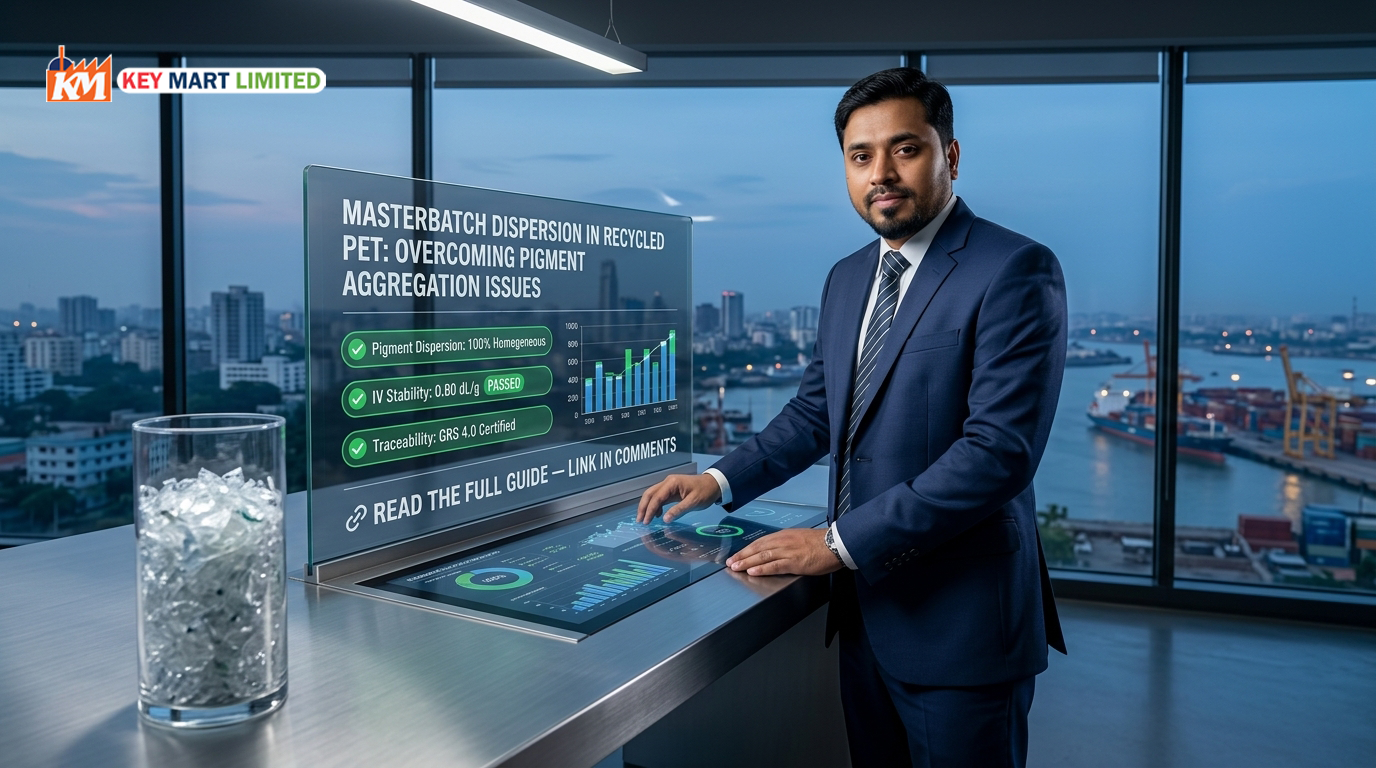
However, moving from virgin polymer chips to recycled PET introduces major color compounding challenges: pigment agglomeration, color streaking, filter-pack clogging, and premature fiber breaks.
Unlike virgin resin, post-consumer rPET contains varying molecular chain lengths, trace moisture, and residual surface contaminants. When masterbatch concentrates are introduced into an unstable rPET melt stream, organic and inorganic pigment particles frequently fail to de-agglomerate, resulting in poor color dispersion and mechanical failure.
This technical guide analyzes the physical chemistry of pigment agglomeration in rPET melt processing, evaluates masterbatch carrier compatibility, and demonstrates how Key Mart Limited supplies clean, consistent feedstock engineered for uniform color dispersion.
1. The Physics and Chemistry of Pigment Agglomeration in rPET
Masterbatch dispersion involves breaking down dry pigment agglomerates into primary particles ($< 1\text{–}2\,\mu\text{m}$) and wetting them homogeneously throughout the molten polymer matrix:
Primary Pigments + Carrier Resin ➔ High-Shear Mixing ➔ Flake Melting & De-Wetting ➔ Interfacial Stress Transfer ➔ Flawless Color Homogeneity
In recycled PET extrusion, pigment dispersion breaks down due to three interrelated factors:
A. Intrinsic Viscosity (IV) Instability and Shear Deficits
Melt shear stress ($\tau = \eta \cdot \dot{\gamma}$) is the physical mechanism that tears pigment agglomerates apart inside the extruder. If incoming pet flakes suffer from hydrolytic degradation due to uncontrolled moisture ($> 0.05\%$), the Intrinsic Viscosity (IV) and melt viscosity ($\eta$) drop sharply. With insufficient melt resistance, the extruder screw cannot generate the shear forces required to break down stubborn pigment clusters like carbon black, phthalocyanine blue, or titanium dioxide ($\text{TiO}_2$).
B. Incompatible Masterbatch Carrier Resins
Masterbatches formulated with low-melting universal carriers—such as Low-Density Polyethylene (LDPE) or Ethylene Vinyl Acetate (EVA)—melt prematurely in the feed zone before the PET flakes soften ($255^\circ\text{C}\text{–}260^\circ\text{C}$). The low-viscosity carrier coats the solid rPET flakes, creating lubrication slip that prevents proper mixing, which leaves undispersed pigment clusters in the melt stream.
C. Chemical Interference from PVC and Residual Adhesives
Trace Polyvinyl Chloride (PVC) releases hydrochloric acid ($\text{HCl}$) at extrusion temperatures, reacting with metallic and organic pigments to induce premature flocculation. Residual label glues carbonize into solid particles, acting as nucleation sites around which pigment particles agglomerate.
Read More: A Step-by-Step Guide to Importing PET Flakes from Bangladesh via Chittagong Port
Technical Purity & Masterbatch Dispersion Benchmark Table
| Processing & Material Parameter | Low-Grade Recycled Flakes | Key Mart Masterbatch-Grade Flakes Standard | Impact on Color Extrusion Line |
| PVC Contamination | $< 150\text{–}300\text{ PPM}$ | < 25 – 50 PPM (Target < 25 PPM) |
Eliminates acid-induced pigment flocculation |
| Residual Moisture (Pre-Dryer) | $> 1.0\%$ | < 0.5% (Pre-Dryer Target) |
Maintains melt shear for agglomerate breakdown |
| Residual Glue & Organics | Variable / Sticky residues | Zero (Hot-Caustic Washed) |
Prevents pigment-glue nucleation specks |
| Intrinsic Viscosity (IV) | $0.62\text{–}0.70\text{ dL/g}$ (Unstable) | 0.78 – 0.82 dL/g (Stable) |
Delivers uniform screw shear and dispersion |
| Fines & Dust ($< 500\,\mu\text{m}$) | $> 2.0\%$ | < 0.3% (Sub-0.1% Target) |
Prevents feed-throat bridging & dosing drift |
| Traceability & Audits | Unverified | GRS 4.0 Transaction Certified |
Satisfies OEM brand compliance & EPR audits |
2. Engineering Strategies to Eliminate Dispersion Defects
To achieve uniform color development and prevent filter screen blinding in rPET processing, converters apply four best practices:
-
PET-Carrier Masterbatch Formulation: Utilize masterbatches formulated with an amorphous PET (PETG) or low-IV PET carrier resin. Matching the carrier’s melting kinetics with the base rPET flakes ensures simultaneous melting and balanced shear distribution.
-
Optimized Dispersing Aids: Incorporate specialized low-molecular-weight dispersing waxes (such as oxidized polyethylene waxes or montan acid esters) to lower interfacial energy between the polar PET matrix and non-polar pigment particles.
-
High-Dispersive Twin-Screw Elements: Configure co-rotating twin-screw extruders with dedicated kneading blocks and distributive mixing elements (such as turbine mixing elements) to subject the melt to repeated extensional flow.
-
Sub-50 PPM Moisture Pre-Drying: Ensure feedstock is dried to $< 0.005\%$ ($< 50\text{ PPM}$) moisture at a $-40^\circ\text{C}$ dew point before compounding to prevent melt-thinning that compromises dispersion shear.
3. How Key Mart Limited Delivers Consistent Color-Compounding Feedstock
Achieving reliable color development requires clean, thermally stable feedstock from an established bangladesh pet flakes manufacturer.
As a premier pet flakes company bangladesh and trusted pet flakes exporter, Key Mart Limited supplies high-purity rPET flakes engineered to optimize masterbatch blending:
-
Source-Controlled Clear & Color Streams: Operating as a leading pet flakes manufacturer dhaka, Key Mart Limited selectively processes 100% post-consumer clear beverage bottles or mono-color sorted streams, ensuring a stable optical baseline for color matching.
-
Continuous Hot-Caustic Decontamination: As an established bangladesh pet flakes manufacturer, our facility subjects crushed feedstock to continuous hot-caustic washing ($85^\circ\text{C}-95^\circ\text{C}$) and automated NIR optical sorting, guaranteeing $\text{PVC} < 25\text{–}50\text{ PPM}$, zero glue residue, and moisture dried below $0.5\%$.
-
Uniform Flake Geometry & De-Dusting: Serving as an experienced pet flakes exporter, Key Mart Limited uses automated air elutriation to reduce fines below $0.3\%$. This consistent $8\text{–}12\text{ mm}$ particle size prevents feeding fluctuations in gravimetric masterbatch blenders.
-
GRS 4.0 Certified Traceability & Lab Testing: Every lot is tested in our Dhaka laboratory for stable Intrinsic Viscosity ($0.78\text{–}0.82\text{ dL/g}$) and accompanied by batch-specific Certificates of Analysis (CoA) and Global Recycled Standard (GRS 4.0) Transaction Certificates (TC).
-
Maximized 25–26 MT Container Logistics: We load 25–26 Metric Tons into every 40ft High Cube container with heavy-duty 100-micron PE inner liners to preserve feedstock dryness during ocean transit under FOB Chittagong, CFR, or CIF shipping terms.
Partner with Key Mart Limited Today
Eliminate pigment aggregation, protect your melt screen packs, and secure high-purity rPET flakes from Bangladesh. Contact our Dhaka export management team today to request Technical Data Sheets, order commercial samples, or reserve monthly container allocations.
-
Company Name: Key Mart Limited
-
Head Office & Factory Address: Plot #31, Road #N-1, Block #K, Eastern Housing, Pallabi 2nd Phase, Rupnagar, Dhaka-1216, Bangladesh.
-
Official Website: www.keymartbd.com
-
Corporate Email: keymartltd@gmail.com | info@keymartbd.com
-
Direct Phone / WhatsApp: +8801760774499, +8801864935478
Join our community today and stay connected with the future of PET recycling.
 Visit our YouTube channel: Key Mart Limited on YouTube
Visit our Facebook Page: Key Mart Limited on Facebook
Subscribe to see our latest factory tours, production updates, and export success stories.