Views: 6
When heavy industrial packaging manufacturers produce high-tensile polyester strapping to secure lumber, structural steel, brick pavers, and paper coils across North American rail corridors, material performance is not just a commercial matter. It is a critical safety consideration.
Under the rules governing open-top railcar and boxcar transport, strapping bands must survive continuous high-impact dynamic shock loads, severe weather exposure, and massive harmonic vibration.
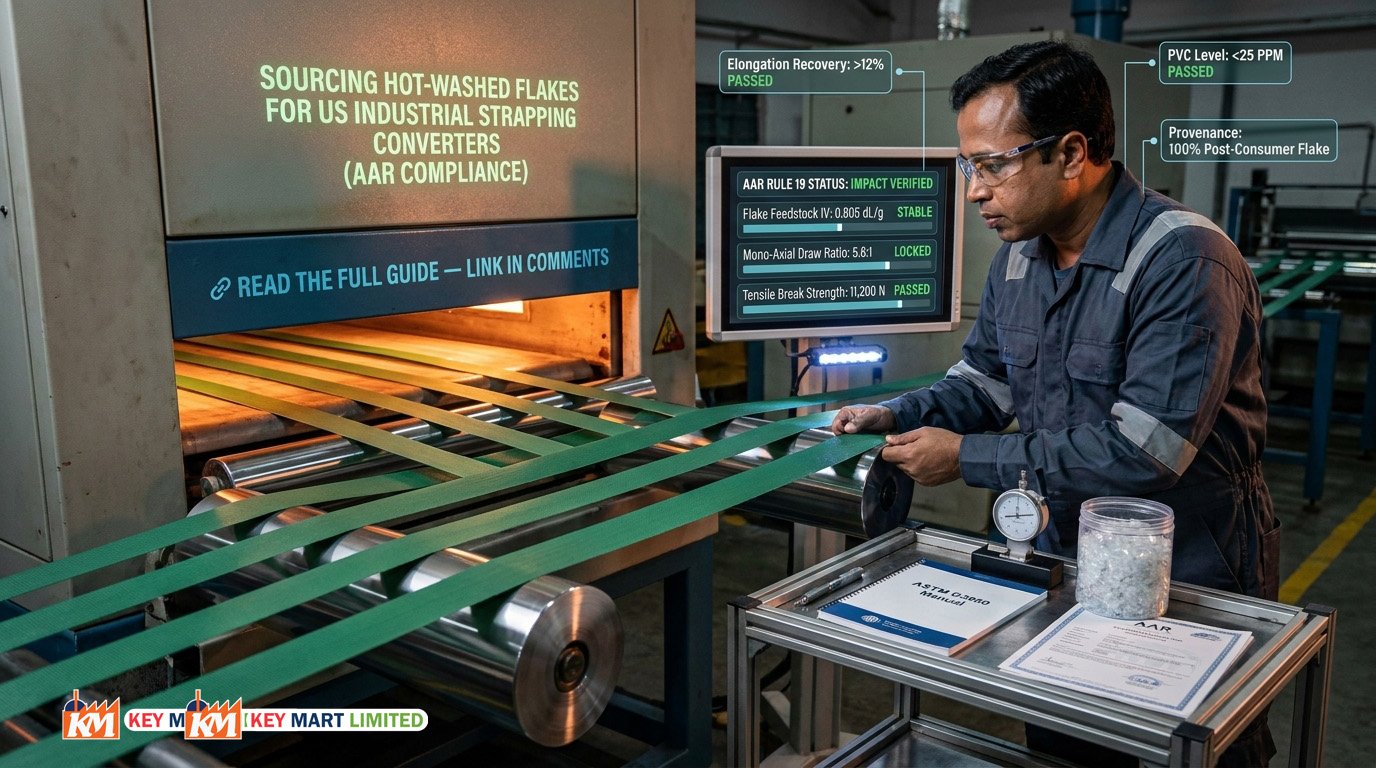
In the United States, open-top rail securement is regulated by the Association of American Railroads (AAR). Under the AAR Open Top Loading Rules (Section 1, Rule 19 and ASTM D3950 standards), polyester strapping must maintain strict tensile break strengths, minimum elongation recovery, and exceptional joint-retention efficiency under dynamic shock.
If a strap snaps during transit, loads shift, trains face emergency trackside setouts, and strapping converters face severe commercial liability.
For industrial converters blending recycled Polyethylene Terephthalate (pet flakes) into strapping bands, passing AAR audits requires tight polymer chain control.
Sourcing PET flakes for strapping Association of American Railroads lines requires maintaining a high baseline Intrinsic Viscosity ( to ), zero un-saponified label glue, and negligible PVC contamination.
This manufacturing guide breaks down AAR open-top performance mandates, details the molecular dynamics of high-draw strapping extrusion, and illustrates how Key Mart Limited delivers extrusion-ready rPET flakes to industrial packaging converters across North America.
1. The Physics of AAR Rail Banding: Why Intrinsic Viscosity Determines Survival
Securing heavy multi-ton freight onto open-top rail flatcars requires strapping that absorbs sudden dynamic impact without permanent plastic deformation:
Incoming Clear Bottle Infeed ➔ Solid-State Caustic Decontamination ➔ High-Draw Mono-Axial Orientation (5:1 to 6:1) ➔ Molecular Alignment ➔ Dynamic Impact Shock Resistance ➔ AAR Verification (Rule 19 Pass)
A. The Molecular Mechanics of Draw Ratios (5:1 to 6:1)
-
Mono-Axial Orientation: In strapping extrusion, the extruded polymer ribbon passes through temperature-controlled stretching ovens where it is drawn mono-axially to its original cast length.
-
Crystalline Alignment: This aggressive orientation straightens tangled polymer chains into dense, highly aligned crystalline fibrils, giving polyester its characteristic steel-like tensile strength () and high shock-absorbing elastic memory.
-
The IV Threshold (): Molecular orientation depends entirely on high molecular weight. If the raw flake feedstock has an below , polymer chains are too short to form strong inter-crystalline tie molecules. Under the stress of the stretching ovens, the band suffers longitudinal splitting, strand fibrillation, and low tensile break strength that fails AAR dynamic drop testing.
B. The Contamination Threat: Un-saponified Glues and PVC
-
Glue Gels & Micro-Stress Points: In high-speed strapping extrusion, residual pressure-sensitive label adhesives form rubbery gel specks. During mono-axial orientation, these non-stretching gels act as stress concentrators, causing the strap to snap during orientation or burst longitudinally under pneumatic tensioners.
-
PVC Decomposition: When PVC contamination enters the extruder above , it degrades into hydrochloric acid (HCl), triggering instant hydrolytic chain scission that drops melt viscosity and creates brittle failure spots across the strapping ribbon.
AAR Industrial Strapping Extrusion Performance Benchmark Matrix
Read More: A Step-by-Step Guide to Importing PET Flakes from Bangladesh via Chittagong Port
2. Preventing Extrusion Line Breakages in Heavy-Gauge Banding
Industrial packaging engineers running heavy strapping extruders (handling widths from and calipers up to ) can prevent line stoppages by enforcing three raw material requirements:
-
Keep Viscosity Spans Within : Running high draw ratios through multi-stage stretching ovens requires steady melt pressure at the gear pump. Feedstock viscosity swings shift the neck-in point on the chill roll, causing width fluctuations and thickness tapering that fail ASTM D3950 dimensional tolerances.
-
Eliminate Micro-Fines to Prevent Degradation: Airborne polymer fines () melt too early in the extruder feed throat, clinging to the root of the screw, carbonizing, and dislodging into the melt stream. These carbonized particles cause band splitting under tension.
-
Verify Apparent Bulk Density for Continuous Extruder Feeding: Heavy strapping extruders require consistent volumetric throughput. Running flakes with an apparent bulk density of ensures continuous grooved-barrel feed-zone bite without screw slippage or melt starving.
3. How Key Mart Limited Supplies Extrusion-Grade rPET Flakes to Strapping Plants
Producing industrial strapping that meets AAR safety standards requires partnering with an established bangladesh pet flakes manufacturer that maintains clean source collection, automated hot friction washing, and strict laboratory testing.
As a premier pet flakes company bangladesh and trusted pet flakes exporter, Key Mart Limited delivers low-dust, high-viscosity clear rPET flakes engineered to feed heavy-gauge industrial strapping extruders:
-
100% Post-Consumer Beverage Bottle Collection: Operating as a leading pet flakes manufacturer dhaka, Key Mart Limited selectively processes 100% post-consumer clear water and carbonated soft drink bottles, rejecting contaminated industrial scrap, pesticide containers, and non-PET plastics at intake gates.
-
Continuous Multi-Stage Caustic Washing (): In our Dhaka plant, our pet flakes undergo continuous hot friction washing and automated NIR optical sorting, fully saponifying label glues and stripping organic residues to guarantee and zero adhesive carryover.
-
Sub-0.3% Fines Removal via Air Elutriation: Serving as an experienced pet flakes exporter, Key Mart Limited passes every batch through automated multi-stage zig-zag air classifiers, keeping dust and fines strictly below to eliminate premature burning and melt pressure surges during extrusion.
-
Certified Viscosity Control & Batch Traceability: Every export batch is tested in our Dhaka quality control laboratory for stable Intrinsic Viscosity (), high bulk density (), and low ash, supported by batch-specific Certificates of Analysis (CoA) and Global Recycled Standard (GRS 4.0) Transaction Certificates (TC).
-
Maximized 25–26 MT Container Logistics: We pack 25–26 Metric Tons into every 40ft High Cube container with heavy-duty 100-micron PE inner liners to preserve feedstock dryness during transit under FOB Chittagong, CFR, or CIF shipping terms, with contractually secured extended free time at major US ports.
Partner with Key Mart Limited Today
Manufacture AAR-compliant polyester strapping, prevent strand breakage during high-ratio drawing, and secure high-viscosity rPET flakes from Bangladesh. Contact our Dhaka export management team today to request Technical Data Sheets, order commercial testing samples, or reserve monthly container allocations.
-
Company Name: Key Mart Limited
-
Head Office & Factory Address: Plot #31, Road #N-1, Block #K, Eastern Housing, Pallabi 2nd Phase, Rupnagar, Dhaka-1216, Bangladesh.
-
Official Website: www.keymartbd.com
-
Corporate Email: keymartltd@gmail.com | info@keymartbd.com
-
Direct Phone / WhatsApp: +8801760774499, +8801864935478
Join our community today and stay connected with the future of PET recycling.
 Visit our YouTube channel: Key Mart Limited on YouTube
Visit our Facebook Page: Key Mart Limited on Facebook
Subscribe to see our latest factory tours, production updates, and export success stories.