Views: 17
When an American plastics processing engineer or quality assurance director evaluates an overseas shipment of recycled Polyethylene Terephthalate (pet flakes), visual cleanliness and bulk clarity are only basic checkpoints. Production line efficiency is determined by mechanical and rheological consistency.
For technical compounders, sheet extruders, and blow-molding operations in North America, processing secondary polymers is fundamentally an exercise in polymer chain dynamics.
If the incoming feedstock exhibits wide viscosity swings, variable particle geometries, or moisture-induced chain cleavage, processing lines suffer immediate consequences: extruder feed-throat bridging, screw torque surges, parison sag during blow molding, and brittle failure in finished thermoformed parts.
Many overseas scrap suppliers provide in-house test certificates that rely on uncalibrated solvent tests, subjective visual scales, or regional test standards that fail to translate into American plant setups.
Bridging the gap between Asian mechanical manufacturing and US converting lines requires verifying materials against standardized ASTM D4603 PET intrinsic viscosity testing and related physical testing methods.
Using standardized American Society for Testing and Materials (ASTM) protocols establishes verified physical baselines, predictable melt flows, and batch-to-batch consistency.
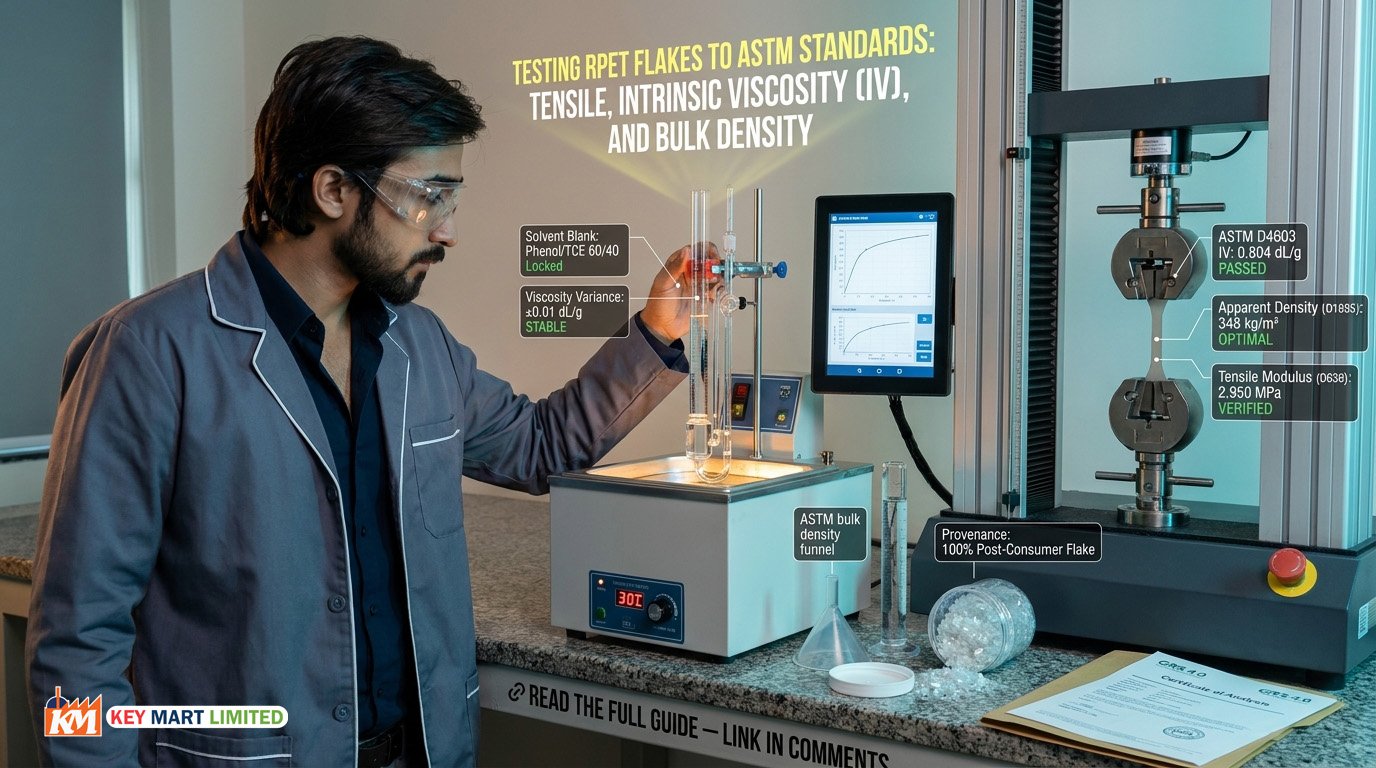
This technical testing guide covers ASTM test methods for Intrinsic Viscosity, bulk density, and tensile performance, and illustrates how Key Mart Limited applies US-standard laboratory testing to every export lot from Dhaka.
1. The Core ASTM Test Suite for Secondary PET
Translating secondary flake properties into American processing parameters relies on three foundational ASTM testing methodologies:
Incoming Source Flake ➔ ASTM D1895 Apparent Bulk Density ➔ ASTM D4603 Capillary Ubbelohde IV ➔ ASTM D638 Extruded Tensile Testing ➔ Calibrated Certificate of Analysis (CoA)
A. Intrinsic Viscosity (ASTM D4603 / Ubbelohde Capillary Viscometry)
-
The Methodology: ASTM D4603 measures the solution viscosity of PET dissolved at $110^\circ\text{C}$ in a $60/40$ weight-percent mixture of phenol and 1,1,2,2-tetrachloroethane. The relative flow time of the polymer solution versus the pure solvent baseline is tracked through a calibrated glass capillary Ubbelohde viscometer in a controlled $30^\circ\text{C} \pm 0.05^\circ\text{C}$ oil bath.
-
The Intrinsic Viscosity Equation: The inherent viscosity ($\eta_{\text{inh}}$) and intrinsic viscosity ($[\eta]$) are derived via the Billmeyer relationship:
Where $\eta_{\text{rel}} = t / t_0$ (ratio of solution flow time $t$ to solvent blank flow time $t_0$) and $C$ represents polymer solution concentration ($0.50\text{ g/dL}$).
-
Converting Impact: Virgin bottle preforms require $0.78\text{–}0.84\text{ dL/g}$; strapping applications demand $> 0.85\text{ dL/g}$; packaging sheet operates at $0.72\text{–}0.76\text{ dL/g}$. Fluctuations greater than $\pm 0.02\text{ dL/g}$ result in unstable melt pressure at the extrusion die.
B. Apparent Bulk Density (ASTM D1895, Method A/B)
-
The Methodology: Measures the weight of loose polymer flake that pours through a standardized funnel into a calibrated $100\text{ cm}^3$ or $400\text{ cm}^3$ cylindrical receiver without compaction.
-
The Processing Target: Premium washed bottle flakes must maintain a poured bulk density between $320\text{ and }380\text{ kg/m}^3$ ($0.32\text{–}0.38\text{ g/cm}^3$).
-
The Operational Risk: Low bulk density ($< 280\text{ kg/m}^3$) indicates curled, irregular chips or high micro-flake fractions, which starve single-screw extruder throats and cause pneumatic conveying clogs. High, uniform bulk density ensures steady volumetric feed rates without requiring feed-throat crammers.
C. Tensile Properties & Modulus (ASTM D638 / ISO 527)
-
The Methodology: Flakes are dried below $30\text{ PPM}$ moisture, injection-molded into Type I tensile dogbone specimens, and pulled to yield on a universal testing machine (UTM) at a crosshead speed of $50\text{ mm/min}$.
-
Key Targets:
-
Tensile Strength at Yield: $\ge 55\text{ to }62\text{ MPa}$
-
Elongation at Break: $> 150\%$ (unnotched)
-
Tensile Modulus: $2,800\text{ to }3,100\text{ MPa}$
-
-
Low yield values or early brittle fracture ($< 20\%$ elongation) highlight unremoved contaminants (such as un-saponified label glue or PVC micro-particles) that serve as mechanical stress concentrators.
ASTM Physical & Mechanical Performance Benchmark Matrix
Read More: A Step-by-Step Guide to Importing PET Flakes from Bangladesh via Chittagong Port
| Material Parameter | Unscreened Scrap Lot | Typical Commercial Flake | Key Mart Certified Laboratory Standard |
| Testing Standard Citation | None (Visual only) | Partial ISO references | 100% ASTM Standards (D4603, D1895, D638) |
| Intrinsic Viscosity (IV) | $0.62\text{–}0.68\text{ dL/g}$ (Degraded) | $0.70\text{–}0.74\text{ dL/g}$ | 0.78 – 0.82 dL/g (Tight ±0.02 Span) |
| Poured Bulk Density (D1895) | $< 260\text{ kg/m}^3$ (Bridging) | $290\text{–}310\text{ kg/m}^3$ | 330 – 370 kg/m³ (Steady Throat Feed) |
| Particle Retention ($4\text{–}10\text{ mm}$) | $< 70\%$ (Wide Variance) | $78\text{–}82\%$ | > 88% Retention (Calibrated Rotary Cut) |
| PVC Contamination Ceiling | $> 150\text{–}300\text{ PPM}$ | $50\text{–}100\text{ PPM}$ | < 25 – 50 PPM (Continuous Hot-Caustic) |
| Micro-Dust & Fines ($<500\,\mu\text{m}$) | $> 2.5\text{–}3.5\%$ (Burn Risk) | $1.0\text{–}1.5\%$ | < 0.3% (Multi-Stage Air Elutriated) |
| Moisture Content at Packaging | $> 1.2\%$ (Hydrolysis Risk) | $0.5\text{–}0.8\%$ | < 0.5% (Centrifugally & Heat Dried) |
| Chain-of-Custody Certification | Unverified | Self-Declared | GRS 4.0 Transaction Certified (TC) |
2. Preventing Extrusion Instability Through Lab Screening
Converters can reduce downtime when running recycled flakes by monitoring three lab-verified parameters:
-
Pre-Dry Material to Prevent Hydrolytic Degradation: PET chains cleave instantly when heated in the presence of water. An increase in moisture from $0.005\%$ to $0.02\%$ can drop IV by $0.10\text{ dL/g}$ during extrusion. Sourcing flakes that leave the production plant at $< 0.5\%$ moisture reduces desiccant drying cycles and preserves molecular weight.
-
Control Particle Sieve Distribution (ASTM D1921): Sieve analysis should confirm that over $88\%$ of flakes fall between $4.0\text{ mm and }10.0\text{ mm}$. A high proportion of undersized flakes melts too early in the extruder feed zone, while oversized flakes can bridge in feed hoppers.
-
Confirm PVC PPM Thresholds via Thermal Yellowing Tests: When heated above $200^\circ\text{C}$, PVC degrades into hydrochloric acid (HCl), turning clear PET yellow, corroding barrel liners, and lowering tensile strength. Testing flakes to guarantee $< 25\text{–}50\text{ PPM}$ PVC protects extruder screws and maintains clear part appearance.
3. How Key Mart Limited Supplies ASTM-Certified rPET Flakes
Meeting the technical expectations of American converters requires partnering with an established bangladesh pet flakes manufacturer that pairs advanced wash-line infrastructure with comprehensive laboratory testing.
As a premier pet flakes company bangladesh and trusted pet flakes exporter, Key Mart Limited delivers audit-proof, lab-verified clear rPET flakes engineered to meet North American processing specifications:
-
100% Post-Consumer Beverage Bottle Collection: Operating as a leading pet flakes manufacturer dhaka, Key Mart Limited selectively processes 100% post-consumer clear water and carbonated soft drink bottles, rejecting mixed industrial scrap, colored packaging, and non-PET plastics at intake gates.
-
Continuous Multi-Stage Caustic Washing ($85^\circ\text{C}-95^\circ\text{C}$): In our Dhaka plant, our pet flakes undergo continuous hot friction washing and automated NIR optical sorting, fully saponifying label glues and stripping organic residues to guarantee $\text{PVC} < 25\text{–}50\text{ PPM}$ and zero adhesive carryover.
-
Sub-0.3% Fines Removal via Air Elutriation: Serving as an experienced pet flakes exporter, Key Mart Limited passes every batch through automated multi-stage zig-zag air classifiers, keeping dust and fines strictly below $0.3\%$ to eliminate premature burning and melt pressure surges during extrusion.
-
In-House ASTM Laboratory Testing: Every export batch is tested in our Dhaka quality control laboratory for stable Intrinsic Viscosity via ASTM D4603 ($0.78\text{–}0.82\text{ dL/g}$), ASTM D1895 apparent bulk density ($330\text{–}370\text{ kg/m}^3$), and color luminance ($L^* \ge 74.0, b^* \le +1.2$), backed by batch-specific Certificates of Analysis (CoA) and Global Recycled Standard (GRS 4.0) Transaction Certificates (TC).
-
Maximized 25–26 MT Container Logistics: We pack 25–26 Metric Tons into every 40ft High Cube container with heavy-duty 100-micron PE inner liners to preserve feedstock dryness during transit under FOB Chittagong, CFR, or CIF shipping terms, with contractually secured extended free time at major US ports.
Partner with Key Mart Limited Today
Source lab-verified, ASTM-compliant rPET flakes, eliminate melt instability, and secure high-viscosity feedstocks from Bangladesh. Contact our Dhaka export management team today to request Technical Data Sheets, order commercial testing samples, or reserve monthly container allocations.
-
Company Name: Key Mart Limited
-
Head Office & Factory Address: Plot #31, Road #N-1, Block #K, Eastern Housing, Pallabi 2nd Phase, Rupnagar, Dhaka-1216, Bangladesh.
-
Official Website: www.keymartbd.com
-
Corporate Email: keymartltd@gmail.com | info@keymartbd.com
-
Direct Phone / WhatsApp: +8801760774499, +8801864935478
Join our community today and stay connected with the future of PET recycling.
 Visit our YouTube channel: Key Mart Limited on YouTube
Visit our Facebook Page: Key Mart Limited on Facebook
Subscribe to see our latest factory tours, production updates, and export success stories.