Views: 5
If you manage production, maintenance, or operations in an American thermoforming facility, managing conversion cost per pound is an everyday challenge. Between fluctuating polymer markets, rising industrial power rates, and tight customer price caps, every kilowatt-hour and extra processing step directly impacts your plant’s margin.
Historically, running post-consumer recycled Polyethylene Terephthalate (pet flakes) into thermoformable rollstock required a two-step process: buy washed scrap, send it through a dedicated pelletizing line with solid-state polycondensation (SSP), and only then feed the re-granulated resin into your sheet extruder.
That intermediate compounding pass comes at a steep price.
Compounding adds $0.08 to $0.14 per pound in processing overhead, subjects the polyester chain to an unnecessary heat cycle that drops molecular weight, and ties up working capital in intermediate warehouse inventory.
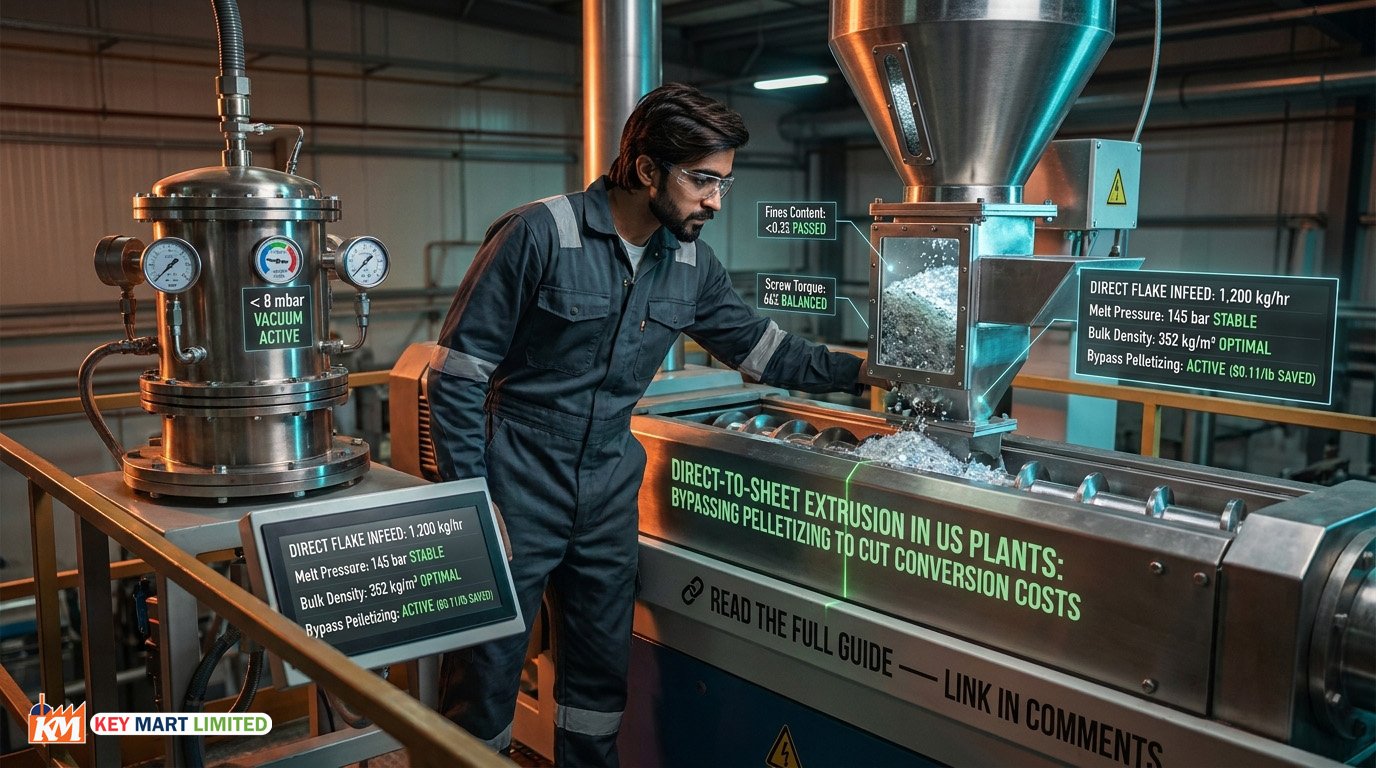
Modern converting plants are increasingly eliminating that step through direct flake to sheet extrusion US thermoforming setups.
Equipped with co-rotating twin-screw extruders or planetary roller systems paired with high-vacuum multi-vent degassing, plant operators can feed clean, mechanically prepared bottle flakes straight into sheet dies.
Bypassing pelletizing saves substantial energy and protects operating margins, but it shifts the performance burden onto the raw material.
Running direct extrusion successfully requires flakes with tight bulk density, low fines, and predictable intrinsic viscosity ().
This operational guide details the engineering principles of direct-to-sheet extrusion, highlights the raw material thresholds required to avoid feed-throat bridging, and demonstrates how Key Mart Limited supplies clean, low-dust rPET flakes to high-speed American sheet lines.
1. The Direct Extrusion Advantage: Eliminating the Thermal Penalty
Feeding washed flakes directly into a degassing twin-screw extruder streamlines polymer conversion by removing an entire thermal degradation cycle:
[Traditional Route]: Washed Flake ➔ Extruder #1 ➔ Melt Pellets ➔ SSP Re-Heat ➔ Transport ➔ Extruder #2 ➔ Sheet Die
                                                                                               ▲
[Direct Route]: Washed Flake ➔ High-Vacuum Degassing Twin-Screw Extruder (Direct) ────────────┘
A. Protecting the Intrinsic Viscosity (IV) Baseline
-
Thermal Degradation in Compounding: Every time PET melts at , mechanical shear and heat induce chain scission. An intermediate compounding step degrades virgin or recycled by unless counteracted by energy-intensive SSP reactors.
-
Direct Extrusion Preservation: Direct feeding preserves polymer chain length by subjecting the resin to only one melting event. Starting with high-quality flakes () and pairing them with high-vacuum multi-port devolatilization () extracts moisture and trace volatiles directly from the melt, producing thermoforming sheet with a finished without upstream re-pelletizing.
B. Energy and Operating Cost Reductions
-
Power Savings: Bypassing the pelletizing line cuts energy consumption by , lowering utility expenses on continuous, high-volume lines.
-
Shorter Lead Times: Converting incoming raw flakes directly into thermoformed rollstock shortens production cycles from weeks to hours, allowing plants to adjust to changing customer order volumes quickly.
Direct Extrusion vs. Compounded Pellet Processing Matrix
Read More: A Step-by-Step Guide to Importing PET Flakes from Bangladesh via Chittagong Port
2. Preventing Line Surges and Feed-Throat Bridging
When running direct-to-sheet extrusion without pellets, the irregular geometry of raw flakes makes feed handling more challenging. Maintaining steady output requires monitoring three physical material metrics:
-
Eliminate Electrostatic Micro-Fines (): High fines () cause feeding issues. Polymer dust clings to extruder feed-throat walls through static attraction, melting early and building up sticky deposits that cause screw starvation and surging melt pressure at the die. Using flakes cleaned via multi-stage air elutriation prevents feed-throat plugging.
-
Maintain Consistent Apparent Bulk Density (): Flakes with low bulk density () consist of curled, irregular fragments that resist screw intake, causing screw-flight cavitation and surging output. Feeding flakes with an apparent bulk density of ensures smooth, positive conveyance into the melting zone.
-
Minimize PVC to Protect Chrome Rolls: Because direct extrusion runs without an intermediate compounding filter, residual PVC decomposes directly inside the sheet die into hydrochloric acid (HCl). This acid causes pitting on mirror-finish calender rolls and creates dark carbon specks across clear thermoforming webs. Running flakes with PVC preserves roll tooling and maintains optical clarity.
3. How Key Mart Limited Supports US Direct Extrusion Lines
Running direct-to-sheet extrusion reliably requires partnering with an established bangladesh pet flakes manufacturer that delivers clean cutting, hot-caustic decontamination, and automated air classification.
As a premier pet flakes company bangladesh and trusted pet flakes exporter, Key Mart Limited delivers low-dust, high-viscosity clear rPET flakes engineered specifically for direct-feed sheet extruders:
-
100% Post-Consumer Beverage Bottle Intake: Operating as a leading pet flakes manufacturer dhaka, Key Mart Limited selectively processes 100% post-consumer clear water and soft drink containers, rejecting mixed industrial scrap, colored packaging, and non-PET plastics at our collection gates.
-
Continuous Multi-Stage Caustic Washing (): In our Dhaka plant, our pet flakes undergo continuous hot friction washing and automated NIR optical sorting, fully saponifying label glues and stripping organic residues to guarantee and zero adhesive carryover.
-
Sub-0.3% Fines Removal via Air Elutriation: Serving as an experienced pet flakes exporter, Key Mart Limited passes every batch through automated multi-stage zig-zag air classifiers, keeping dust and fines strictly below to eliminate premature burning and melt pressure surges during extrusion.
-
Tight Viscosity Control & Batch Traceability: Every export batch is tested in our Dhaka quality control laboratory for stable Intrinsic Viscosity (), high bulk density (), and low moisture (), backed by batch-specific Certificates of Analysis (CoA) and Global Recycled Standard (GRS 4.0) Transaction Certificates (TC).
-
Maximized 25–26 MT Container Logistics: We pack 25–26 Metric Tons into every 40ft High Cube container with heavy-duty 100-micron PE inner liners to preserve feedstock dryness during transit under FOB Chittagong, CFR, or CIF shipping terms, with contractually secured extended free time at major US ports.
Partner with Key Mart Limited Today
Bypass expensive pelletizing lines, lower conversion costs on your thermoforming sheet extruders, and source high-viscosity rPET flakes from Bangladesh. Contact our Dhaka export management team today to request Technical Data Sheets, order commercial testing samples, or reserve monthly container allocations.
-
Company Name: Key Mart Limited
-
Head Office & Factory Address: Plot #31, Road #N-1, Block #K, Eastern Housing, Pallabi 2nd Phase, Rupnagar, Dhaka-1216, Bangladesh.
-
Official Website: www.keymartbd.com
-
Corporate Email: keymartltd@gmail.com | info@keymartbd.com
-
Direct Phone / WhatsApp: +8801760774499, +8801864935478
Join our community today and stay connected with the future of PET recycling.
 Visit our YouTube channel: Key Mart Limited on YouTube
Visit our Facebook Page: Key Mart Limited on Facebook
Subscribe to see our latest factory tours, production updates, and export success stories.