Views: 4
In civil engineering, soil stabilization, road construction, and coastal erosion defense, non-woven geotextiles provide essential filtration, separation, drainage, and load reinforcement. Traditionally produced using virgin polypropylene (PP) or virgin polyester chips, the civil infrastructure sector is undergoing a rapid transition toward sustainable materials.
Under tightening global ESG public-procurement rules and Extended Producer Responsibility (EPR) mandates, international civil contractors and geotextile manufacturers are actively replacing virgin polymers with 100% post-consumer recycled Polyethylene Terephthalate (pet flakes).
However, continuous spunbond non-woven extrusion is one of the most demanding processes in polymer engineering.
Continuous filaments are extruded through thousands of micro-orifices at high speeds ($3,000\text{–}6,000\text{ m/min}$) and drawn down to fine-denier fibers ($2.0\text{–}6.0\text{ dtex}$). Even trace impurities or Intrinsic Viscosity (IV) drops lead to filament snapping, spinneret fouling, pressure surges, and punctured non-woven webs.
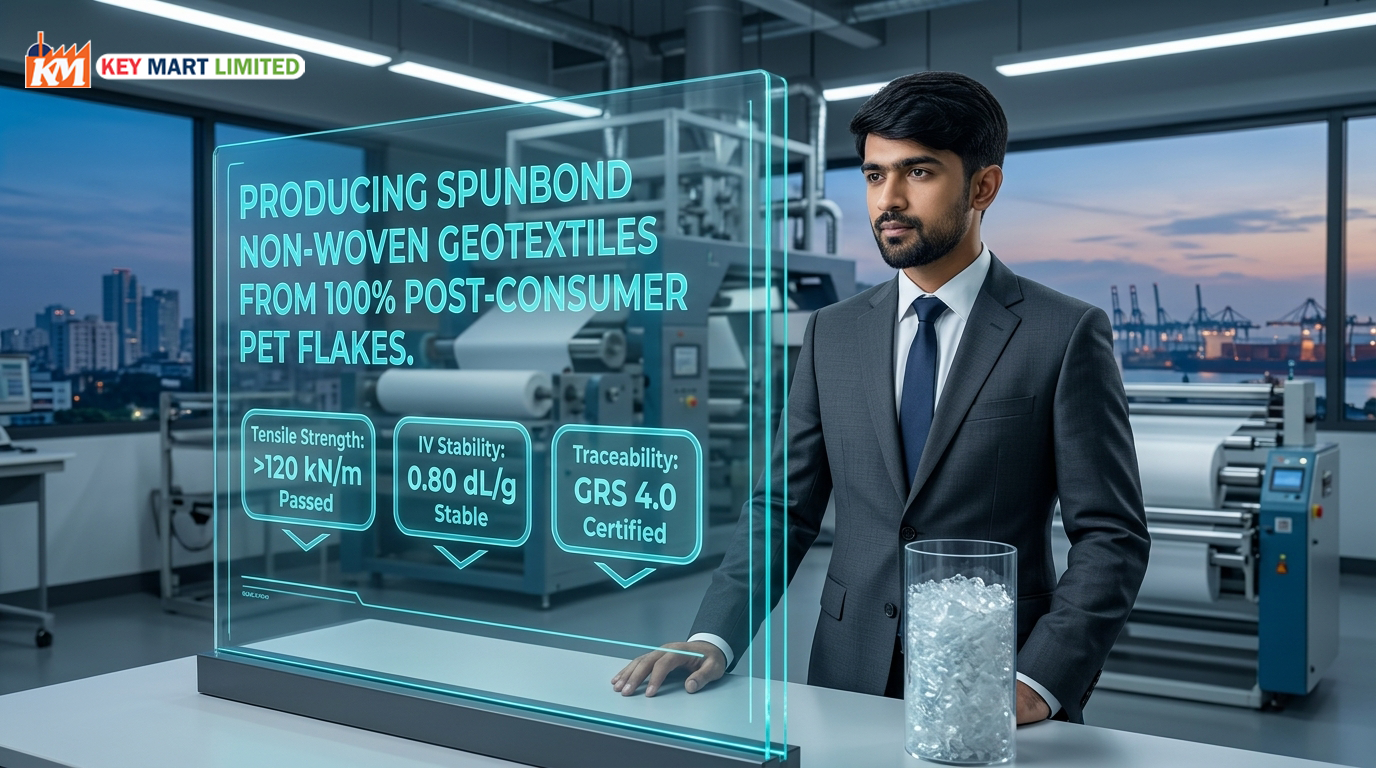
This technical guide analyzes the rheology of spunbond extrusion from rPET flakes, defines purity benchmarks for zero-break production, and demonstrates how Key Mart Limited supplies candidate feedstock engineered for continuous technical geotextiles.
1. The Rheology and Engineering of Continuous Spunbond Extrusion
The spunbond process integrates polymer melting, continuous filament extrusion, aerodynamic attenuation, web laydown, and thermal/needle-punch bonding into a single, high-speed production line:
Ultra-Dry High-IV rPET Flakes ➔ High-Shear Degassing Extruder ➔ Melt Filtration (≤25 µm) ➔ Multi-Hole Spinnerets ➔ Aerodynamic Air Attenuation ➔ Laydown Belt & Needle-Punching ➔ High-Tenacity Geotextile Roll
A. Intrinsic Viscosity (IV) and Melt Extensional Rheology
-
The Drawing Force: During aerodynamic attenuation, high-velocity air streams stretch molten filaments at high speeds. This requires high melt elasticity and high molecular weight ($IV \ge 0.78\text{–}0.82\text{ dL/g}$).
-
The Failure Mechanism: If incoming flakes suffer from hydrolytic degradation ($> 50\text{ PPM}$ moisture) or wide batch-to-batch IV variation, the melt undergoes shear thinning and loses extensional strength. This causes immediate filament breakage at the spinneret exit, creating defects called “drops” or “shots” that ruin web uniformity.
B. Micro-Particulate and PVC Carbonization
-
Spinneret Orifice Clogging: Spunbond spinneret capillaries are narrow ($0.25\text{–}0.40\text{ mm}$). Solid contaminants such as cross-linked label glues, unmelted polyolefins, or charred PVC specks plug these orifices, deflecting adjacent filaments and causing line breaks.
-
Corrosive Degradation: Thermal breakdown of PVC releases acidic hydrochloric gas ($\text{HCl}$), which corrodes expensive spin-packs and accelerates polymer chain cleavage.
C. Thermal Crystallization and Needle-Punch Tenacity
Geotextiles must deliver exceptional grab tensile strength, trapezoidal tear resistance, and CBR puncture resistance (ISO 12236). Uniform molecular alignment during aerodynamic drawing ensures consistent fiber crystallization, which is essential to withstand the mechanical stress of multi-stage needle-punch bonding.
Read More: A Step-by-Step Guide to Importing PET Flakes from Bangladesh via Chittagong Port
Technical Purity & Spunbond Geotextile Feedstock Benchmark Table
| Processing & Quality Parameter | Standard Industrial Grade Flakes | Spunbond Geotextile Grade Standard | Operational Impact on Geotextile Line |
| Intrinsic Viscosity (IV) | $0.65\text{–}0.72\text{ dL/g}$ (Unstable) | 0.78 – 0.82 dL/g (Stable) |
Ensures high filament draw without breaks |
| PVC Contamination | $< 150\text{–}300\text{ PPM}$ | < 25 – 50 PPM (Target < 25 PPM) |
Prevents spinneret blockage & spin-pack corrosion |
| Polyolefin (PE/PP) | $< 200\text{ PPM}$ | < 25 PPM |
Eliminates fiber voids, splits, and weak spots |
| Residual Moisture (Pre-Dryer) | $> 1.0\%$ | < 0.5% (Pre-Dryer Target) |
Prevents hydrolytic IV loss during melting |
| Residual Glue & Organics | Variable | Zero (Continuous Hot-Caustic Washed) |
Prevents cross-linked gel fisheyes & die drool |
| Fines & Dust ($< 500\,\mu\text{m}$) | $> 2.0\%$ | < 0.3% (Sub-0.1% Target) |
Prevents premature melting and thermal charring |
| Traceability Audit | Unverified | GRS 4.0 Transaction Certified |
Qualifies for public infrastructure ESG bids |
2. Preventing Process Downtime on Spunbond Lines
To operate a 100% rPET spunbond continuous geotextile line without frequent pack changes or pressure spikes, convertors enforce three essential operational protocols:
-
Continuous Fine Melt Filtration: Employing automatic continuous backflushing screen changers rated at $\le 20\text{–}30\,\mu\text{m}$ captures trace inorganic particles before they reach the spin beam.
-
Deep Vacuum Degassing ($\le 10\text{ mbar}$): Using twin-screw or planetary roller extruders with multi-port vacuum degassing extracts volatilized cyclic oligomers and moisture, stabilizing melt pressure across the die.
-
Strict Feedstock Sizing ($8\text{–}12\text{ mm}$): Consistent bulk density ($> 350\text{ g/L}$) with minimal fines ($< 0.3\%$) ensures homogeneous plasticization inside the extruder screw, eliminating thermal hot spots.
3. How Key Mart Limited Meets Global Demand for Geotextile-Grade Feedstock
Producing feedstock capable of sustaining high-speed continuous spunbond filament extrusion requires an established bangladesh pet flakes manufacturer with precision processing capabilities.
As a premier pet flakes company bangladesh and trusted pet flakes exporter, Key Mart Limited supplies technical-grade rPET flakes engineered specifically for non-woven geotextile lines:
-
Source-Segregated Collection in Dhaka: Operating as a leading pet flakes manufacturer dhaka, Key Mart Limited selectively processes post-consumer beverage bottles, eliminating multi-layer barrier containers and degraded industrial scrap at the sorting gate.
-
Continuous Hot-Caustic Decontamination: As an established bangladesh pet flakes manufacturer, our facility subjects crushed flakes to continuous hot-caustic washing ($85^\circ\text{C}-95^\circ\text{C}$) and automated NIR optical sorting, guaranteeing $\text{PVC} < 25\text{–}50\text{ PPM}$, polyolefins $< 25\text{ PPM}$, and zero adhesive residues.
-
Automated Elutriation & Fines Removal: Serving as an experienced pet flakes exporter, Key Mart Limited utilizes multi-stage air classifiers to reduce dust and fines below $0.3\%$ ($8\text{–}12\text{ mm}$ flake sizing) and dries moisture below $0.5\%$, backed by Certificates of Analysis (CoA).
-
GRS 4.0 Certified Traceability: Every production lot is accompanied by official Global Recycled Standard (GRS 4.0) Transaction Certificates (TCs), ensuring your non-woven geotextiles qualify for municipal infrastructure, civil engineering, and international ESG procurement contracts.
-
Maximized 25–26 MT Container Payloads: We pack 25–26 Metric Tons into every 40ft High Cube container with heavy-duty 100-micron PE inner liners to preserve feedstock dryness during ocean transit under FOB Chittagong, CFR, or CIF shipping terms.
Partner with Key Mart Limited Today
Eliminate filament snapping, optimize your spunbond line throughput, and secure high-tenacity rPET flakes from Bangladesh for your non-woven geotextile production. Contact our Dhaka export management team today to request Technical Data Sheets, order commercial samples, or reserve monthly container allocations.
-
Company Name: Key Mart Limited
-
Head Office & Factory Address: Plot #31, Road #N-1, Block #K, Eastern Housing, Pallabi 2nd Phase, Rupnagar, Dhaka-1216, Bangladesh.
-
Official Website: www.keymartbd.com
-
Corporate Email: keymartltd@gmail.com | info@keymartbd.com
-
Direct Phone / WhatsApp: +8801760774499, +8801864935478
Join our community today and stay connected with the future of PET recycling.
 Visit our YouTube channel: Key Mart Limited on YouTube
Visit our Facebook Page: Key Mart Limited on Facebook
Subscribe to see our latest factory tours, production updates, and export success stories.