Views: 6
In additive manufacturing and rotational molding (rotomolding), resin processors have historically relied on Polyethylene (LLDPE/HDPE), Polyamide (PA12), and Polylactic Acid (PLA). However, as industrial manufacturers face aggressive sustainability mandates and Extended Producer Responsibility (EPR) targets, the demand for circular, high-temperature engineering materials has expanded rapidly.
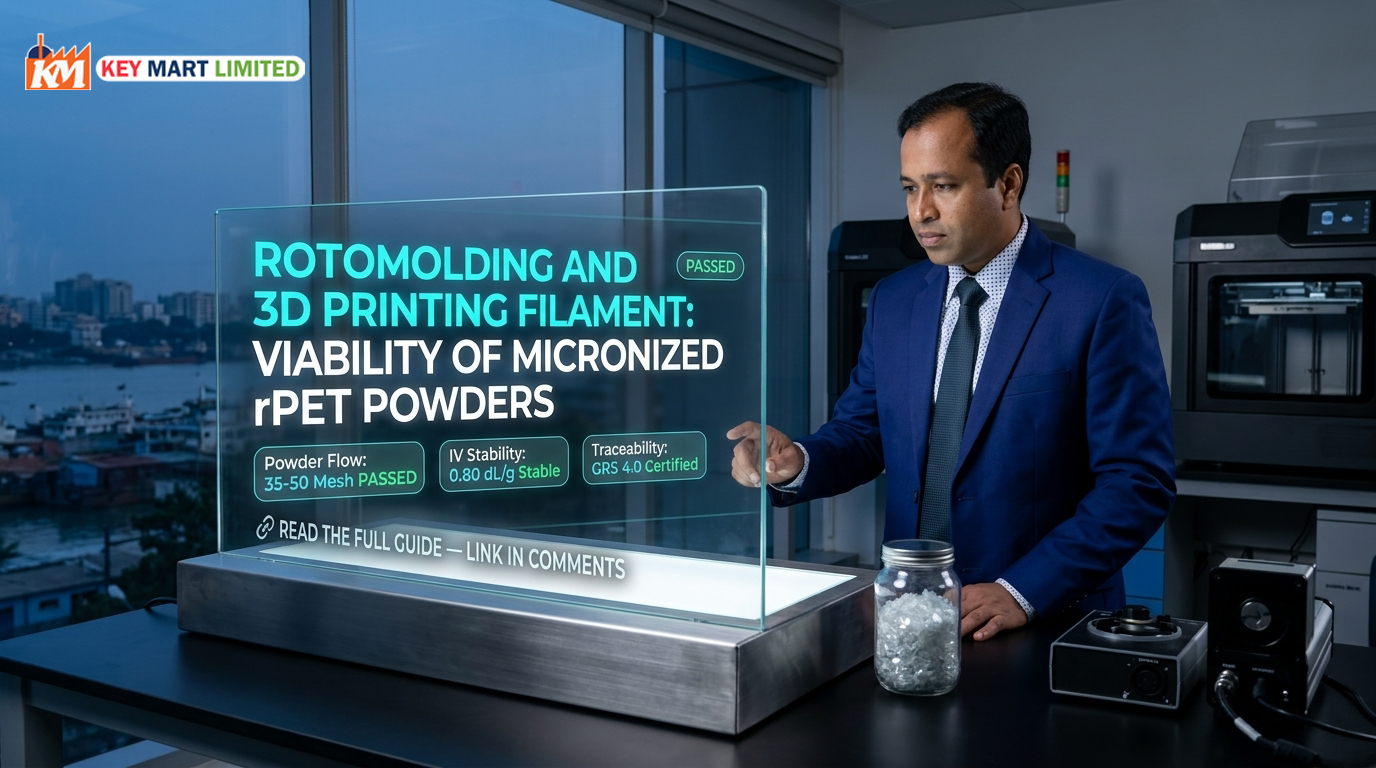
Upcycling post-consumer recycled Polyethylene Terephthalate (pet flakes) into micronized rPET powders offers a sustainable pathway to produce functional hollow parts (rotomolding) and high-strength Fused Filament Fabrication (FFF) / Selective Laser Sintering (SLS) materials (3D printing).
Unlike standard pelletized extrusion, processing fine-mesh rPET powders and precision 3D printing filaments presents distinct rheological and thermal hurdles: sintering coalescence, narrow processing temperature windows, thermal crystallization warping, and hydrolytic degradation.
This technical guide evaluates the engineering viability of micronized rPET powders, details cryogenic grinding and compounding protocols, and demonstrates how Key Mart Limited supplies clean, high-stability feedstock for additive and powder manufacturing.
1. The Physics and Material Science of Micronized rPET
Converting flake feedstock into functional rotomolding powders ($150\text{–}500\,\mu\text{m}$) or precision 3D printing filament ($1.75\text{ mm} \pm 0.03\text{ mm}$) requires overcoming fundamental polymer kinetics:
High-IV rPET Flakes ➔ Cryogenic Pin-Mill Micronization ➔ Powder Spheroidization / Filament Extrusion ➔ Sintering & Zero-Shear Coalescence ➔ High-Strength Rotomolded & 3D Printed Parts
A. Zero-Shear Viscosity in Rotational Molding
Rotomolding is a low-pressure, zero-shear thermal process. Powder particles must tumble across the hot mold wall ($260^\circ\text{C}\text{–}280^\circ\text{C}$), melt, and fuse into a continuous, pinhole-free hollow wall purely via surface tension and thermal coalescence.
-
The IV Threshold: If the Intrinsic Viscosity (IV) is too high ($> 0.90\text{ dL/g}$), zero-shear melt viscosity restricts powder coalescence, trapping micro-air bubbles and causing surface porosity.
-
The Degradation Risk: If the IV is too low ($< 0.70\text{ dL/g}$), the melt sags inside the rotating mold, resulting in uneven wall thickness and brittle mechanical properties.
B. Cryogenic Milling and Particle Spheroidization
Mechanical grinding of PET at ambient temperatures leads to fibrous, jagged particles with poor Dry Flow Rates (CFR) and low bulk density. Cryogenic pin milling (using liquid nitrogen at $-196^\circ\text{C}$) fractures PET below its glass transition temperature ($T_g \approx 78^\circ\text{C}$), generating uniform, spherical powder particles ($35\text{–}50\text{ Mesh}$) with high powder flowability.
C. Crystallization Kinetics in 3D Printing Filament
When extruding 3D printing filament or SLS powders from rPET, uncontrolled crystallization causes intense shrinkage ($1.5\%\text{–}2.5\%$) and warping. Utilizing glycol-modified or branching chain extenders suppresses rapid cold crystallization, ensuring optimal layer-to-layer adhesion and dimensional accuracy in printed parts.
Technical Purity & Micronized rPET Benchmark Table
| Material & Rheological Parameter | Standard Flake Scrap | Micronized Powder & 3D Filament Standard | Operational Impact on Processing |
| Particle Size Distribution | Irregular ($8\text{–}12\text{ mm}$) | 150 – 500 µm (35–50 Mesh Spheroidized) |
Ensures bubble-free rotomold coalescence |
| Intrinsic Viscosity (IV) | $0.65\text{–}0.70\text{ dL/g}$ | 0.78 – 0.82 dL/g (Stable) |
Delivers optimal melt flow without sagging |
| PVC Contamination | $< 150\text{–}300\text{ PPM}$ | < 25 – 50 PPM (Target < 25 PPM) |
Prevents acid-induced degradation & nozzle clog |
| Residual Moisture (Pre-Dryer) | $> 1.0\%$ | < 0.5% (Pre-Dryer Target) |
Eliminates hydrolytic foaming and bubbling |
| Residual Glue & Organics | Variable | Zero (Hot-Caustic Washed) |
Prevents 3D nozzle charring and print voids |
| Traceability & Compliance | Unverified | GRS 4.0 Transaction Certified |
Qualifies for circular economy & ESG mandates |
2. Preventing Process Defects in Powder & Filament Manufacturing
To ensure reliable performance in rotomolding and additive manufacturing lines, converters follow three operational rules:
-
Sub-50 PPM PVC Limits: Near-Infrared (NIR) optical sorting ensures the elimination of PVC. At 3D printing extrusion temperatures ($250^\circ\text{C}\text{–}270^\circ\text{C}$), trace PVC degrades into hydrochloric acid ($\text{HCl}$), corroding 3D printer nozzles and forming charred black specks that cause print layer delamination.
-
Intensive Hot-Caustic De-Gluation: Multi-stage hot-caustic washing ($85^\circ\text{C}-95^\circ\text{C}$) eliminates all bottle label adhesives, preventing the formation of cross-linked gels that clog $0.4\text{ mm}$ 3D printer nozzles.
-
Deep Desiccant Dehumidification: Processing rPET powders or printing filaments requires pre-drying to $< 0.005\%$ ($< 50\text{ PPM}$) moisture at a $-40^\circ\text{C}$ dew point to avoid steam bubbling and molecular weight loss.
Read More: A Step-by-Step Guide to Importing PET Flakes from Bangladesh via Chittagong Port
3. How Key Mart Limited Supplies the Additive and Rotomolding Sector
Delivering raw materials suitable for precision cryogenic milling and filament extrusion requires an established bangladesh pet flakes manufacturer with advanced washing and sorting capabilities.
As a premier pet flakes company bangladesh and trusted pet flakes exporter, Key Mart Limited delivers premium rPET feedstock engineered for advanced compounding:
-
Source-Controlled Sourcing in Dhaka: Operating as a leading pet flakes manufacturer dhaka, Key Mart Limited selectively processes 100% post-consumer clear beverage bottles, eliminating multi-layer barrier containers and degraded industrial scrap at the collection gate.
-
Continuous Hot-Caustic Decontamination: As an established bangladesh pet flakes manufacturer, our facility subjects crushed feedstock to continuous hot-caustic washing ($85^\circ\text{C}-95^\circ\text{C}$) and automated NIR optical sorting, guaranteeing $\text{PVC} < 25\text{–}50\text{ PPM}$, zero glue residues, and moisture dried below $0.5\%$.
-
Uniform Flake Geometry & De-Dusting: Serving as an experienced pet flakes exporter, Key Mart Limited uses automated air elutriation to reduce dust and fines below $0.3\%$ ($8\text{–}12\text{ mm}$ flake sizing), ensuring predictable bulk density for cryogenic pulverizers and filament extruders.
-
GRS 4.0 Certified Traceability & Lab Testing: Every lot is tested in our Dhaka laboratory for stable Intrinsic Viscosity ($0.78\text{–}0.82\text{ dL/g}$) and accompanied by batch-specific Certificates of Analysis (CoA) and Global Recycled Standard (GRS 4.0) Transaction Certificates (TC).
-
Maximized 25–26 MT Container Logistics: We pack 25–26 Metric Tons into every 40ft High Cube container with heavy-duty 100-micron PE moisture-barrier inner liners to preserve feedstock dryness during ocean transit under FOB Chittagong, CFR, or CIF shipping terms.
Partner with Key Mart Limited Today
Eliminate nozzle clogging, optimize powder coalescence, and secure high-purity rPET flakes from Bangladesh for your rotomolding and additive manufacturing lines. Contact our Dhaka export management team today to request Technical Data Sheets, order commercial samples, or reserve monthly container allocations.
-
Company Name: Key Mart Limited
-
Head Office & Factory Address: Plot #31, Road #N-1, Block #K, Eastern Housing, Pallabi 2nd Phase, Rupnagar, Dhaka-1216, Bangladesh.
-
Official Website: www.keymartbd.com
-
Corporate Email: keymartltd@gmail.com | info@keymartbd.com
-
Direct Phone / WhatsApp: +8801760774499, +8801864935478
Join our community today and stay connected with the future of PET recycling.
 Visit our YouTube channel: Key Mart Limited on YouTube
Visit our Facebook Page: Key Mart Limited on Facebook
Subscribe to see our latest factory tours, production updates, and export success stories.