Views: 8
Corporate Sustainability Officers (CSOs), ESG procurement directors, and packaging sustainability leads face an increasingly demanding mandate: decarbonize product supply chains under aggressive Scope 3 emissions targets while ensuring strict mechanical and optical performance. When sourcing recycled Polyethylene Terephthalate (pet flakes), procurement teams face a critical strategic decision: mechanical recycling or chemical depolymerization.
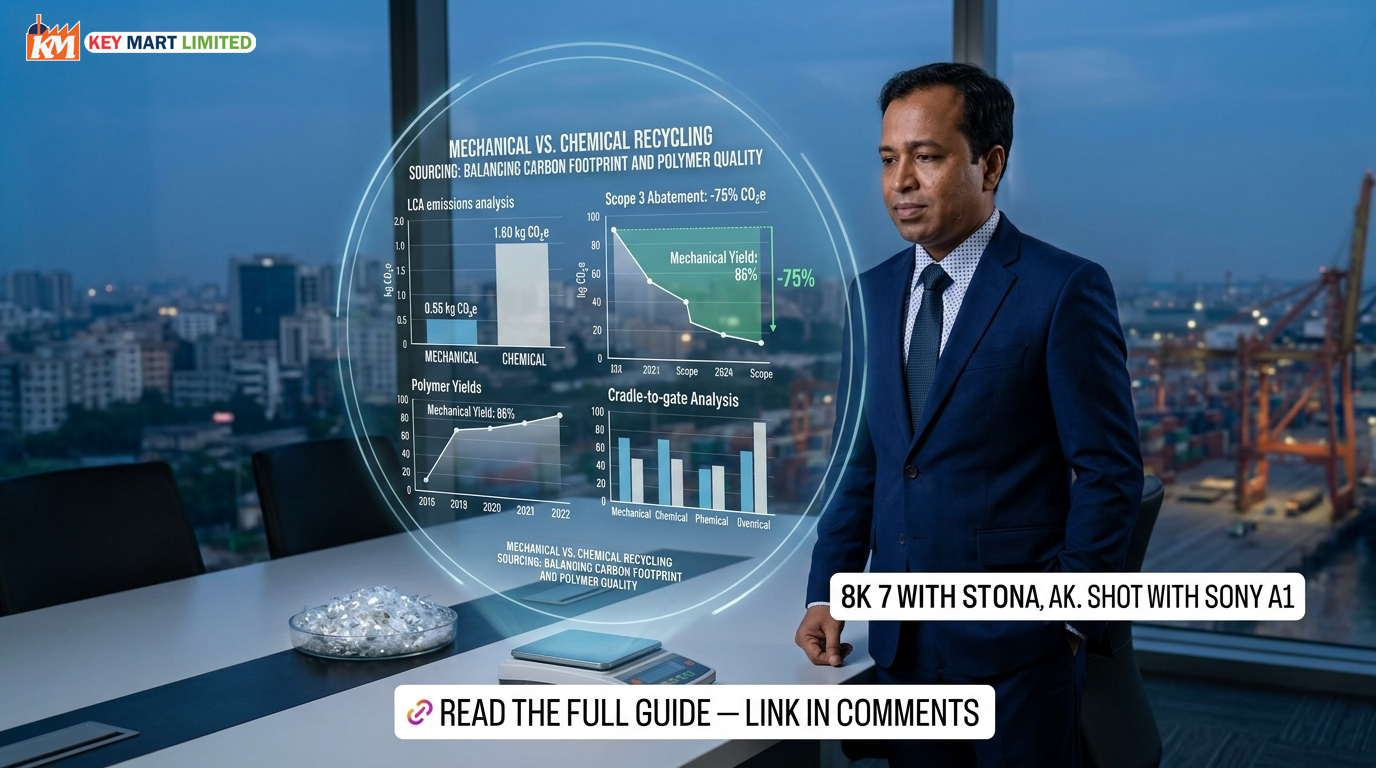
The trade-off between mechanical vs chemical rPET carbon footprint impacts both corporate greenhouse gas (GHG) reporting and product performance.
Mechanical recycling delivers significant carbon abatement and high material recovery yields, while chemical recycling offers virgin-like purity for heavily contaminated streams at the expense of higher energy intensity.
Balancing these pathways requires understanding Life Cycle Assessment (LCA) boundaries, yield metrics, and how premium mechanically processed feedstock achieves virgin-grade performance with minimal environmental impact.
This technical procurement guide analyzes the carbon metrics of mechanical and chemical rPET, establishes sourcing frameworks for Scope 3 optimization, and demonstrates how Key Mart Limited delivers low-carbon, high-purity rPET feedstock to global enterprises.
1. Life Cycle Carbon Analysis: Mechanical vs. Chemical Pathways
Evaluating the carbon intensity of recycled PET requires calculating cradle-to-gate Global Warming Potential (GWP, measured in $\text{kg CO}_2\text{e}$ per $\text{kg}$ of resin produced):
Fossil Virgin PET (~2.15–2.50 kg CO₂e/kg)
  ▲
  │  [+120% Carbon Penalty]
  ├── Chemical Depolymerization (~1.20–1.80 kg CO₂e/kg)
  │  ▲
  │  │  [+200% to +350% Carbon Advantage]
  └── High-Purity Mechanical rPET (~0.45–0.65 kg CO₂e/kg)
A. Mechanical Recycling: Low-Carbon Material Preservation
Mechanical processing preserves the original polymer chain architecture through physical sorting, hot-caustic friction de-gluing, and optical decontamination:
-
Carbon Intensity: High-efficiency mechanical recycling generates $0.45\text{–}0.65\text{ kg CO}_2\text{e/kg}$, delivering a $70\%\text{–}80\%$ reduction in Scope 3 GHG emissions compared to virgin fossil PET.
-
Mass Yield: High-yield mechanical washing lines achieve material conversion rates of $82\%\text{–}88\%$ from collected post-consumer bottles to optical-grade flakes.
Read More: A Step-by-Step Guide to Importing PET Flakes from Bangladesh via Chittagong Port
B. Chemical Recycling: High Purity with Higher Process Energy
Chemical depolymerization (glycolysis, methanolysis, and pyrolysis) cleaves ester bonds into monomer precursors (BHET, DMT, PTA/MEG) followed by high-temperature repolymerization:
-
Carbon Intensity: Due to thermal heating, solvent distillation, and catalytic energy demands, chemical depolymerization generates $1.20\text{–}1.80\text{ kg CO}_2\text{e/kg}$—substantially higher than mechanical recycling.
-
Mass Yield: Monomer recovery and purification losses reduce mass yields to $65\%\text{–}75\%$, requiring more gross feedstock per metric ton of final resin.
Life Cycle Assessment & Technical Sourcing Matrix
| Comparative Sustainability Metric | Virgin Fossil PET | Chemical Monomer Recovery (Methanolysis/Glycolysis) | High-Purity Mechanical Flakes (Key Mart Standard) |
| Cradle-to-Gate GWP ($\text{kg CO}_2\text{e/kg}$) | $2.15\text{–}2.50$ | $1.20\text{–}1.80$ (Moderate Abatement) | 0.45 – 0.65 (Maximum Scope 3 Reduction) |
| Process Conversion Yield | Baseline ($100\%$) | $65\%\text{–}75\%$ (Distillation Loss) | 84% – 88% (High Resource Efficiency) |
| Process Energy Demand ($\text{MJ/kg}$) | $70\text{–}80\text{ MJ}$ | $45\text{–}60\text{ MJ}$ | 12 – 18 MJ (Low-Carbon Manufacturing) |
| Optical Clarity & Lightness ($L^*$) | $L^* \ge 78.0$ | $L^* \ge 78.0$ (Virgin Duplicate) | L* ≥ 74.0, b* ≤ +1.2 (Clear Packaging Grade) |
| Intrinsic Viscosity (IV) Stability | $0.80\text{ dL/g}$ | Tailored Repolymerization | 0.78 – 0.82 dL/g (Tight Continuous Span) |
| PVC Contamination | $0\text{ PPM}$ | Tolerates up to $50\text{ PPM}$ | < 25 – 50 PPM (Continuous Hot-Caustic) |
| Traceability & Chain of Custody | Fossil Baseline | Mass-Balance Allocation | GRS 4.0 Transaction Certified (Physical) |
2. Strategic Sourcing Framework for Corporate Sustainability Officers
To balance ESG decarbonization commitments with product quality standards, procurement officers should adopt a tiered sourcing framework:
-
Prioritize Mechanical Feedstock for Core Packaging: Allocate high-purity mechanical flakes to standard thermoforming, bottle-to-bottle, and fiber applications ($80\%\text{–}90\%$ of volume) to maximize Scope 3 reductions.
-
Reserve Chemical Recycling for Difficult Fractions: Deploy chemical recycling selectively for opaque, multi-layer, or highly contaminated post-industrial streams where mechanical washing cannot achieve optical or mechanical criteria.
-
Mandate Physical Chain-of-Custody Certification: Avoid ambiguous mass-balance accounting when possible by prioritizing physically traceable Global Recycled Standard (GRS 4.0) certified mechanical flakes.
3. How Key Mart Limited Meets Global Scope 3 Sourcing Targets
Achieving low-carbon procurement without sacrificing material performance requires an established bangladesh pet flakes manufacturer with institutional quality control and energy-efficient washing infrastructure.
As a premier pet flakes company bangladesh and trusted pet flakes exporter, Key Mart Limited delivers low-carbon, optical-grade rPET flakes engineered for sustainability-focused enterprises:
-
Source-Segregated Collection in Dhaka: Operating as a leading pet flakes manufacturer dhaka, Key Mart Limited selectively processes 100% post-consumer clear beverage bottles, excluding tinted plastics, multi-layer containers, and degraded scrap at collection centers.
-
Continuous Multi-Stage Hot-Caustic Washing: As an established bangladesh pet flakes manufacturer, our facility subjects flakes to continuous hot-caustic friction washing ($85^\circ\text{C}-95^\circ\text{C}$) and automated NIR optical sorting, guaranteeing $\text{PVC} < 25\text{–}50\text{ PPM}$, zero glue residue, and moisture dried below 0.5%.
-
Sub-0.3% Fines Removal via Air Elutriation: Serving as an experienced pet flakes exporter, Key Mart Limited passes every batch through automated multi-stage zig-zag air classifiers, keeping dust and fines strictly below $0.3\%$ to eliminate extrusion pressure surges and filter blinding.
-
High IV Stability & Physical Traceability: Every export batch is tested in our Dhaka quality control laboratory for stable Intrinsic Viscosity ($0.78\text{–}0.82\text{ dL/g}$), backed by batch-specific Certificates of Analysis (CoA) and Global Recycled Standard (GRS 4.0) Transaction Certificates (TC).
-
Maximized 25–26 MT Container Logistics: We pack 25–26 Metric Tons into every 40ft High Cube container with heavy-duty 100-micron PE inner liners to preserve feedstock dryness during transit under FOB Chittagong, CFR, or CIF shipping terms.
Partner with Key Mart Limited Today
Achieve your corporate Scope 3 decarbonization targets, optimize packaging circularity, and secure high-purity rPET flakes from Bangladesh. Contact our Dhaka export management team today to request Technical Data Sheets, order commercial testing samples, or reserve monthly container allocations.
-
Company Name: Key Mart Limited
-
Head Office & Factory Address: Plot #31, Road #N-1, Block #K, Eastern Housing, Pallabi 2nd Phase, Rupnagar, Dhaka-1216, Bangladesh.
-
Official Website: www.keymartbd.com
-
Corporate Email: keymartltd@gmail.com | info@keymartbd.com
-
Direct Phone / WhatsApp: +8801760774499, +8801864935478
Join our community today and stay connected with the future of PET recycling.
 Visit our YouTube channel: Key Mart Limited on YouTube
Visit our Facebook Page: Key Mart Limited on Facebook
Subscribe to see our latest factory tours, production updates, and export success stories.