Views: 5
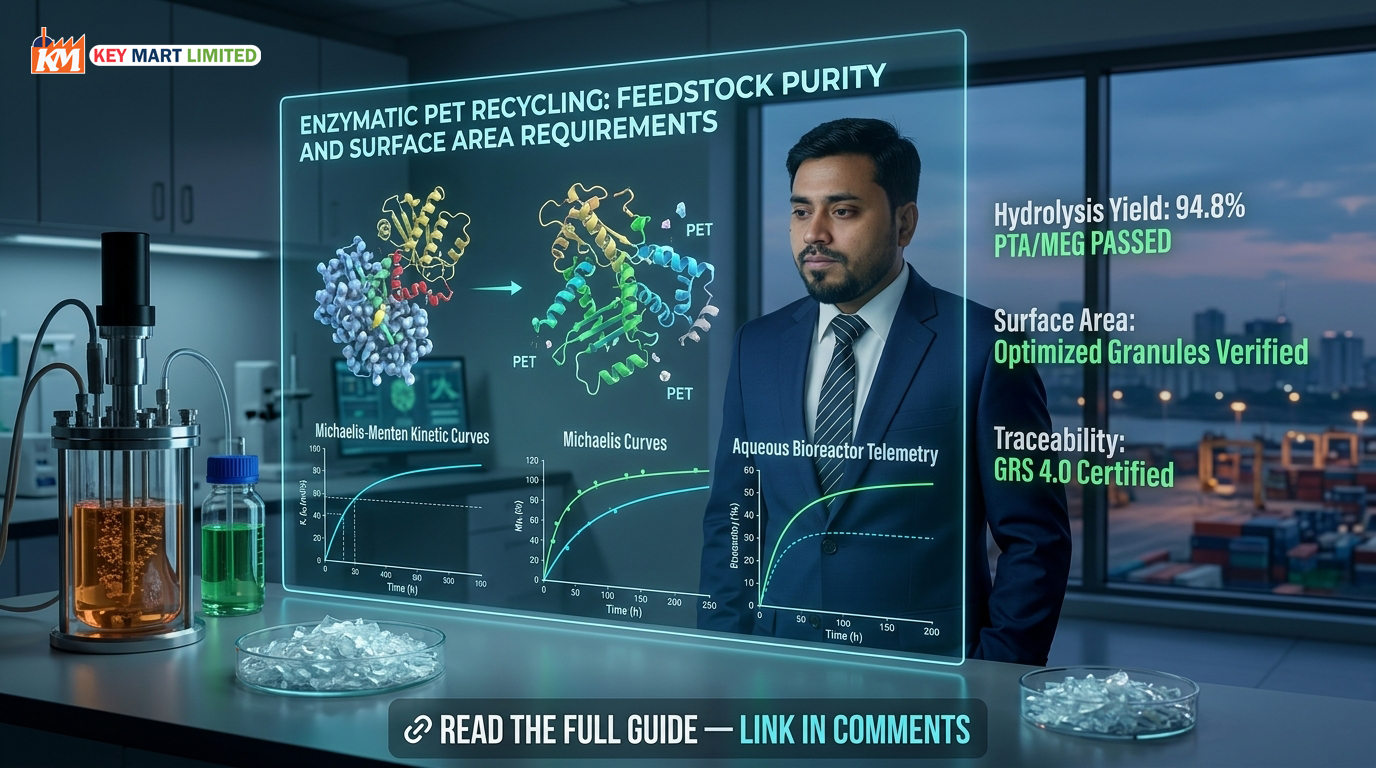
In the emerging bio-circular economy, enzymatic hydrolysis using engineered PET hydrolases (such as leaf-branch compost cutinase mutants like LCC-ICCG and FAST-PETase) represents a breakthrough in plastic biorecycling. By operating in mild, aqueous conditions ($50^\circ\text{C}\text{–}70^\circ\text{C}$, atmospheric pressure, neutral to mild alkaline $\text{pH}$), biological depolymerization cleaves post-consumer Polyethylene Terephthalate (pet flakes) directly into pure Terephthalic Acid (PTA) and Monoethylene Glycol (MEG).
Unlike thermo-chemical routes, enzymatic degradation occurs strictly at the solid-liquid interface.
Enzyme accessibility is limited by solid polymer chain entanglement, crystalline domain barriers, and chemical contaminants that deactivate active enzyme binding pockets.
Achieving $>90\%$ depolymerization in under 10–16 hours requires precise mechanical pre-treatment, amorphization, and sourcing compliant enzymatic PET depolymerization feedstock.
This technical guide analyzes the surface dynamics and biocatalytic requirements of enzymatic recycling, establishes flake specifications, and demonstrates how Key Mart Limited delivers high-purity, low-contaminant rPET feedstock to industrial biorecycling facilities.
1. Biocatalytic Reaction Kinetics: Surface Area, Amorphization, and Enzyme Binding
Enzyme-catalyzed ester bond cleavage is a heterogeneous biocatalytic process governed by Michaelis-Menten surface kinetics:
Amorphized Micronized Flake ➔ Enzyme Surface Adsorption ➔ Ester Linkage Hydrolysis ➔ Monomer Release (PTA + MEG) ➔ Enzyme Desorption & Re-engagement
A. Specific Surface Area ($S_a$) and Micronization
Because PET hydrolases cannot penetrate deep into solid plastics, hydrolysis rate ($v$) is directly proportional to active surface area ($A_{active}$):
-
Geometry Optimization: Traditional coarse flakes ($8\text{–}12\text{ mm}$) exhibit low surface-area-to-volume ratios, leading to prolonged reaction cycles.
-
Controlled Flake Granulation: Micronizing flakes into calibrated $1.0\text{–}3.0\text{ mm}$ particles or micro-granules increases the specific surface area ($> 1.5\text{–}2.5\text{ m}^2\text{/g}$), accelerating initial enzyme adsorption and reducing digestion time by up to 60%.
B. Crystallinity Limits ($\le 10\%\text{–}15\%$)
Standard bottle flakes possess $30\%\text{–}40\%$ semi-crystalline structures. Densely packed crystalline lamellae block enzyme catalytic clefts. Effective enzymatic digestion requires thermal or mechanical pre-amorphization (lowering crystallinity to $\le 10\%$) to keep ester bonds in an open, flexible conformation.
Read More: A Step-by-Step Guide to Importing PET Flakes from Bangladesh via Chittagong Port
Enzymatic Biorecycling Feedstock Benchmark Table
| Biochemical & Material Parameter | Standard Scrap Flakes | Biorecycling Standard (Key Mart) | Impact on Bioreactor Yield |
| PVC Contamination | $> 150\text{–}300\text{ PPM}$ | < 25 – 50 PPM (Continuous Hot-Washed) |
Prevents biocatalyst toxicity & inhibition |
| Residual Surfactants & Glues | Variable / High | < 10 PPM (Optical NIR & Friction Clean) |
Eliminates enzyme denaturation in solution |
| Heavy Metals (Sb, Ti, Co, Fe) | $> 250\text{ PPM}$ | < 10 PPM Controlled (Optical NIR Sorted) |
Prevents active site metal coordination failure |
| Dust & Fines ($< 500\,\mu\text{m}$) | $> 3.5\%$ (Uncontrolled) | < 0.3% (Multi-Stage Air Elutriated) |
Prevents biomass foaming & reactor blinding |
| Particle Size Distribution | $6\text{–}14\text{ mm}$ (Irregular) | 1.0 – 4.0 mm Uniform Granulation |
Maximizes specific surface area ($S_a$) |
| Intrinsic Viscosity (IV) Baseline | $0.65\text{–}0.70\text{ dL/g}$ (Variable) | 0.78 – 0.82 dL/g (Stable Pure Baseline) |
Ensures predictable chain cleavage rates |
| Traceability & Chain of Custody | Unverified | GRS 4.0 Transaction Certified (TC) | Audit-ready for EU PPWR mass balance rules |
2. Preventing Biocatalyst Poisoning and Reactor Fouling
Maintaining high enzyme turnover numbers (TON) in multi-cubic-meter bioreactors requires three strict feedstock controls:
-
Eliminating Ionic Surfactants & Label Glues: Residual detergent chemicals and acrylic adhesives disrupt the hydrophobic binding pockets of hydrolases, causing irreversible enzyme unfolding.
-
Float-Sink Polyolefin Separation ($< 50\text{ PPM}$): Unseparated polypropylene (PP) and high-density polyethylene (HDPE) cap residues form an inert, floating crust in aqueous bioreactors, fouling agitator blades and level sensors.
-
Continuous Hot-Caustic Decontamination ($85^\circ\text{C}-95^\circ\text{C}$): Hot-wash saponification removes bio-burdens and organic food residues that would otherwise cultivate competing bacterial contamination inside the warm enzymatic slurry.
3. How Key Mart Limited Supplies Advanced Biorecycling Facilities
Scaling enzymatic recycling operations requires a reliable bangladesh pet flakes manufacturer with precision washing, color uniformity, and mechanical classification systems.
As a premier pet flakes company bangladesh and trusted pet flakes exporter, Key Mart Limited delivers candidate rPET flakes engineered specifically for enzymatic depolymerization lines:
-
Source-Segregated Clear Bottle Intake in Dhaka: Operating as a leading pet flakes manufacturer dhaka, Key Mart Limited processes 100% post-consumer clear beverage bottles, excluding heavy metal dyes, multi-layer barriers, and post-industrial scrap at the collection stage.
-
Continuous Multi-Stage Caustic Washing: As an established bangladesh pet flakes manufacturer, our facility subjects flakes to continuous hot-caustic friction washing ($85^\circ\text{C}-95^\circ\text{C}$) and automated NIR optical sorting, guaranteeing $\text{PVC} < 25\text{–}50\text{ PPM}$, zero glue residue, and moisture dried below 0.5%.
-
Sub-0.3% Fines Removal via Air Elutriation: Serving as an experienced pet flakes exporter, Key Mart Limited passes every batch through automated multi-stage zig-zag air classifiers, keeping dust and fines strictly below $0.3\%$ to eliminate uncontrollable foaming and slurry handling errors.
-
High Chemical Purity & Batch Traceability: Every export batch is tested in our Dhaka quality control laboratory for stable Intrinsic Viscosity ($0.78\text{–}0.82\text{ dL/g}$) and low ash content, backed by batch-specific Certificates of Analysis (CoA) and Global Recycled Standard (GRS 4.0) Transaction Certificates (TC).
-
Maximized 25–26 MT Container Logistics: We pack 25–26 Metric Tons into every 40ft High Cube container with heavy-duty 100-micron PE inner liners to preserve feedstock dryness during transit under FOB Chittagong, CFR, or CIF shipping terms.
Partner with Key Mart Limited Today
Protect your biocatalyst investments, accelerate enzymatic hydrolysis cycle times, and secure high-purity rPET flakes from Bangladesh. Contact our Dhaka export management team today to request Technical Data Sheets, order commercial trial samples, or reserve monthly container allocations.
-
Company Name: Key Mart Limited
-
Head Office & Factory Address: Plot #31, Road #N-1, Block #K, Eastern Housing, Pallabi 2nd Phase, Rupnagar, Dhaka-1216, Bangladesh.
-
Official Website: www.keymartbd.com
-
Corporate Email: keymartltd@gmail.com | info@keymartbd.com
-
Direct Phone / WhatsApp: +8801760774499, +8801864935478
Join our community today and stay connected with the future of PET recycling.
 Visit our YouTube channel: Key Mart Limited on YouTube
Visit our Facebook Page: Key Mart Limited on Facebook
Subscribe to see our latest factory tours, production updates, and export success stories.