Views: 19
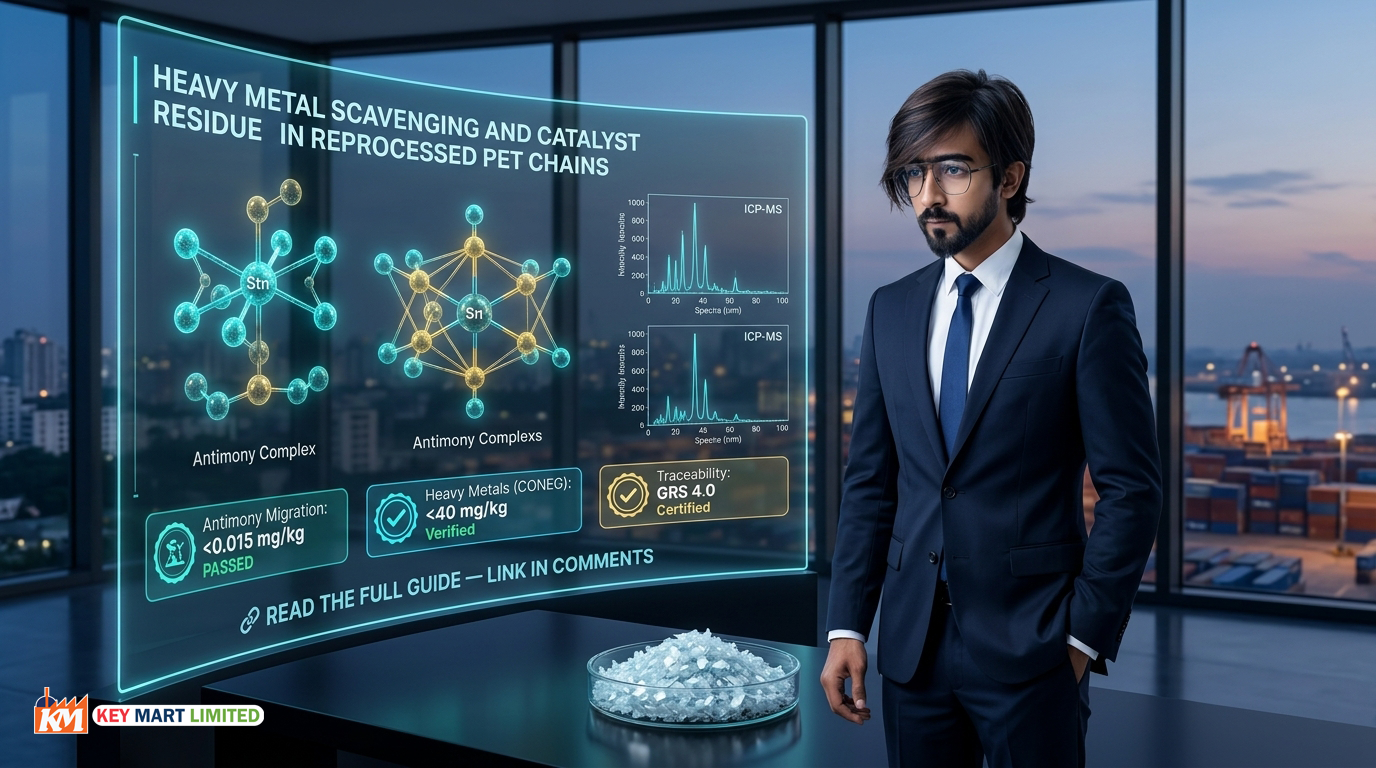
For safety-conscious global brand owners, fast-moving consumer goods (FMCG) packaging directors, and food-contact compliance officers, incorporating post-consumer recycled Polyethylene Terephthalate (pet flakes) into packaging requires strict toxicological safety and regulatory compliance. Beyond aesthetic clarity and mechanical tenacity, brand protection hinges on a critical chemical metric: antimony catalyst residue recycled PET and heavy metal migration.
Over 85% to 90% of global virgin PET is synthesized using Antimony Trioxide ($\text{Sb}_2\text{O}_3$) as a polycondensation catalyst, leaving residual elemental antimony bound within the polymer matrix ($150\text{–}300\text{ mg/kg}$).
During repeated mechanical recycling loops, thermal re-extrusion, and high-heat washing, residual catalyst species can undergo chemical reorganization, generating active pro-degradant sites that accelerate thermal yellowing, acetaldehyde (AA) generation, and elevated heavy-metal migration.
Furthermore, post-consumer streams run the risk of secondary heavy-metal contamination—including Lead ($\text{Pb}$), Cadmium ($\text{Cd}$), Mercury ($\text{Hg}$), and Hexavalent Chromium ($\text{Cr}^{6+}$)—originating from printing inks, masterbatch colorants, and PVC bottle closures.
Meeting stringent food-contact safety frameworks—such as EU Regulation (EU) 10/2011, US FDA 21 CFR §177.1630, EU Packaging and Packaging Waste Regulation (PPWR), and CONEG heavy metal limits ($<100\text{ mg/kg}$ total)—requires comprehensive laboratory analytical verification and precise upstream decontamination.
This technical compliance guide analyzes the chemical mechanics of antimony catalyst stability, details heavy-metal testing standards, and illustrates how Key Mart Limited delivers laboratory-verified, low-contaminant rPET feedstock to food-contact packaging converters worldwide.
1. Antimony Catalyst Mechanics: Speciation, Thermal Stability, and Migration Limits
Antimony remains in the PET polymer matrix in two primary oxidation states: trivalent ($\text{Sb}^{\text{III}}$) and pentavalent ($\text{Sb}^{\text{V}}$). Managing catalyst behavior during re-extrusion requires understanding its reaction chemistry:
Post-Consumer Bottle Intake ➔ Hot-Caustic Surface Leaching ➔ Controlled Re-Extrusion ➔ Antimony Complex Stabilization ➔ Specific Migration Compliance (<0.04 mg/kg)
A. Specific Migration Limits (SML)
Under EU Regulation (EU) 10/2011 and US FDA compliance testing, packaging must prove that antimony leaching under foreseeable storage conditions remains strictly below established toxicological ceilings:
-
EU Specific Migration Limit (SML): $< 0.04\text{ mg/kg (40 }\mu\text{g/kg)}$ into food simulants (3% acetic acid, 10% ethanol, and distilled water).
-
European Drinking Water Limit: $< 5.0\,\mu\text{g/L}$ total antimony concentration.
B. Thermal Re-activation and Scavenging
During high-temperature re-extrusion ($>270^\circ\text{C}$), unbound $\text{Sb}^{\text{III}}$ can act as an active transesterification catalyst, breaking PET molecular chains and increasing Acetaldehyde generation.
-
Phosphorus Stabilizer Scavenging: Converters utilize organophosphorus scavengers (such as phosphites and phosphoric acid derivatives) to react with active antimony coordination centers, converting them into thermally inert antimony-phosphate complexes:
$$2\,\text{Sb}^{3+} + 3\,\text{R}-\text{PO}_3^{2-} \xrightarrow{\Delta} \text{Sb}_2(\text{R-PO}_3)_3\quad \text{(Thermally Passivated Complex)}$$ -
This chemical passivation stabilizes melt viscosity, prevents thermal degradation, and inhibits catalyst-induced yellowing ($b^*$ index drift).
Read More: A Step-by-Step Guide to Importing PET Flakes from Bangladesh via Chittagong Port
Heavy Metal & Catalyst Residue Benchmark Table
| Analytical Parameter | Regulatory Test Method | Typical Scrap Flakes (Uncontrolled) | Strict Food-Contact Standard (Key Mart) | Impact on Finished Packaging Safety |
| Specific Antimony (Sb) Migration | EU 10/2011 (3% Acetic Acid) | $> 0.035\text{–}0.050\text{ mg/kg}$ | < 0.010 – 0.015 mg/kg (SML < 0.04 mg/kg) |
Eliminates food/beverage contamination risk |
| Total Heavy Metals (Pb+Cd+Hg+Cr⁶⁺) | CONEG / EU 94/62/EC / PPWR | $> 120\text{–}250\text{ mg/kg}$ | < 25 – 40 mg/kg (Limit < 100 mg/kg) |
Passes mandatory US & EU toxic substance limits |
| Lead (Pb) Content | ICP-OES / ICP-MS | $> 10\text{–}25\text{ PPM}$ | < 2.0 PPM (Optical NIR & Float-Sink) |
Complies with strict infant and food contact rules |
| Cadmium (Cd) Content | ICP-OES / ICP-MS | $> 5\text{–}15\text{ PPM}$ | < 1.0 PPM (Automated Color Sorting) |
Prevents toxic accumulation in packaging matrix |
| PVC Contamination | Baked Flake Test ($200^\circ\text{C}$) | $> 150\text{–}300\text{ PPM}$ | < 25 – 50 PPM (Continuous Hot-Caustic) |
Eliminates acidic HCl degradation and char |
| Dust & Fines Content ($<500\,\mu\text{m}$) | Sieve Gravimetric Test | $> 2.5\text{–}3.5\%$ | < 0.3% (Multi-Stage Air Elutriated) |
Prevents metal-rich airborne dust accumulation |
| Chain-of-Custody Certification | Third-Party Physical Audit | Unverified supply | GRS 4.0 Transaction Certified (TC) | Audit-ready traceability for global brand owners |
2. Laboratory Verification Protocols for Brand Owner Due Diligence
To guarantee compliance with US FDA, EU EFSA, and global brand quality covenants, technical packaging converters must mandate the following testing protocols on incoming flake lots:
-
Inductively Coupled Plasma Mass Spectrometry (ICP-MS): Provides part-per-billion (ppb) level quantitative screening of total elemental antimony, lead, cadmium, mercury, and chromium across representative composite flake samples.
-
Standardized Food Simulant Migration Cell Testing: Exposing thermoformed sheet or bottle preforms to 3% acetic acid ($10\text{ days at }40^\circ\text{C}$ or $2\text{ hours at }70^\circ\text{C}$) to simulate worst-case acidic beverage contact conditions under EN 13130.
-
Differential Scanning Calorimetry (DSC) & Colorimetry ($L^*, a^*, b^*$): Evaluating crystallization kinetics and yellow-shift indices to verify that catalyst re-activation has not occurred during feedstock drying and extrusion.
3. How Key Mart Limited Supplies Laboratory-Verified rPET Feedstock
Guaranteeing trace-level chemical safety and heavy-metal compliance requires an established bangladesh pet flakes manufacturer with institutional sorting, caustic decontamination, and testing infrastructure.
As a premier pet flakes company bangladesh and trusted pet flakes exporter, Key Mart Limited delivers laboratory-verified rPET flakes engineered for high-purity thermoforming, packaging, and technical spinning:
-
Source-Segregated Clear Bottle Selection in Dhaka: Operating as a leading pet flakes manufacturer dhaka, Key Mart Limited exclusively processes 100% post-consumer clear beverage bottles, excluding toxic industrial containers, agricultural chemical bottles, heavily printed materials, and PVC at our intake centers.
-
Continuous Multi-Stage Caustic Decontamination: As an established bangladesh pet flakes manufacturer, our facility subjects crushed flakes to continuous hot-caustic friction washing ($85^\circ\text{C}-95^\circ\text{C}$) and automated NIR optical sorting, stripping printing inks, surface-bound heavy metal pigments, and residual adhesives, guaranteeing $\text{PVC} < 25\text{–}50\text{ PPM}$ and moisture dried below 0.5%.
-
Sub-0.3% Fines Removal via Air Elutriation: Serving as an experienced pet flakes exporter, Key Mart Limited passes every batch through automated multi-stage zig-zag air classifiers, keeping dust and fines strictly below $0.3\%$ to eliminate contaminant-concentrated fines from entering the extruder feed hopper.
-
Batch-Specific Laboratory Testing & Traceability: Every export shipment is verified in our Dhaka quality control laboratory for stable Intrinsic Viscosity ($0.78\text{–}0.82\text{ dL/g}$), color purity ($L^* \ge 74$, $b^* \le +1.2$), and heavy-metal safety thresholds, backed by batch-specific Certificates of Analysis (CoA) and Global Recycled Standard (GRS 4.0) Transaction Certificates (TC).
-
Maximized 25–26 MT Container Logistics: We pack 25–26 Metric Tons into every 40ft High Cube container with heavy-duty 100-micron PE inner liners to preserve feedstock dryness during transit under FOB Chittagong, CFR, or CIF shipping terms.
Partner with Key Mart Limited Today
Protect your brand reputation, satisfy stringent food-contact and heavy-metal regulatory audits, and secure high-purity rPET flakes from Bangladesh. Contact our Dhaka export management team today to request Technical Data Sheets, order commercial testing samples, or reserve monthly container allocations.
-
Company Name: Key Mart Limited
-
Head Office & Factory Address: Plot #31, Road #N-1, Block #K, Eastern Housing, Pallabi 2nd Phase, Rupnagar, Dhaka-1216, Bangladesh.
-
Official Website: www.keymartbd.com
-
Corporate Email: keymartltd@gmail.com | info@keymartbd.com
-
Direct Phone / WhatsApp: +8801760774499, +8801864935478
Join our community today and stay connected with the future of PET recycling.
 Visit our YouTube channel: Key Mart Limited on YouTube
Visit our Facebook Page: Key Mart Limited on Facebook
Subscribe to see our latest factory tours, production updates, and export success stories.