Views: 11
If you oversee bulk solids handling, pneumatic conveying, or railcar unloading in an American polymer compounding or packaging plant, you know that handling recycled Polyethylene Terephthalate (pet flakes) is entirely different from moving virgin spherical pellets.
Virgin pellets pour like dry sand with predictable bulk densities around 45 to 52 lbs/ft³ (720 to 830 kg/m³). Post-consumer flakes, by contrast, are flat, irregular, two-dimensional chips.
When your material handling systems are tuned for free-flowing pellets, poor flake geometry can shut down a plant’s transfer lines within minutes.
Feed low-density, irregular flake into a high-throughput dilute-phase pneumatic line or a tall outdoor storage silo, and the mechanical challenges multiply:
-
Rotary airlock binding and blowback: Flakes wedge into rotor tip clearances, stalling drives.
-
Elbow plugging and line salting: Inadequate conveying velocity causes irregular chips to drop out of suspension.
-
Ratholing and bridging in storage silos: Flat flake chips interlock under compressive head pressure, choking discharge cones.
Preventing these bottlenecks requires engineering your material intake around standardized bulk density PET flakes pneumatic conveying US specifications.
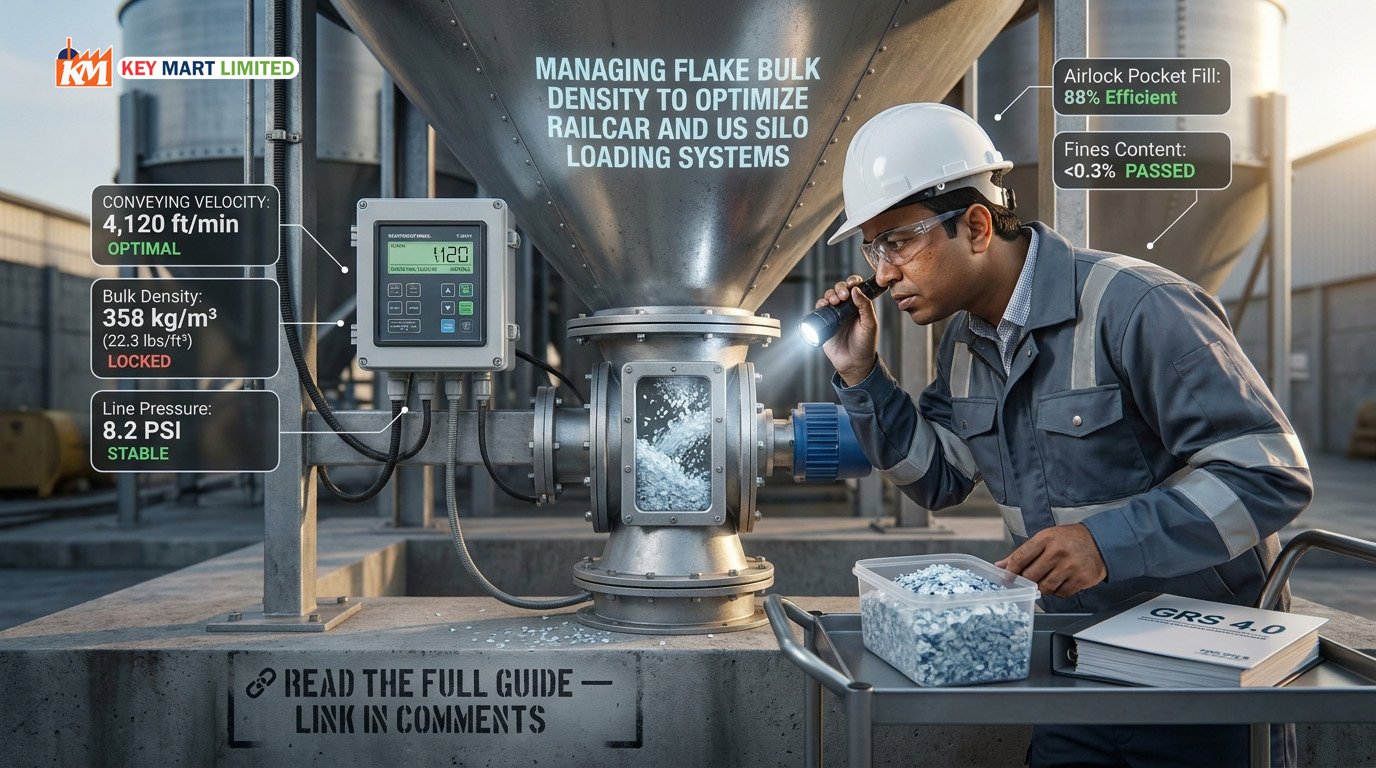
Managing the physical bulk density, particle shape, and cut size of incoming flakes ensures steady pneumatic flow from railcar unloading boots all the way to outdoor silo headhouses.
This bulk materials handling guide breaks down the physical properties of flake conveying, outlines air-to-cloth ratios and minimum conveying velocities, and illustrates how Key Mart Limited delivers dense, flow-optimized rPET flakes directly to North American manufacturers.
1. The Bulk Handling Physics: Pellets vs. Flakes in US Pneumatic Systems
Transferring flakes via dilute- or dense-phase pneumatic systems requires adjusting airflow dynamics to match material aerodynamics:
Railcar / Bulk Container Discharge ➔ Controlled Airlock Feed ➔ Velocity-Tuned Pneumatic Line ➔ Tangential Silo Receiver Cyclofilter ➔ Non-Bridging Active Discharge Cone
A. Poured vs. Aerated Bulk Density (ASTM D1895 Method A/B)
-
The Poured Target: Premium hot-washed clear bottle flakes should achieve an apparent poured bulk density of 21 to 24 lbs/ft³ (330 to 380 kg/m³).
-
The Aeration Hazard: When flakes drop into high-velocity conveying air, their flat, high-surface-area geometry causes them to float. Aerated bulk density can drop below 14 lbs/ft³ (220 kg/m³). If the line’s pickup velocity () is too high, material flutters like paper confetti, leading to premature boundary-layer turbulence and line choking at vertical elbows.
B. Saltation Velocity and Minimum Conveying Air
-
Saltation Limits: In dilute-phase pressure systems, maintaining saltation velocity () is critical. For dense bottle flakes, pickup air velocity must remain between 3,800 and 4,400 ft/min (19 to 22 m/s).
-
The Risk of Over-Velocity: Pushing conveying velocities above 4,800 ft/min causes flakes to scrape pipe walls at high impact, generating friction-induced angel hair, streamers, and static-charged micro-fines that blind silo dust-collector bags.
C. Overcoming Silo Ratholing and Compaction
In tall storage silos (), the sheer weight of the material column creates compressive head pressure. Because irregular flakes interlock under load, standard gravity cones () routinely form stable arches and ratholes. Preventing bridging requires:
-
Steep cone designs ( minimum).
-
Internal low-friction UHMW liners.
-
Active flow-promotion aids such as bin vibrators, fluidizing pads, or mechanical bin activators.
Bulk Pneumatic Handling & Conveying Performance Benchmark
Read More: A Step-by-Step Guide to Importing PET Flakes from Bangladesh via Chittagong Port
2. Preventing Line Plugs and Feeder Starvation
Plant engineers can protect automated pneumatic transfer systems from downtime by enforcing three raw material requirements:
-
Eliminate Electrostatic Micro-Fines (): High fines () cause problems in pneumatic systems. Fines coat conveying pipes, create static cling on sight glasses, and quickly blind pulse-jet dust collector bags on silo roofs. Running flakes that undergo rigorous multi-stage air elutriation keeps dust collectors clean and maintains differential pressure () across filter media.
-
Standardize on Diamond-Cut Flake Geometry: Frayed, curved, or stringy flakes interlock in airlock throats and bridge over rotary feeder vanes. Flakes cut cleanly with sharp rotary granulator blades resist interlocking, ensuring clean release into conveying lines.
-
Control Moisture Content at Unloading (): Moisture on flake surfaces creates capillary bridging between particles, promoting clumping in hopper bottoms and causing flakes to stick to warm airlock pockets. Feeding dry material guarantees smooth discharge into pneumatic air streams.
3. How Key Mart Limited Supports US Bulk Material Handling Systems
Maintaining reliable bulk handling operations requires partnering with an established bangladesh pet flakes manufacturer that prioritizes precise shredding geometry, continuous hot-caustic washing, and aggressive dedusting.
As a premier pet flakes company bangladesh and trusted pet flakes exporter, Key Mart Limited delivers dense, flow-optimized clear rPET flakes engineered to feed high-speed pneumatic handling systems:
-
100% Post-Consumer Beverage Bottle Collection: Operating as a leading pet flakes manufacturer dhaka, Key Mart Limited exclusively processes 100% post-consumer clear beverage bottles, rejecting contaminated industrial scrap, pesticide containers, and non-PET plastics at intake gates.
-
Continuous Multi-Stage Caustic Washing (): In our Dhaka plant, our pet flakes undergo continuous hot friction washing and automated NIR optical sorting, fully saponifying label glues and stripping organic residues to guarantee and zero adhesive carryover.
-
Sub-0.3% Fines Removal via Air Elutriation: Serving as an experienced pet flakes exporter, Key Mart Limited passes every batch through automated multi-stage zig-zag air classifiers, keeping dust and fines strictly below to prevent feed-throat bridging and eliminate filter blinding in pneumatic receivers.
-
High Apparent Bulk Density Optimization: Precision rotary cutting blades ensure clean, un-frayed flake edges with over retention between , yielding an optimal apparent bulk density of for consistent volumetric filling.
-
Maximized 25–26 MT Container Logistics: We pack 25–26 Metric Tons into every 40ft High Cube container with heavy-duty 100-micron PE inner liners to preserve feedstock dryness during transit under FOB Chittagong, CFR, or CIF shipping terms, with contractually secured extended free time at major US ports.
Partner with Key Mart Limited Today
Eliminate pneumatic conveying plugs, optimize railcar and storage silo discharge, and secure dense, high-flow rPET flakes from Bangladesh. Contact our Dhaka export management team today to request Technical Data Sheets, order commercial testing samples, or reserve monthly container allocations.
-
Company Name: Key Mart Limited
-
Head Office & Factory Address: Plot #31, Road #N-1, Block #K, Eastern Housing, Pallabi 2nd Phase, Rupnagar, Dhaka-1216, Bangladesh.
-
Official Website: www.keymartbd.com
-
Corporate Email: keymartltd@gmail.com | info@keymartbd.com
-
Direct Phone / WhatsApp: +8801760774499, +8801864935478
Join our community today and stay connected with the future of PET recycling.
 Visit our YouTube channel: Key Mart Limited on YouTube
Visit our Facebook Page: Key Mart Limited on Facebook
Subscribe to see our latest factory tours, production updates, and export success stories.