Views: 3
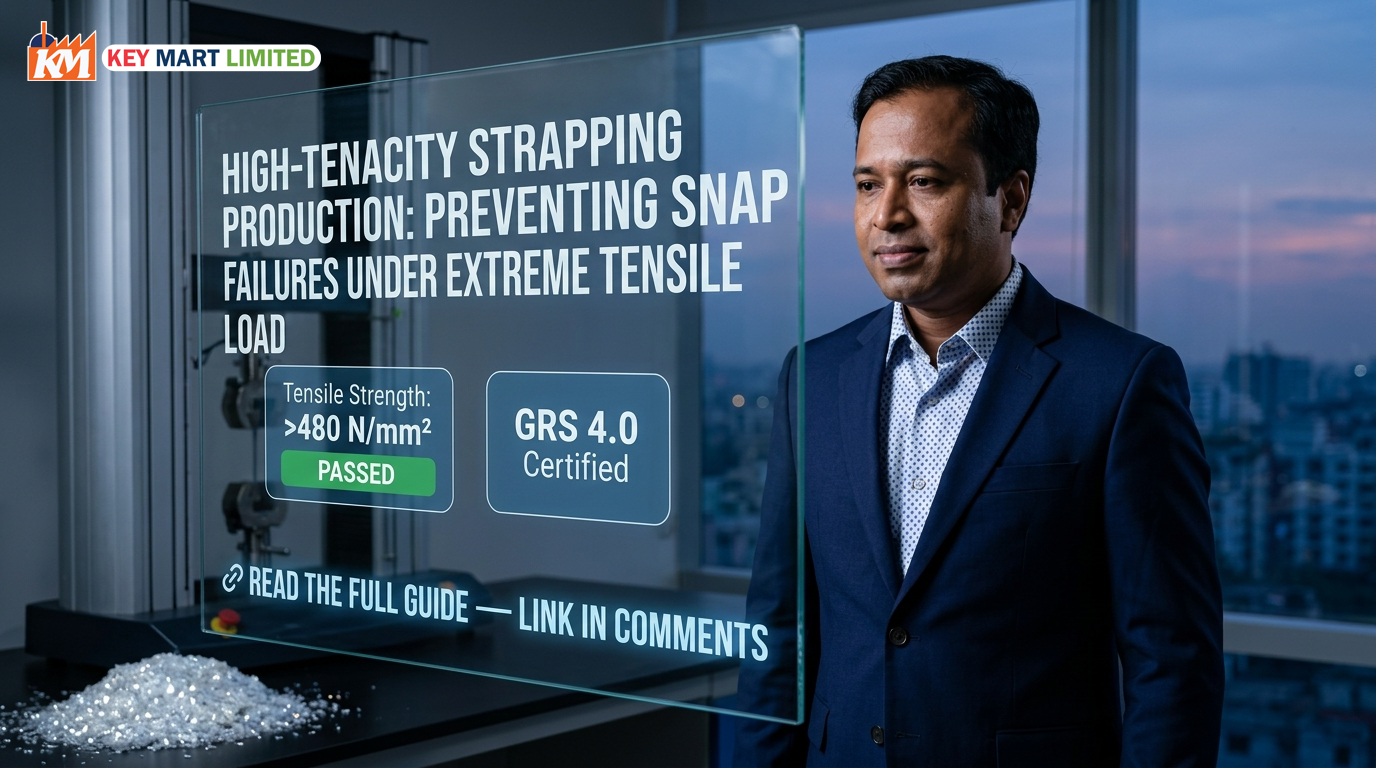
In heavy industrial packaging, logistics, and containerized cargo handling, high-tenacity polyester (PET) strapping band serves as the critical line of defense against load shifting. Designed to replace traditional steel strapping, PET strap must deliver immense break strength, high elongation recovery, and resistance to shock loading across timber, brick, steel coil, and export palletization.
To meet circular economy goals and reduce operational costs, strap extruders increasingly process 100% recycled Polyethylene Terephthalate (pet flakes).
However, high-tenacity strapping lines operate under extreme mono-axial orientation draw ratios ($1:5$ to $1:8$). Under these intense stretching conditions, even trace impurities or molecular chain degradation in the raw material cause catastrophic snap failures, filament splitting, and joint weld fracturing during tensioning.
This technical guide analyzes the root causes of tensile strap failures, outlines the critical Intrinsic Viscosity (IV) and contamination thresholds required for extrusion, and illustrates how Key Mart Limited supplies candidate feedstock engineered for zero-break strap manufacturing.
1. The Physics of Snap Failure Under High Draw Ratios
Producing industrial-grade PET strapping requires extruding a continuous thick profile, followed by water quench cooling, infrared reheating, and multi-stage stretching through heated Godet rolls to align the polymer chains along the longitudinal axis.
High-IV rPET Feedstock ➔ Melt Extrusion & Quench ➔ Godet Drawing (1:5 to 1:8 Stretch) ➔ Embossing & Annealing ➔ High-Tenacity Strapping Band
Snap failures and premature tensile failure occur due to three primary structural defects:
A. Intrinsic Viscosity (IV) Scission & Low Molecular Weight
Intrinsic Viscosity directly measures polymer chain length and molecular weight. Standard bottle-grade flakes possess an IV of $0.72\text{–}0.76\text{ dL/g}$. If excessive moisture ($> 0.5\%$) or thermal stress causes hydrolytic chain scission in the extruder barrel, the IV drops below $0.70\text{ dL/g}$. At this degraded molecular level, the polymer chains cannot withstand mono-axial drawing forces, causing immediate strap breakage on the line or joint failure during pneumatic strapping tool tensioning.
B. Micro-Void Initiation from PVC & Insoluble Inclusions
When Polyvinyl Chloride (PVC) contaminants enter the high-temperature extruder barrel ($260^\circ\text{C}-280^\circ\text{C}$), they carbonize into solid black specks ($\text{HCl}$ degradation). As the strapping band is drawn down to its final cross-sectional profile, these rigid inclusions cannot stretch. They create microscopic stress-concentration notches (micro-voids). Under extreme tensile load, stress propagates rapidly from these notches, resulting in brittle snap failure.
C. Polyolefin Contamination (Fibrillation and Splitting)
Residual polyethylene (PE caps) or polypropylene (PP labels) do not mix with PET. During longitudinal stretching, these unblended polyolefin phases elongate into laminar micro-channels, causing the strap to split lengthwise (fibrillation) under corner tension or vibration.
Read More: A Step-by-Step Guide to Importing PET Flakes from Bangladesh via Chittagong Port
Technical Purity & Mechanical Performance Benchmark Table
| Material Parameter | Standard Textile Grade Flakes | High-Tenacity Strapping Grade Standard | Impact on Strapping Line |
| Intrinsic Viscosity (IV) | $0.65\text{–}0.72\text{ dL/g}$ | 0.78 – 0.84 dL/g (High & Stable) |
Delivers >450–500 N/mm² tensile strength |
| PVC Contamination | $< 150\text{–}300\text{ PPM}$ | < 25 – 50 PPM |
Eliminates carbon notches & snap failures |
| Polyolefin (PE/PP) | $< 200\text{ PPM}$ | < 25 PPM |
Eliminates longitudinal splitting & delamination |
| Moisture Content | $> 1.0\%$ | < 0.5% (Pre-Dryer Target) |
Prevents hydrolytic IV degradation in extrusion |
| Flake Sizing & Fines | Irregular / Fines $> 2\%$ | Uniform 8–12 mm (Fines < 0.3%) |
Ensures steady feeding & stable melt pressure |
| Traceability Audit | Unverified | GRS 4.0 Transaction Certified |
Satisfies global ESG and EPR compliance |
2. Preventing Process Downtime on Solid-State Polycondensation (SSP) Lines
Many high-tenacity strapping operations utilize Liquid State Polycondensation (LSP) or Solid State Polycondensation (SSP) reactors to elevate rPET IV up to $0.85\text{–}0.95\text{ dL/g}$. To optimize SSP reactor kinetics, the incoming flake feedstock must meet strict physical standards:
-
Sub-50 PPM PVC Purity: Automated Near-Infrared (NIR) optical sorting prevents acidic chlorine generation, protecting expensive SSP vacuum pumps and screen-changers from chemical corrosion.
-
Homogeneous Bulk Density ($> 350\text{ g/L}$): Consistent $8\text{–}12\text{ mm}$ flake geometry ensures even heat transfer and uniform residence time during solid-state crystallization, eliminating batch-to-batch IV variation.
-
Hot-Caustic De-Gluation ($85^\circ\text{C}-95^\circ\text{C}$): Removing all residual glue prevents cross-linked gel formation that weakens strap weld-joint efficiency.
3. How Key Mart Limited Meets Global Demand for Strapping-Grade Feedstock
Producing feedstock capable of enduring extreme tensile drawing requires an advanced bangladesh pet flakes manufacturer with robust sorting and washing infrastructure.
As a premier pet flakes company bangladesh and trusted pet flakes exporter, Key Mart Limited supplies high-tenacity candidate rPET flakes engineered specifically for strapping extrusion:
-
Automated Processing in Dhaka: Operating as a leading pet flakes manufacturer dhaka, Key Mart Limited utilizes multi-stage continuous hot-caustic washing, high-speed friction washers, and automated NIR optical sorters to eliminate adhesives, polyolefins, and PVC.
-
Guaranteed Sub-50 PPM Purity & High IV: As an established bangladesh pet flakes manufacturer, our facility guarantees $\text{PVC} < 25\text{–}50\text{ PPM}$, moisture $< 0.5\%$, and uniform $8\text{–}12\text{ mm}$ flake geometry, verified batch-by-batch in our Dhaka laboratory and documented with official Certificates of Analysis (CoA).
-
GRS 4.0 Certified Traceability: Serving as an experienced pet flakes exporter, Key Mart Limited provides complete chain-of-custody documentation and GRS 4.0 Transaction Certificates (TCs), ensuring your products satisfy European PPWR and North American EPR statutory requirements.
-
Maximized 25–26 MT Container Logistics: We load 25–26 Metric Tons into every 40ft High Cube container with heavy-duty 100-micron moisture-barrier inner liners, protecting material dryness during ocean freight under FOB Chittagong, CFR, or CIF shipping terms.
Partner with Key Mart Limited Today
Eliminate strap snap failures, optimize your SSP reactor throughput, and secure high-purity rPET flakes from Bangladesh. Contact our Dhaka export management team today to request Technical Data Sheets, order commercial samples, or reserve monthly container allocations.
-
Company Name: Key Mart Limited
-
Head Office & Factory Address: Plot #31, Road #N-1, Block #K, Eastern Housing, Pallabi 2nd Phase, Rupnagar, Dhaka-1216, Bangladesh.
-
Official Website: www.keymartbd.com
-
Corporate Email: keymartltd@gmail.com | info@keymartbd.com
-
Direct Phone / WhatsApp: +8801760774499, +8801864935478
Join our community today and stay connected with the future of PET recycling.
 Visit our YouTube channel: Key Mart Limited on YouTube
Visit our Facebook Page: Key Mart Limited on Facebook
Subscribe to see our latest factory tours, production updates, and export success stories.