Views: 7
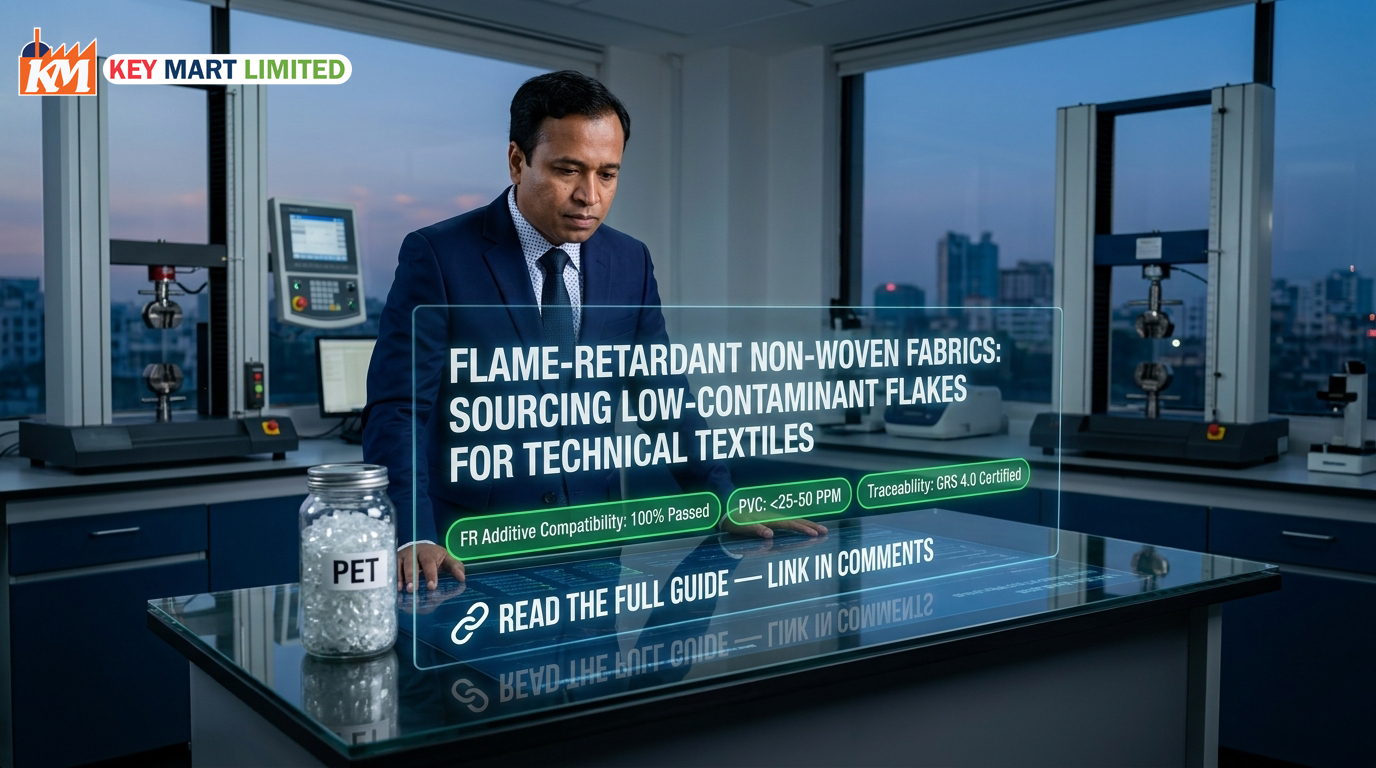
In the technical textiles industry, producing high-performance flame-retardant (FR) non-woven fabrics requires extreme raw material precision. Whether engineered for automotive acoustic insulation, aerospace interiors, commercial construction underlays, or specialized protective apparel, these fabrics must satisfy stringent international fire safety standards—such as UL 94, FMVSS 302, and EN 13501-1.
While textile manufacturers are under growing pressure to replace virgin polyester staple fiber (PSF) with recycled Polyethylene Terephthalate (pet flakes), processing FR technical fibers presents unique melt-spinning challenges.
Flame-retardant masterbatches and organophosphorus additives are chemically sensitive. When introduced to recycled feedstock containing high levels of Polyvinyl Chloride (PVC), residual adhesives, moisture, or polyolefins, the resulting chemical interactions lead to spinning line breaks, additive degradation, and compromised fire-retardancy ratings.
This technical guide analyzes the chemical mechanics of spinning FR technical textiles from rPET, identifies critical contamination risks, and demonstrates how Key Mart Limited delivers low-contaminant feedstock engineered for high-tenacity technical fiber extrusion.
1. The Chemistry of Flame-Retardant Melt Spinning with rPET
Manufacturing flame-retardant non-wovens generally involves compounding rPET flakes with halogen-free, phosphorus-based flame-retardant additives in a twin-screw extruder before spinning fine-denier staple fibers ($1.5\text{–}6.0\text{ DPF}$).
Low-Contaminant rPET Flakes + FR Additive Masterbatch ➔ Compounding & Melt Spinning ➔ Drawing & Crimping ➔ Needle-Punched Non-Woven Web ➔ Certified FR Technical Textile
A. The Phosphorous Synergistic Reaction
Phosphorous-based FR additives function primarily in the condensed phase. When exposed to flame, they decompose thermally to form an impermeable vitreous phosphoric acid carbonaceous char layer on the fiber surface, cutting off oxygen and heat transfer to the underlying polymer.
B. Why Feedstock Purity Dictates FR Performance
If the incoming rPET contains chemical impurities, the flame-retardant mechanism is destabilized:
-
Acidic Deactivation: Thermal breakdown of PVC releases hydrochloric acid ($\text{HCl}$), which reacts aggressively with organic phosphorus compounds, deactivating the active flame-retardant chemistry.
-
Spinneret Clogging & Fiber Voids: Residual glues, cross-linked gels, and polyolefin caps melt unevenly, creating microscopic voids within the extruded filament. Under thermal stress, these voids act as thermal hotspots, causing the fiber to ignite and fail fire-propagation testing.
Technical Purity and FR Spinning Benchmark Table
| Quality & Purity Parameter | Standard Industrial Grade Flakes | FR Technical Textile Standard | Impact on FR Non-Woven Line |
| PVC Contamination | $< 150\text{–}300\text{ PPM}$ | < 25 – 50 PPM |
Prevents additive deactivation & die buildup |
| Residual Moisture | $> 1.0\%$ | < 0.5% (Pre-Dryer Target) |
Eliminates hydrolytic degradation of FR chemistry |
| Polyolefin (PE/PP) | $< 200\text{ PPM}$ | < 25 PPM |
Eliminates fiber spinning breaks & flammability spots |
| Glue & Organic Residue | Variable | Zero (Hot-Caustic Washed) |
Prevents spinneret clogging and fiber discoloration |
| Intrinsic Viscosity (IV) | $0.65\text{–}0.72\text{ dL/g}$ | 0.78 – 0.82 dL/g (Stable) |
Ensures high tensile strength & needle-punch durability |
| Traceability & Audits | Unverified | GRS 4.0 Transaction Certified |
Fulfills OEM automotive & architectural ESG audits |
2. Overcoming Contamination Bottlenecks in Fine-Denier Extrusion
To ensure continuous filament extrusion without frequent spinneret pack backflushing or filament snapping during high-speed drawing, technical textile manufacturers require rPET feedstock meeting three strict criteria:
-
Sub-50 PPM PVC Content: NIR optical sorting eliminates PVC flakes, protecting screw barrels from corrosive wear and preventing black speck charring.
-
Intensive Hot-Caustic De-Gluation: Multi-stage washing ($85^\circ\text{C}-95^\circ\text{C}$) dissolves water-based and hot-melt bottle adhesives that would otherwise carbonize at extrusion temperatures ($> 270^\circ\text{C}$).
-
Controlled Flake Geometry ($8\text{–}12\text{ mm}$): Eliminating dust and fines ($< 0.3\%$) ensures homogeneous bulk density, preventing feeding fluctuations and stabilizing the polymer-to-additive compounding ratio.
Read More: A Step-by-Step Guide to Importing PET Flakes from Bangladesh via Chittagong Port
3. How Key Mart Limited Fulfills Global Demand for Technical Textile Feedstock
Supplying raw material engineered for high-tenacity, flame-retardant fiber spinning requires an advanced bangladesh pet flakes manufacturer with precision processing capabilities.
As a premier pet flakes company bangladesh and trusted pet flakes exporter, Key Mart Limited supplies candidate rPET feedstock tailored for technical non-wovens and high-tenacity staple fiber production:
-
Automated Processing in Dhaka: Operating as a leading pet flakes manufacturer dhaka, Key Mart Limited utilizes multi-stage continuous hot-caustic washing, high-speed friction washers, and automated NIR optical sorters to eliminate adhesives, polyolefins, and PVC.
-
Guaranteed Sub-50 PPM Purity: As an established bangladesh pet flakes manufacturer, our facility guarantees $\text{PVC} < 25\text{–}50\text{ PPM}$, moisture $< 0.5\%$, and uniform $8\text{–}12\text{ mm}$ flake sizing, verified batch-by-batch in our Dhaka laboratory and documented with official Certificates of Analysis (CoA).
-
GRS 4.0 Certified Traceability: Serving as an experienced pet flakes exporter, Key Mart Limited provides full chain-of-custody documentation and GRS 4.0 Transaction Certificates (TCs), ensuring your technical textiles meet OEM automotive and architectural compliance standards.
-
Maximized 25–26 MT Container Loading: We load 25–26 Metric Tons into every 40ft High Cube container with heavy-duty 100-micron moisture-barrier inner liners to preserve feedstock dryness during ocean transit under FOB Chittagong, CFR, or CIF terms.
Partner with Key Mart Limited Today
Eliminate filament breaks, protect your flame-retardant additive efficiency, and secure high-purity rPET flakes from Bangladesh. Contact our Dhaka export management team today to request Technical Data Sheets, order laboratory samples, or reserve monthly container allocations.
-
Company Name: Key Mart Limited
-
Head Office & Factory Address: Plot #31, Road #N-1, Block #K, Eastern Housing, Pallabi 2nd Phase, Rupnagar, Dhaka-1216, Bangladesh.
-
Official Website: www.keymartbd.com
-
Corporate Email: keymartltd@gmail.com | info@keymartbd.com
-
Direct Phone / WhatsApp: +8801760774499, +8801864935478
Join our community today and stay connected with the future of PET recycling.
 Visit our YouTube channel: Key Mart Limited on YouTube
Visit our Facebook Page: Key Mart Limited on Facebook
Subscribe to see our latest factory tours, production updates, and export success stories.