Views: 4
In the rigid thermoforming and retail packaging sectors, Amorphous Polyethylene Terephthalate (APET) sheet and film are the gold standards for visual appeal. From crystal-clear clamshells and thermoformed blister packs to food-display trays, consumer purchasing decisions depend directly on package transparency, surface gloss, and flawless optical clarity.
To meet circular economy goals, packaging converters face rising demand to incorporate high percentages of recycled Polyethylene Terephthalate (pet flakes) into extruded APET sheet lines.
However, moving from virgin resin to post-consumer rPET introduces major optical hurdles: internal haze, yellow tinting, and black specks.
This technical guide analyzes the root causes of optical defects in APET sheet extrusion, outlines the physical and chemical thresholds needed to eliminate haze, and demonstrates how Key Mart Limited delivers ultra-clean feedstock for high-clarity thermoforming film.
1. The Physics of Optical Defects in APET Film Extrusion
APET film requires rapid chill-roll quenching to prevent PET from crystallizing, locking the polymer chains into a clear amorphous state. When rPET feedstock contains chemical or physical contaminants, optical defects manifest across three primary categories:
Feedstock Impurities (PVC / Glue / Caps) ➔ Thermal Carbonization & Insoluble Phases ➔ Melt Stream Inclusions ➔ Optical Haze & Surface Specks
A. Black Specks from PVC Carbonization
Polyvinyl Chloride (PVC) is the primary cause of optical specks. PVC decomposes thermally at $160^\circ\text{C}$, well below the standard PET melt temperature of $260^\circ\text{C}\text{–}280^\circ\text{C}$. When PVC flakes enter the extruder barrel, they char instantly, releasing hydrochloric acid ($\text{HCl}$) and forming hard carbonized inclusions. These black specks bypass coarse screen changers and show up as prominent visual defects in the finished film.
B. Internal Haze from Polyolefin Cross-Contamination
Residual caps and labels—primarily Polyethylene (PE) and Polypropylene (PP)—are immiscible in molten PET. During flat-die extrusion, these polyolefins disperse as microscopic droplets that do not share the refractive index of amorphous PET ($n \approx 1.57$). This refractive mismatch scatters light internally, transforming high-clarity film into a milky, hazy sheet.
C. Yellowing ($b^*$-Value Drift) and Gel Formations
Residual bottle adhesives, thermal stabilizers, and sub-micron fines decompose in the melt stream, creating cross-linked gels and chemical chromophores. This shifts the optical color balance, increasing the yellowness index ($b^*$-value) and dropping overall light transmittance ($L^*$-value).
Read More: A Step-by-Step Guide to Importing PET Flakes from Bangladesh via Chittagong Port
Technical Purity and APET Optical Benchmark Table
| Material Parameter | Standard Industrial Grade Flakes | High-Clarity APET Film Grade Standard | Optical Impact on Thermoformed Film |
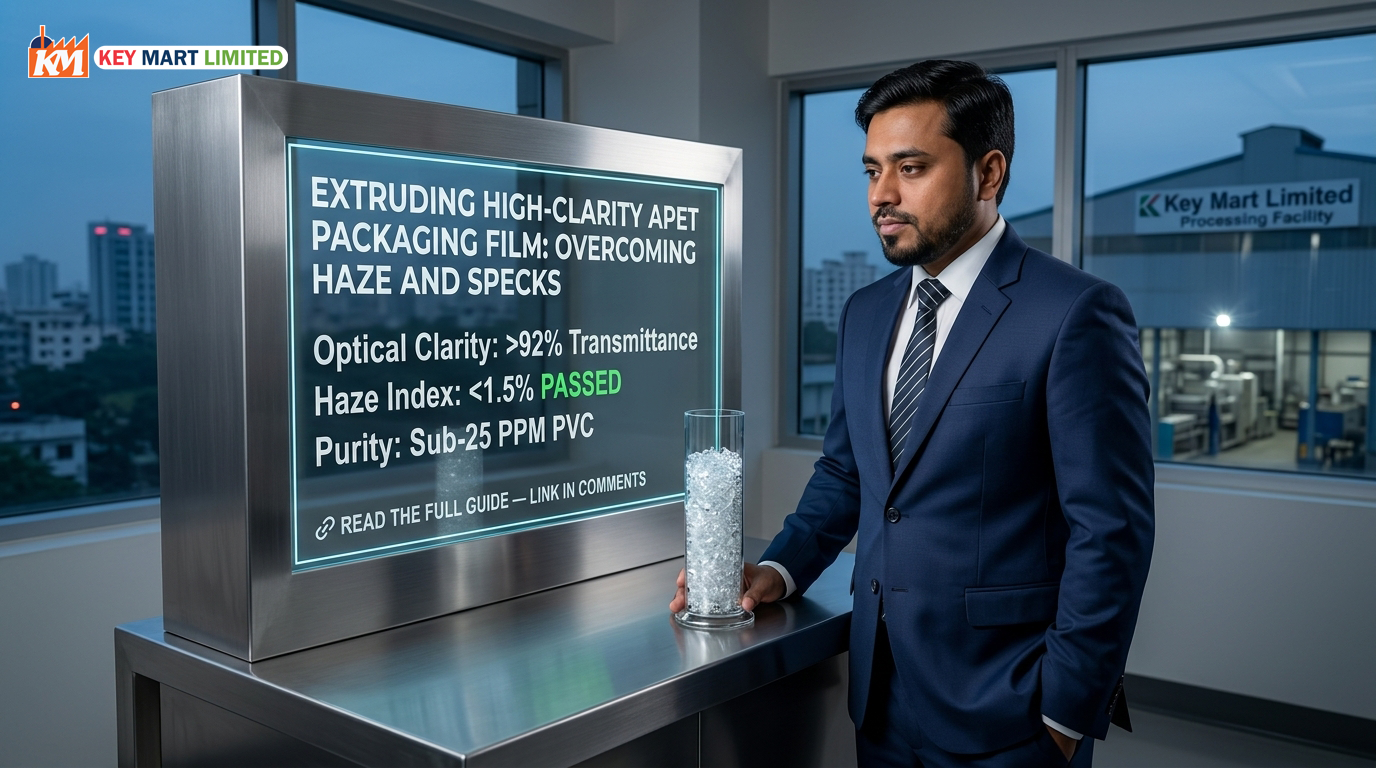
| PVC Contamination | $< 150\text{–}300\text{ PPM}$ | < 25 – 50 PPM (Target < 25 PPM) |
Eliminates carbon black specks & die lines |
| Polyolefin (PE/PP) | $< 200\text{ PPM}$ | < 25 PPM |
Eliminates refractive haze & light scattering |
| Optical L-Value (Clarity)* | $60\text{–}68$ (Variable) | ≥ 72 – 75 (High Brightness) |
Maximizes shelf visibility & glass-like gloss |
| Optical b-Value (Yellowness)* | $+2.5\text{ to }+4.5$ | ≤ +1.0 to +1.5 (Low Yellowness) |
Prevents yellow tinting in multi-layer thermoforming |
| Residual Moisture | $> 1.0\%$ | < 0.5% (Pre-Dryer Target) |
Prevents hydrolytic IV scission & bubble formation |
| Residual Glue & Organics | Variable | Zero (Continuous Hot-Caustic Washed) |
Prevents cross-linked gel fisheyes & die drool |
2. Best Practices for Extruding Flawless APET Sheet from rPET
Achieving crystal clarity on high-speed flat-die or co-extrusion (A/B/A) sheet lines requires strict upstream quality control and optimized extrusion setups:
-
Automated NIR Optical Sorting: Multi-stage Near-Infrared spectroscopy combined with RGB optical sorting ensures the elimination of off-color flakes and drops PVC content below $25\text{–}50\text{ PPM}$.
-
Intensive Hot-Caustic Washing ($85^\circ\text{C}-95^\circ\text{C}$): Complete removal of water-soluble and hot-melt bottle adhesives eliminates gel-forming contaminants that create surface blemishes.
-
Fine Melt Filtration: Employing continuous backflushing screen changers with mesh ratings of $40\text{–}75\,\mu\text{m}$ captures trace particulate matter before the melt enters the T-die.
-
Moisture Control & De-Dusting: Using de-dusted flakes ($< 0.3\%$ fines) dried to $< 50\text{ PPM}$ moisture prevents hydrolytic chain degradation, stabilizing melt pressure and eliminating surface air streaks.
3. How Key Mart Limited Meets Global Buyer Demand for APET-Grade Feedstock
Producing feedstock suitable for food clamshells and high-clarity thermoforming requires an established, export-oriented bangladesh pet flakes manufacturer with advanced washing and sorting technology.
As a premier pet flakes company bangladesh and trusted pet flakes exporter, Key Mart Limited supplies premium rPET flakes engineered specifically for APET film extrusion:
-
Source-Segregated Clear Bottle Processing: Operating as a leading pet flakes manufacturer dhaka, Key Mart Limited selectively sources 100% post-consumer clear beverage bottles, minimizing colored and non-food contaminants before washing begins.
-
Continuous Hot-Caustic Washing & Optical Sorting: As an established bangladesh pet flakes manufacturer, our facility utilizes multi-stage hot caustic baths, friction de-labeling, and automated NIR optical sorting to guarantee $\text{PVC} < 25\text{–}50\text{ PPM}$, polyolefins $< 25\text{ PPM}$, and zero residual glues.
-
Lab-Verified Optical & Physical Consistency: Serving as an experienced pet flakes exporter, Key Mart Limited verifies every production batch in our Dhaka laboratory for moisture ($< 0.5\%$), uniform $8\text{–}12\text{ mm}$ flake sizing, and high $L^*$-value whiteness, backed by Certificates of Analysis (CoA) and GRS 4.0 Transaction Certificates (TC).
-
Maximized 25–26 MT Container Logistics: We pack 25–26 Metric Tons into every 40ft High Cube container with heavy-duty 100-micron PE moisture-barrier inner liners to preserve feedstock dryness during transit under FOB Chittagong, CFR, or CIF shipping terms.
Partner with Key Mart Limited Today
Eliminate optical haze, remove black specks, and secure high-clarity rPET flakes from Bangladesh for your APET sheet lines. Contact our Dhaka export management team today to request Technical Data Sheets, order commercial trial samples, or reserve container allocation schedules.
-
Company Name: Key Mart Limited
-
Head Office & Factory Address: Plot #31, Road #N-1, Block #K, Eastern Housing, Pallabi 2nd Phase, Rupnagar, Dhaka-1216, Bangladesh.
-
Official Website: www.keymartbd.com
-
Corporate Email: keymartltd@gmail.com | info@keymartbd.com
-
Direct Phone / WhatsApp: +8801760774499, +8801864935478
Join our community today and stay connected with the future of PET recycling.
 Visit our YouTube channel: Key Mart Limited on YouTube
Visit our Facebook Page: Key Mart Limited on Facebook
Subscribe to see our latest factory tours, production updates, and export success stories.