Views: 3
If you run a thermoforming line, spin polyester yarn, or produce bottle-to-bottle preforms, you know that raw recycled feedstock can make or break your product quality. Post-consumer beverage bottles arrive coated with more than just label glue and dust—they are covered in dried soda sugars, sticky dairy residues, starch paste, and stubborn bacterial films.
When standard soaking or low-intensity rinse tanks fail to scour these organic layers away, the consequences show up right in your extruder: foul odors, sudden yellow shifts, foaming in the degassing ports, and carbonized black specks in your finished parts.
Getting rid of microscopic organic contamination requires serious mechanical energy.
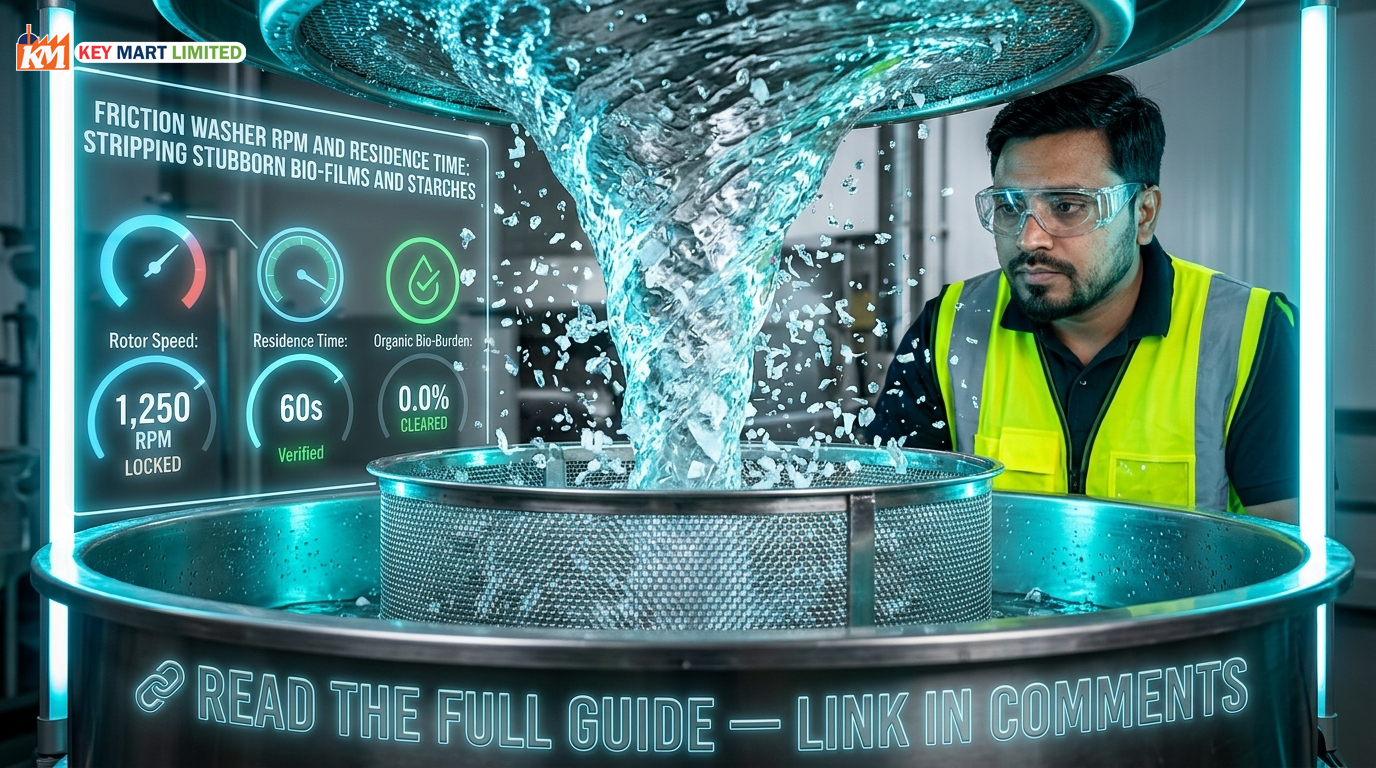
That is where dialing in the right balance of rotor RPM and retention time in a high-speed friction washer PET flakes setup makes all the difference.
By optimizing rotor shear velocity ($1,000\text{–}1,400\text{ RPM}$) with calibrated residence times ($45\text{–}90\text{ seconds}$), modern washing lines scour bottle flakes clean through intense flake-on-flake mechanical friction, lifting biological deposits without damaging the base polymer.
1. The Physics of High-Intensity Friction Washing
Unlike passive float-sink tanks that rely on buoyancy, dynamic friction washers use intense kinetic energy to shear away surface contaminants:
Flake Intake ➔ High-Velocity Rotor Acceleration (1,000–1,400 RPM) ➔ Flake-on-Flake Dynamic Scouring ➔ Rapid Biofilm & Starch Emulsification ➔ High-Centrifugal Separation via Screen Basket ➔ Clean, Organic-Free Polymer Stream
A. Rotor RPM and Mechanical Shear Energy
Inside a horizontal or inclined friction washer, a multi-paddle rotor spins at high velocity inside a cylindrical perforated screen basket:
-
Flake-on-Flake Friction: Centrifugal acceleration forces wet pet flakes against each other and against the internal screen surface at speeds up to $25\text{ m/s}$.
-
Scouring Biofilms: This constant, turbulent abrasion grinds away tough protein films and dried syrups that chemical soaking alone cannot dissolve.
-
Continuous Dewatering: The high centrifugal force drives wash water, loosened starch, and dissolved organic debris outward through screen apertures ($2.0\text{–}3.0\text{ mm}$), preventing dirty wash water from re-contaminating the polymer.
B. Dialing in Residence Time
If flakes move through the unit too quickly ($<30\text{ seconds}$), stubborn starch residues stay locked in the surface micro-crevices. If they stay in too long ($>120\text{ seconds}$), excessive frictional heat can raise temperatures past $75^\circ\text{C}$, softening the material and causing unwashed fines to break apart.
-
Calibrated Paddle Pitch: Angling rotor paddles between $15^\circ\text{ and }25^\circ$ maintains a controlled retention window of $45\text{ to }90\text{ seconds}$, balancing thorough surface scrubbing with continuous, clog-free throughput.
Read More: A Step-by-Step Guide to Importing PET Flakes from Bangladesh via Chittagong Port
Organic Contamination & Friction Washing Benchmark
| Cleaning Metric | Low-Shear Soaking / Basic Wash Tank | Standard Friction Unit (<800 RPM) | High-Intensity Friction Line (Key Mart Standard) |
| Rotor Speed (RPM) | $0\text{ RPM}$ (Static Wash) | $600\text{–}800\text{ RPM}$ | 1,000 – 1,400 RPM (High-Shear Scrubbing) |
| Residence Time Window | $5\text{–}10\text{ Minutes}$ | $20\text{–}30\text{ Seconds}$ | 45 – 90 Seconds (Optimized Scour) |
| Residual Sugar & Protein Starch | $> 250\text{ PPM}$ (High Organic Load) | $50\text{–}100\text{ PPM}$ | < 10 PPM (Complete Bio-Removal) |
| Extruder Odor & Volatile Gassing | Strong burning syrup smell | Noticeable off-gassing | Zero Odor / Neutral Extrusion |
| Optical Clarity ($L^*$ Coordinate) | $68.0\text{–}72.0$ (Dull Haze) | $74.0\text{–}78.0$ | 84.0 – 86.5+ (Sparkling Clear) |
| PVC Contamination | $> 150\text{–}300\text{ PPM}$ | $50\text{–}100\text{ PPM}$ | < 25 – 50 PPM (Continuous Hot-Caustic) |
| Micro-Dust & Fines ($<500\,\mu\text{m}$) | $> 3.5\%$ (Unseparated) | $1.5\text{–}2.0\%$ | < 0.3% (Multi-Stage Air Elutriated) |
| Supply Traceability & Audit | Unverified | Self-Declared | GRS 4.0 Transaction Certified (TC) |
2. Preventing Extruder Foaming and Yellow Discoloration
Removing starch, sugar, and bacterial slime upstream protects your downstream processing machinery:
-
Eliminating Vacuum Port Foaming: Organic starches and sugars retain surface moisture. When fed into an extruder, they flash-boil under vacuum degassing, creating heavy foaming that clogs vacuum pump filters and causes melt surges.
-
Preventing Caramelization and Charring: Beverage syrups and food sugars start pyrolyzing at around $160^\circ\text{C}\text{–}180^\circ\text{C}$. Inside a standard $280^\circ\text{C}$ PET extruder barrel, these sugars char into black specks and cause severe yellowing ($b^* > +2.5$).
-
Protecting Pre-Dryer Air Circuits: Clean, residue-free flakes dry efficiently in desiccant or infrared systems without generating sticky aerosol deposits that glaze desiccant beads and reduce drying efficiency.
3. How Key Mart Limited Supplies Thoroughly Scoured, Residue-Free rPET Flakes
Securing consistently clean, organic-free raw material requires partnering with an established bangladesh pet flakes manufacturer that invests in multi-stage dynamic washing and water management.
As a premier pet flakes company bangladesh and trusted pet flakes exporter, Key Mart Limited delivers thoroughly decontaminated, high-clarity rPET flakes tailored for high-end converting lines:
-
Source-Segregated Sourcing in Dhaka: Operating as a leading pet flakes manufacturer dhaka, Key Mart Limited selectively processes 100% post-consumer clear beverage bottles, rejecting contaminated post-industrial waste, chemical packaging, and heavily soiled municipal scrap at the intake gate.
-
High-Speed Friction Washing & Caustic Saponification: As an established bangladesh pet flakes manufacturer, our facility subjects flakes to continuous hot-caustic washing ($85^\circ\text{C}-95^\circ\text{C}$) followed by dynamic high-speed friction washers ($1,200\text{ RPM}$), completely stripping sugars, milk proteins, and label glues to guarantee $\text{PVC} < 25\text{–}50\text{ PPM}$ and moisture dried below 0.5%.
-
Sub-0.3% Fines Removal via Air Elutriation: Serving as an experienced pet flakes exporter, Key Mart Limited passes every batch through multi-stage zig-zag air classifiers, keeping dust and fines strictly below $0.3\%$ to eliminate feed throat bridging and melt instability.
-
Consistent IV and Batch-Specific Lab Testing: Every export batch is tested in our Dhaka quality control laboratory for stable Intrinsic Viscosity ($0.78\text{–}0.82\text{ dL/g}$), high luminance ($L^* \ge 84.0$), and low yellow shift ($b^* \le +1.2$), backed by batch-specific Certificates of Analysis (CoA) and Global Recycled Standard (GRS 4.0) Transaction Certificates (TC).
-
Maximized 25–26 MT Container Logistics: We pack 25–26 Metric Tons into every 40ft High Cube container with heavy-duty 100-micron PE inner liners to preserve feedstock dryness during transit under FOB Chittagong, CFR, or CIF shipping terms.
Partner with Key Mart Limited Today
Eliminate extruder foaming, prevent yellowing defects, and secure sparkling clean, high-purity rPET flakes from Bangladesh. Contact our Dhaka export management team today to request Technical Data Sheets, order commercial testing samples, or reserve monthly container allocations.
-
Company Name: Key Mart Limited
-
Head Office & Factory Address: Plot #31, Road #N-1, Block #K, Eastern Housing, Pallabi 2nd Phase, Rupnagar, Dhaka-1216, Bangladesh.
-
Official Website: www.keymartbd.com
-
Corporate Email: keymartltd@gmail.com | info@keymartbd.com
-
Direct Phone / WhatsApp: +8801760774499, +8801864935478
Join our community today and stay connected with the future of PET recycling.
 Visit our YouTube channel: Key Mart Limited on YouTube
Visit our Facebook Page: Key Mart Limited on Facebook
Subscribe to see our latest factory tours, production updates, and export success stories.