Views: 6
If you run high-precision sheet extrusion dies, fine-denier fiber spinnerets, or bottle preform molds, you know that trace metal contamination is an absolute line killer. While standard rare-earth overhead magnets catch stray iron wires and steel shavings with ease, non-ferrous contaminants slip right past magnetic fields.
In post-consumer bottle streams, the biggest culprit is aluminum: broken pilfer-proof cap rings, neck foils, and heat-seal liners.
When shredded aluminum fragments enter an extruder, the damage is immediate and costly.
Aluminum doesn’t melt at PET processing temperatures ($270^\circ\text{C}\text{–}290^\circ\text{C}$).
Instead, solid metal flakes bridge melt channels, puncture fine filter mesh, score extrusion die lips—leaving permanent drag lines across clear sheet—and cause catastrophic spinneret blowouts.
Eliminating non-ferrous scrap requires a dedicated aluminum separation PET recycling line powered by high-frequency Eddy Current Separators (ECS).
By harnessing the physics of repulsive electromagnetic fields, high-speed eccentric rotor systems launch non-ferrous conductive metals out of the clean polymer stream, ensuring zero metallic inclusions in your melt.
1. How Eddy Current Separation Works: Physics and Mechanics
Eddy current separation relies on electromagnetic induction to physically split conductive metals from non-conductive plastics:
Flake Stream ➔ Vibratory Feeding Chute ➔ High-Speed Magnetic Rotor (3,000+ RPM) ➔ Induced Eddy Currents ➔ Repulsive Lorentz Force Ejection ➔ Splitter Blade Separation ➔ 100% Metal-Free PET Stream
A. The Induction Mechanism (Lorentz Repulsion)
-
High-Speed Magnetic Rotor: Inside the shell of an ECS belt conveyor, an internal rotor lined with alternating neodymium-iron-boron ($\text{NdFeB}$) permanent magnets spins at $3,000\text{ to }3,800\text{ RPM}$.
-
Induced Eddy Currents: As crushed pet flakes pass over the drum, the rapidly alternating magnetic field induces closed electrical loops (eddy currents) within conductive aluminum particles:
$$\vec{F} = q(\vec{E} + \vec{v} \times \vec{B})\quad \text{(Repulsive Lorentz Force)}$$ -
Trajectory Divergence: These internal currents generate an opposing magnetic field. The resulting repulsive force throws the aluminum fragments forward over an adjustable splitter plate, while inert, non-conductive PET flakes drop straight down via gravity.
B. Concentric vs. Eccentric Rotor Configurations
For fine particles like shredded cap rings ($1.0\text{–}6.0\text{ mm}$), eccentric rotor designs are critical.
By mounting the magnetic rotor off-center within the outer belt shell, the peak magnetic force concentrates exclusively at the separation point. This prevents stray metal from getting pulled under the belt and damaging the conveyor assembly.
Read More: A Step-by-Step Guide to Importing PET Flakes from Bangladesh via Chittagong Port
Non-Ferrous Metal Removal Benchmark Table
| Performance Parameter | Unscreened Scrap Flakes | Standard Overhead Magnet Only | High-Frequency ECS Line (Key Mart Standard) |
| Aluminum Cap Ring Residue | $> 150\text{–}350\text{ PPM}$ | $> 120\text{–}250\text{ PPM}$ (Missed) | < 2.0 – 5.0 PPM (Complete Elimination) |
| Die Lip Scoring & Streaking | High Risk (Frequent repairs) | High Risk | Zero Abrasive Metal Scoring |
| Melt Filter Screen Life | Blinds / Tears rapidly | Frequent screen blowouts | Stable Delta P / Long Run Times |
| Particle Size Detection Range | Unmonitored | Ferrous only ($> 5\text{ mm}$) | 0.5 mm – 12.0 mm (Fine Aluminum Ejection) |
| Dust & Fines ($<500\,\mu\text{m}$) | $> 3.5\%$ (Uncontrolled) | $1.5\text{–}2.0\%$ | < 0.3% (Multi-Stage Air Elutriated) |
| PVC Contamination | $> 150\text{–}300\text{ PPM}$ | $50\text{–}100\text{ PPM}$ | < 25 – 50 PPM (Continuous Hot-Caustic) |
| Intrinsic Viscosity (IV) Baseline | $0.65\text{–}0.70\text{ dL/g}$ | $0.72\text{–}0.75\text{ dL/g}$ | 0.78 – 0.82 dL/g (Stable Pure Baseline) |
| Supply Traceability & Audit | Unverified | Self-Declared | GRS 4.0 Transaction Certified (TC) |
2. Protecting Extrusion Dies, Melt Pumps, and Downstream Tooling
Integrating multi-stage non-ferrous extraction directly safeguards downstream conversion machinery:
-
Eliminating Sheet Die Lip Lines: Even a sub-millimeter aluminum flake caught on a flat sheet die lip creates continuous longitudinal drag lines across extruded APET web rolls, turning optical-grade rolls into scrap.
-
Preventing Melt Pump Seizures: Unmelted metal particles wedging into precision gear pump teeth cause instantaneous motor torque overloads and severe mechanical galling.
-
Extending Screen Pack Cycles: Removing conductive foil and cap fragments upstream keeps melt pressure drops ($\Delta P$) stable, preventing screen blowouts and costly unplanned shutdowns.
3. How Key Mart Limited Supplies Metal-Free rPET Feedstock
Delivering feedstock pure enough for high-precision extrusion requires partnering with an established bangladesh pet flakes manufacturer that invests in multi-stage magnetic and inductive separation.
As a premier pet flakes company bangladesh and trusted pet flakes exporter, Key Mart Limited delivers magnetically screened, hot-washed rPET flakes designed for sensitive extrusion dies:
-
Source-Segregated Sourcing in Dhaka: Operating as a leading pet flakes manufacturer dhaka, Key Mart Limited selectively processes 100% post-consumer clear beverage containers, pre-sorting raw bales to eliminate heavy metallic and industrial packaging at the intake stage.
-
Multi-Stage Magnetic & Eddy-Current Sorting: As an established bangladesh pet flakes manufacturer, our facility passes all granulated material across 12,000-Gauss rare-earth neodymium magnets and high-speed eccentric eddy current separators, stripping all ferrous and non-ferrous aluminum down to trace levels.
-
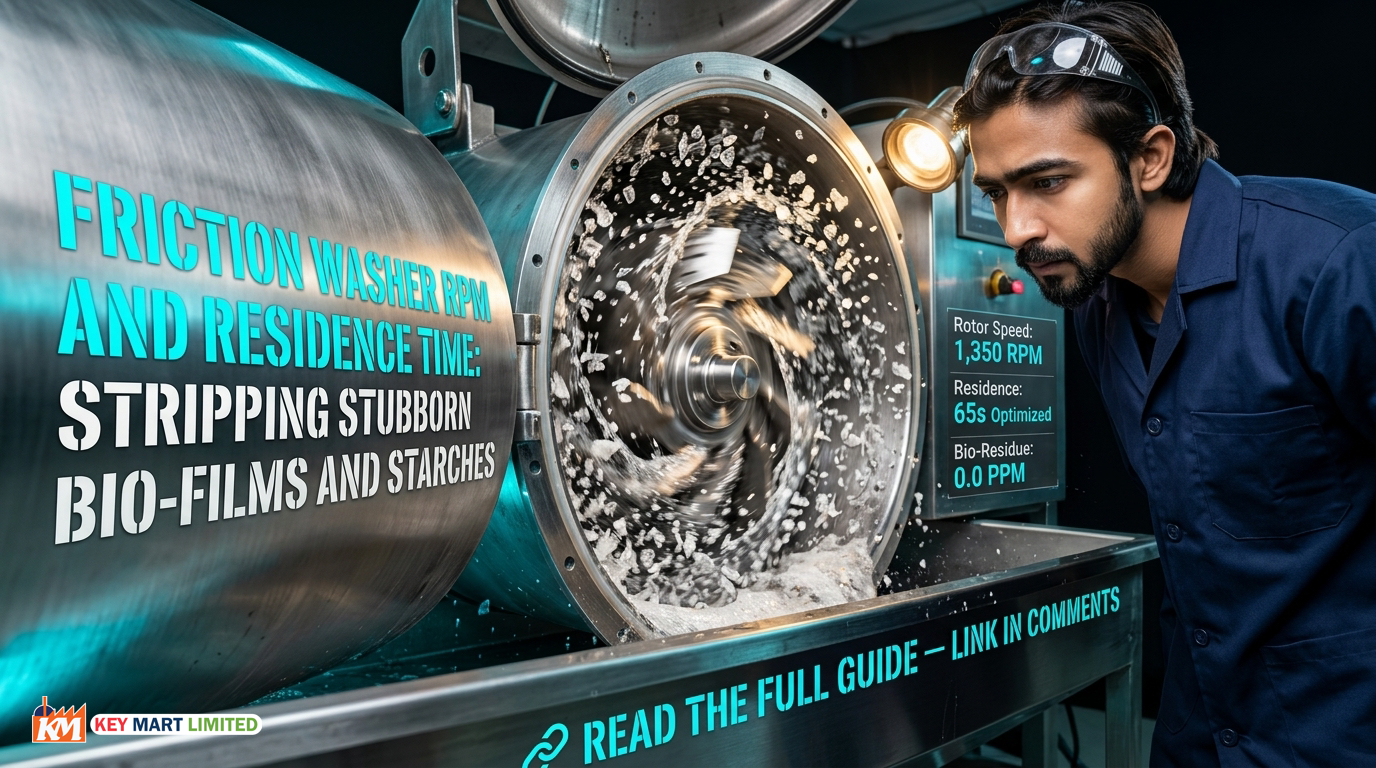
Continuous Hot-Caustic Washing ($85^\circ\text{C}-95^\circ\text{C}$): Flakes undergo intensive friction washing to eliminate adhesives, label paper, and organic starches, guaranteeing $\text{PVC} < 25\text{–}50\text{ PPM}$ and moisture dried below 0.5%.
-
Sub-0.3% Fines Removal via Air Elutriation: Serving as an experienced pet flakes exporter, Key Mart Limited removes micro-dust using multi-stage zig-zag classifiers, preventing feed throat bridging and carbonization.
-
Laboratory Verified Quality & Traceability: Every export batch is tested in our Dhaka quality control laboratory for stable Intrinsic Viscosity ($0.78\text{–}0.82\text{ dL/g}$) and high luminance ($L^* \ge 74.0, b^* \le +1.2$), backed by batch-specific Certificates of Analysis (CoA) and Global Recycled Standard (GRS 4.0) Transaction Certificates (TC).
-
Maximized 25–26 MT Container Logistics: We pack 25–26 Metric Tons into every 40ft High Cube container with heavy-duty 100-micron PE inner liners to preserve feedstock dryness during transit under FOB Chittagong, CFR, or CIF shipping terms.
Partner with Key Mart Limited Today
Protect your extrusion dies, eliminate sheet line defects, and secure metal-free, high-purity rPET flakes from Bangladesh. Contact our Dhaka export management team today to request Technical Data Sheets, order commercial testing samples, or reserve monthly container allocations.
-
Company Name: Key Mart Limited
-
Head Office & Factory Address: Plot #31, Road #N-1, Block #K, Eastern Housing, Pallabi 2nd Phase, Rupnagar, Dhaka-1216, Bangladesh.
-
Official Website: www.keymartbd.com
-
Corporate Email: keymartltd@gmail.com | info@keymartbd.com
-
Direct Phone / WhatsApp: +8801760774499, +8801864935478
Join our community today and stay connected with the future of PET recycling.
 Visit our YouTube channel: Key Mart Limited on YouTube
Visit our Facebook Page: Key Mart Limited on Facebook
Subscribe to see our latest factory tours, production updates, and export success stories.