Views: 6
In high-throughput mechanical recycling facilities, the granulator rotor and stator blade assembly represents the mechanical core of product quality. When processing post-consumer recycled Polyethylene Terephthalate (pet flakes), granulator cutting dynamics directly govern particle geometry, bulk density, and fines generation.
Substandard cutting edges tear and crush polymer walls rather than slicing them cleanly.
Dull knives increase mechanical friction, generate heat, and induce tearing that produces unmanageable levels of micro-dust ($< 500\,\mu\text{m}$) and irregular “feathered” edges.
Achieving uniform particle distribution and minimizing fines generation requires selecting knife metallurgy based on PET granulator blade wear resistance.
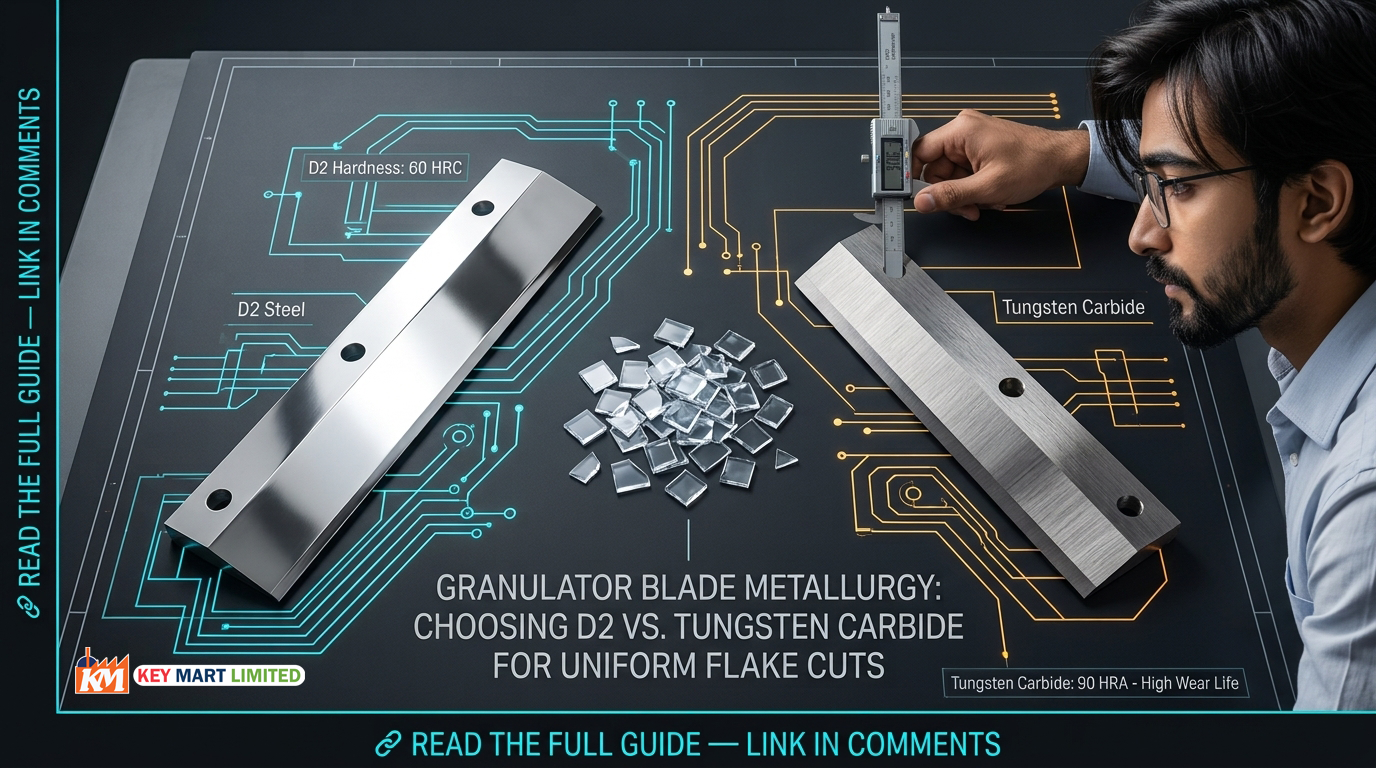
Choosing between AISI D2 High-Carbon High-Chromium Cold Work Tool Steel and Tungsten Carbide (WC-Co) Tipped Inserts dictates knife service life, knife-gap maintenance, and downstream extrusion stability.
This engineering guide compares D2 tool steel and Tungsten Carbide metallurgy, details precision knife-gap maintenance, and illustrates how Key Mart Limited applies precision cutting controls to supply uniform, low-dust rPET feedstock globally.
1. Metallurgical Comparison: AISI D2 Tool Steel vs. Tungsten Carbide (WC)
Selecting blade metallurgy requires balancing abrasive wear resistance against impact fracture toughness:
De-Baled Clear PET Feedstock ➔ High-Shear Rotary Grinding ➔ Sharp Scissor Cutting (D2 / Tungsten Carbide) ➔ Calibrated Screen Discharge (8–12 mm) ➔ Sub-0.3% Dust Generation
A. AISI D2 Tool Steel (High Carbon, High Chromium)
-
Chemical Composition: $1.5\%\text{ C}$, $12.0\%\text{ Cr}$, $0.9\%\text{ Mo}$, $0.8\%\text{ V}$.
-
Hardness Profile: Heat-treated to $58\text{–}62\text{ HRC}$.
-
Performance Profile: High impact toughness that resists catastrophic chipping if tramp metal or hard contaminants pass through. However, abrasive wear from residual silica grit dulls D2 edges faster, requiring resharpening every $100\text{ to }160\text{ operating hours}$.
B. Tungsten Carbide (WC-Co Insert Inlays)
-
Structure: Sub-micron tungsten carbide grains sintered within a $10\%\text{–}15\%$ cobalt binder matrix brazed onto alloy steel knife bodies.
-
Hardness Profile: Extreme hardness of $88\text{–}92\text{ HRA}$ ($\approx 70\text{–}75\text{ HRC}$).
-
Performance Profile: Delivers $8\times\text{ to }12\times$ the wear life of standard D2 steel, maintaining razor-sharp scissor cutting edges for over $1,000\text{–}1,500\text{ operating hours}$. Because carbide is brittle, it requires upstream magnetic and trommel pre-screening to eliminate heavy tramp metals.
Read More: A Step-by-Step Guide to Importing PET Flakes from Bangladesh via Chittagong Port
Granulator Blade Metallurgy & Performance Matrix
| Performance Parameter | Standard Low-Alloy Tool Steel | AISI D2 Cold Work Steel | Tungsten Carbide (WC-Co Tipped) (Key Mart Standard) |
| Surface Hardness | $52\text{–}55\text{ HRC}$ | $58\text{–}62\text{ HRC}$ | 88 – 92 HRA (Ultra-High Wear) |
| Blade Resharpening Interval | Every $40\text{–}60\text{ Hours}$ | Every $120\text{–}160\text{ Hours}$ | Every 1,000 – 1,500 Hours |
| Micro-Fines Generation ($<500\,\mu\text{m}$) | $> 3.5\text{–}5.0\%$ (Torn Flakes) | $1.5\text{–}2.5\%$ | < 0.3% (Clean Scissor Cut) |
| Knife Gap Tolerance Retention | Widens rapidly ($> 1.0\text{ mm}$) | Widens moderately ($0.5\text{ mm}$) | Holds 0.25 – 0.35 mm Tight Tolerance |
| Particle Size Uniformity ($8\text{–}12\text{ mm}$) | Poor ($< 70\%$ On-Spec) | Moderate ($82\%\text{ On-Spec}$) | > 94% – 98% Uniform Geometric Cuts |
| Impact Fracture Resistance | High (Ductile) | High (Good Toughness) | Requires upstream metal separation |
| PVC Contamination | $> 150\text{–}300\text{ PPM}$ | $50\text{–}100\text{ PPM}$ | < 25 – 50 PPM (Continuous Hot-Caustic) |
| Chain-of-Custody Certification | Unverified | Self-Declared | GRS 4.0 Transaction Certified (TC) |
2. The Physics of Knife-Gap Calibration and Dust Prevention
Micro-fines ($< 500\,\mu\text{m}$) are not simply undersized flakes—they act as thermal degradation points and cause severe dust loss during pneumatic handling:
Dull Blade Radius (>0.1 mm) ➔ Polymer Pinching & Tearing ➔ Frictional Heating (>80°C) ➔ High Fines Generation (>3%)
Razor-Sharp Blade Radius (<0.02 mm) ➔ Scissor Cutting Action ➔ Low-Heat Shear ➔ Clean Flake Edges (<0.3% Fines)
-
Tight Knife-Gap Tolerances ($0.25\text{–}0.35\text{ mm}$): Maintaining an exact gap between rotating and stationary bed knives ensures clean shearing. When gaps expand beyond $0.6\text{ mm}$, PET stretches and tears instead of cutting cleanly.
-
Double-Angle Shear Geometries: Utilizing helical rotor knife geometry creates a continuous true scissor-cut action along the rotor length, reducing peak torque loads, lowering operating temperatures, and eliminating flake edge curling.
-
Calibrated Sizing Screens ($9\text{–}12\text{ mm}$): Precision-machined, anti-clogging discharge screens prevent over-grinding, clearing cleanly sliced flakes immediately from the cutting chamber.
3. How Key Mart Limited Supplies Geometrically Uniform, Low-Dust rPET Flakes
Consistently delivering uniform flake sizes requires an established bangladesh pet flakes manufacturer with institutional cutting tool maintenance and classification infrastructure.
As a premier pet flakes company bangladesh and trusted pet flakes exporter, Key Mart Limited delivers low-dust, precision-granulated rPET flakes to international convertors:
-
Tungsten Carbide & D2 Cutting Technology in Dhaka: Operating as a leading pet flakes manufacturer dhaka, Key Mart Limited maintains strict granulator blade calibration, utilizing high-wear tooling to ensure clean scissor cuts and prevent edge fraying.
-
Continuous Multi-Stage Caustic Washing: As an established bangladesh pet flakes manufacturer, our facility subjects flakes to continuous hot-caustic friction washing ($85^\circ\text{C}-95^\circ\text{C}$) and automated NIR optical sorting, guaranteeing $\text{PVC} < 25\text{–}50\text{ PPM}$, zero glue residue, and moisture dried below 0.5%.
-
Sub-0.3% Fines Removal via Air Elutriation: Serving as an experienced pet flakes exporter, Key Mart Limited passes all granulated material through multi-stage zig-zag air classifiers, keeping dust and fines strictly below $0.3\%$ to eliminate feed throat bridging and vacuum port fouling in downstream extrusion.
-
Tight Particle Distribution & Laboratory Verification: Every export lot is verified in our Dhaka quality control laboratory for uniform flake sizing ($8\text{–}12\text{ mm}$), stable Intrinsic Viscosity ($0.78\text{–}0.82\text{ dL/g}$), and high lightness ($L^* \ge 74$), backed by batch-specific Certificates of Analysis (CoA) and Global Recycled Standard (GRS 4.0) Transaction Certificates (TC).
-
Maximized 25–26 MT Container Logistics: We pack 25–26 Metric Tons into every 40ft High Cube container with heavy-duty 100-micron PE inner liners to preserve feedstock dryness during transit under FOB Chittagong, CFR, or CIF shipping terms.
Partner with Key Mart Limited Today
Eliminate extrusion feed throat bridging, minimize fines losses, and secure precision-cut, high-purity rPET flakes from Bangladesh. Contact our Dhaka export management team today to request Technical Data Sheets, order commercial testing samples, or reserve monthly container allocations.
-
Company Name: Key Mart Limited
-
Head Office & Factory Address: Plot #31, Road #N-1, Block #K, Eastern Housing, Pallabi 2nd Phase, Rupnagar, Dhaka-1216, Bangladesh.
-
Official Website: www.keymartbd.com
-
Corporate Email: keymartltd@gmail.com | info@keymartbd.com
-
Direct Phone / WhatsApp: +8801760774499, +8801864935478
Join our community today and stay connected with the future of PET recycling.
 Visit our YouTube channel: Key Mart Limited on YouTube
Visit our Facebook Page: Key Mart Limited on Facebook
Subscribe to see our latest factory tours, production updates, and export success stories.