Views: 3
When you are manufacturing optical thermoforming sheets, fine-denier textile fibers, or food-grade packaging from post-consumer recycled Polyethylene Terephthalate (pet flakes), unseen cross-polymer contamination is your worst enemy. A batch of flakes might look clean and transparent to the naked eye, but if it carries trace amounts of chemically incompatible polymers, your extrusion process will run into serious problems.
Mismatched melting points, incompatible degradation temperatures, and chemical immiscibility trigger rapid processing failures.
Even a trace amount of Polyvinyl Chloride (PVC) releases acidic hydrochloric gas ($HCl$), degrading your extruder screws and turning clear sheets yellow. Polyolefins (PP/PE) create cloudy haze and catastrophic un-melted gels, while Polylactic Acid (PLA) and Polycarbonate (PC) cause severe molecular weight loss through transesterification.
Visual inspection and float-sink tanks alone cannot catch transparent lookalikes.
Verifying true polymer purity requires FTIR analysis rPET flake purity protocols to scan the molecular backbone of every incoming batch.
By measuring the exact infrared absorption bands of the material, Fourier-Transform Infrared (FTIR) spectroscopy gives you clear proof of zero cross-polymer contamination before the resin ever hits your extruder throat.
Read More: A Step-by-Step Guide to Importing PET Flakes from Bangladesh via Chittagong Port
1. How FTIR Spectroscopy Detects Cross-Polymer Contamination
FTIR spectroscopy works by exposing a polymer sample to infrared radiation. The chemical bonds within the polymer absorb specific frequencies of light, vibrating at resonant frequencies and producing a unique molecular “fingerprint”:
Flake Sample Selection ➔ ATR-FTIR Crystal Contact ➔ Infrared Beam Transmittance (4000–400 cm⁻¹) ➔ Interferogram Transformation ➔ Characteristic Absorbance Peaks ➔ Polymer Purity Confirmation
A. The Baseline PET Fingerprint
Pure post-consumer PET displays distinct, predictable absorption bands:
-
Ester Carbonyl Peak ($C=O$): Strong, sharp stretch at $1715\text{–}1725\text{ cm}^{-1}$.
-
Ester Ether Linkage ($C-O-C$): Asymmetric and symmetric stretching at $1240\text{ cm}^{-1}$ and $1100\text{ cm}^{-1}$.
-
Aromatic Ring Vibrations ($C=C$): Characteristic ring stretching at $1410\text{ cm}^{-1}$ and $1505\text{ cm}^{-1}$.
B. Spotting Rogue Contaminants via Spectral Peaks
When foreign polymers are present, they trigger unmistakable spectral anomalies:
-
Polyvinyl Chloride (PVC): The carbon-chlorine ($C-Cl$) stretch creates an immediate signature at $600\text{–}690\text{ cm}^{-1}$. Catching this prevents corrosive degradation and yellowing ($b^*$ index drift).
-
Polypropylene & Polyethylene (PP/PE): Aliphatic carbon-hydrogen ($C-H$) stretching produces sharp doublets at $2915\text{ cm}^{-1}$ and $2850\text{ cm}^{-1}$, alerting operators to potential melt gel defects.
-
Polylactic Acid (PLA): The aliphatic carbonyl stretch shifts distinctly to $1750\text{ cm}^{-1}$, separating bio-plastics from genuine rPET.
-
Polycarbonate (PC): Displays a carbonate linkage ($O-C(=O)-O$) peak at $1775\text{ cm}^{-1}$ and bisphenol-A methyl bands at $2965\text{ cm}^{-1}$.
Cross-Polymer Risk & FTIR Detection Thresholds
| Contaminant Polymer | Typical Origin | Processing Consequence in rPET Extrusion | FTIR Detection Peak (cm−1) | Key Mart Rejection Limit |
| Polyvinyl Chloride (PVC) | Blister packs, bottle sleeves | $HCl$ gas release, screw corrosion, black char | $600\text{–}690\text{ cm}^{-1}$ ($C-Cl$) | < 25 – 50 PPM |
| Polypropylene (PP) | Bottle caps, closures | Unmelted gels, optical haze, poor clarity | $2915 / 2850\text{ cm}^{-1}$ ($C-H$) | < 50 PPM |
| Polyethylene (HDPE/LDPE) | Rings, tamper-evident bands | Matrix delamination, fiber spinning breaks | $2920 / 2850\text{ cm}^{-1}$ ($C-H$) | < 50 PPM |
| Polylactic Acid (PLA) | Bio-bottles, thermoformed cups | Hydrolytic chain scission, severe IV drop | $1750\text{ cm}^{-1}$ (Carbonyl) | 0.0% Detected |
| Polycarbonate (PC) | Multi-trip water bottles | Gel formation, transesterification cross-linking | $1775\text{ cm}^{-1}$ (Carbonate) | 0.0% Detected |
| Dust & Fines ($<500\,\mu\text{m}$) | Granulator knife wear | Melt pressure surging, vacuum port clogging | N/A (Sieve analysis) | < 0.3% |
2. Preventing Line Failures and Extruder Screw Wear
Using FTIR-verified feedstock protects converting equipment and keeps processing lines stable:
-
Protecting Screws and Barrels from Acid Corrosion: When PVC slips past inspection, it pyrolyzes at $200^\circ\text{C}\text{–}240^\circ\text{C}$, releasing corrosive hydrochloric acid inside the extruder barrel. Keeping PVC strictly below $25\text{–}50\text{ PPM}$ prevents pitting and extends screw barrel service life.
-
Eliminating Haze in Optical APET Sheet: Even $0.1\%$ polyolefin contamination creates millions of microscopic phase-separated domains in the melt, turning high-clarity sheets hazy and unmarketable.
-
Preventing Filament Snapping in Fine-Denier Fiber Spinning: Unmelted foreign plastics lodge inside fine spinneret capillary orifices ($0.15\text{–}0.30\text{ mm}$), causing filament breaks, pressure spikes, and downtime.
3. How Key Mart Limited Supplies Laboratory-Verified rPET Flakes
Guaranteeing absolute polymer purity requires partnering with an established bangladesh pet flakes manufacturer that maintains rigorous upstream sorting, hot-caustic washing, and laboratory validation.
As a premier pet flakes company bangladesh and trusted pet flakes exporter, Key Mart Limited delivers laboratory-screened, single-polymer rPET feedstock ready for high-end conversion:
-
Source-Segregated Collection in Dhaka: Operating as a leading pet flakes manufacturer dhaka, Key Mart Limited exclusively processes 100% post-consumer clear beverage bottles, rejecting mixed post-industrial plastics, PVC blister packs, and multi-layer barriers at our intake gates.
-
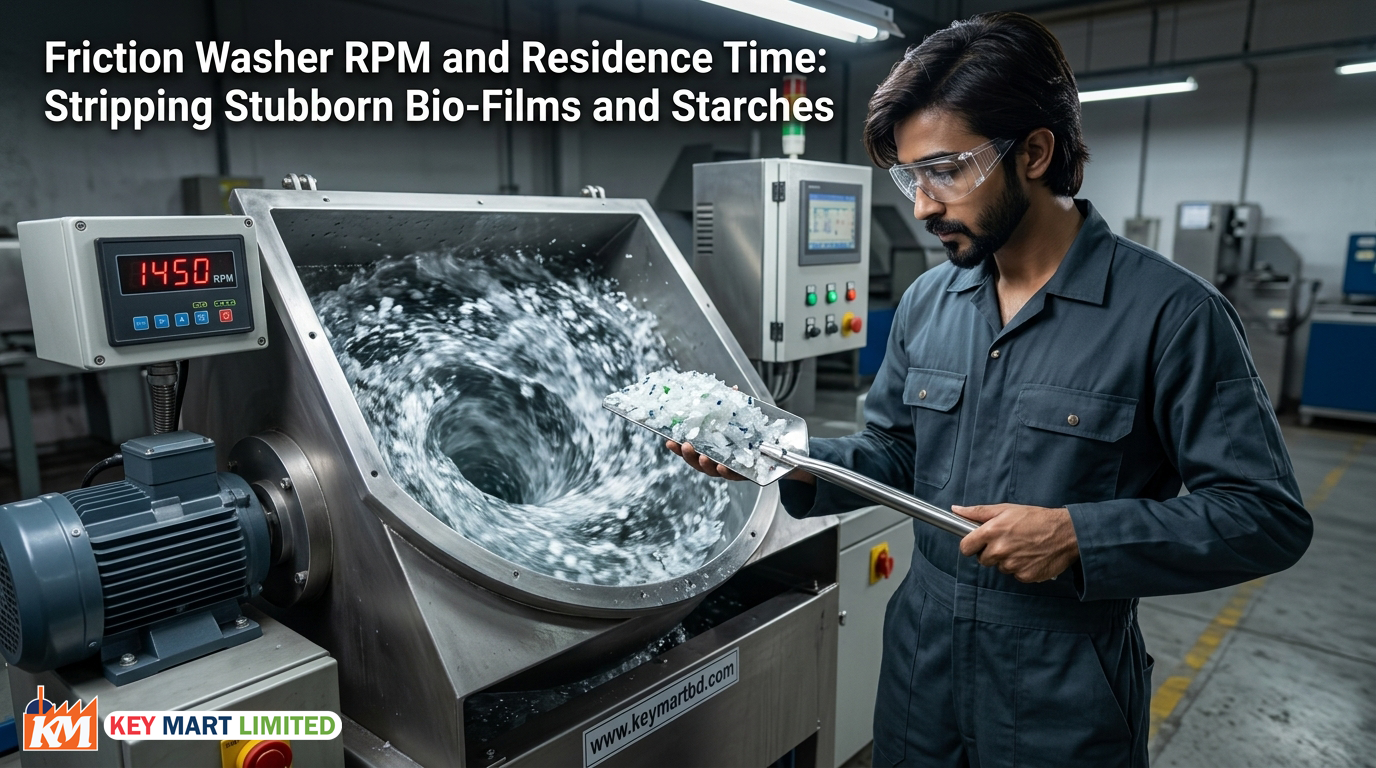
Continuous Multi-Stage Caustic Washing: As an established bangladesh pet flakes manufacturer, our facility subjects crushed flakes to continuous hot-caustic friction washing ($85^\circ\text{C}-95^\circ\text{C}$) and automated NIR optical sorting, guaranteeing $\text{PVC} < 25\text{–}50\text{ PPM}$, zero glue residue, and moisture dried below 0.5%.
-
Sub-0.3% Fines Removal via Air Elutriation: Serving as an experienced pet flakes exporter, Key Mart Limited passes every batch through automated multi-stage zig-zag air classifiers, keeping dust and fines strictly below $0.3\%$ to prevent feed throat bridging and melt instability.
-
Batch-Specific Lab Testing & Quality Verification: Every export lot is verified in our Dhaka quality control laboratory for stable Intrinsic Viscosity ($0.78\text{–}0.82\text{ dL/g}$), high optical clarity ($L^* \ge 74.0, b^* \le +1.2$), and zero foreign polymer blending via spectroscopy screening, backed by batch-specific Certificates of Analysis (CoA) and Global Recycled Standard (GRS 4.0) Transaction Certificates (TC).
-
Maximized 25–26 MT Container Logistics: We pack 25–26 Metric Tons into every 40ft High Cube container with heavy-duty 100-micron PE inner liners to preserve feedstock dryness during transit under FOB Chittagong, CFR, or CIF shipping terms.
Partner with Key Mart Limited Today
Protect your extruder barrels, eliminate cross-polymer hazing, and secure laboratory-verified, high-purity rPET flakes from Bangladesh. Contact our Dhaka export management team today to request Technical Data Sheets, order commercial testing samples, or reserve monthly container allocations.
-
Company Name: Key Mart Limited
-
Head Office & Factory Address: Plot #31, Road #N-1, Block #K, Eastern Housing, Pallabi 2nd Phase, Rupnagar, Dhaka-1216, Bangladesh.
-
Official Website: www.keymartbd.com
-
Corporate Email: keymartltd@gmail.com | info@keymartbd.com
-
Direct Phone / WhatsApp: +8801760774499, +8801864935478
Join our community today and stay connected with the future of PET recycling.
 Visit our YouTube channel: Key Mart Limited on YouTube
Visit our Facebook Page: Key Mart Limited on Facebook
Subscribe to see our latest factory tours, production updates, and export success stories.