Views: 6
If you have ever seen a desiccant drying hopper seize up because amorphous PET flakes sintered into a solid block, you know how unpredictable incoming material can be.
Polyethylene terephthalate is inherently polymorphic. In a standard post-consumer bale, the flakes you feed into your line do not share a single thermal history. The blow-molded body of a soda bottle is biaxially oriented with moderate crystallinity, the thick injection-molded neck finish is highly crystalline and opaque, and thermoformed sheet scrap is almost entirely amorphous.
When these diverse flake fractions enter a high-temperature desiccant or infrared drying system, they behave completely differently. Amorphous flakes soften and become sticky at their glass transition temperature ($T_g \approx 78^\circ\text{C}$ to $82^\circ\text{C}$), agglomerating into heavy clumps unless they are properly pre-crystallized. Meanwhile, highly crystalline flakes resist moisture release, demanding calculated residence times to reach the critical $\le 50\ \text{ppm}$ moisture threshold required to prevent hydrolytic degradation during extrusion.
Managing this processing window requires knowing your feedstock’s exact baseline crystalline fraction ($X_c$). For industrial laboratories and extrusion facilities, PET flake crystallinity measurement using density gradient columns provides the fastest, most reliable quantitative data.
      ┌─────────────────────────────────────────────────────────────┐
      │       Incoming Post-Consumer PET Flakes (Mixed Bale)        │
      │   • Amorphous Body Flakes (~10–15% Crystalline)             │
      │   • Semi-Crystalline Sidewalls (~25–30% Crystalline)        │
      │   • Highly Crystalline Necks/Closures (>35% Crystalline)    │
      └──────────────────────────────┬──────────────────────────────┘
                                     │
                                     ▼
      ┌─────────────────────────────────────────────────────────────┐
      │           Density Gradient Column Testing (ASTM D1505)       │
      │     • Liquid column (ZnCl₂/H₂O or NaBr/H₂O)                 │
      │     • Calibrated glass floats establish true density        │
      │     • Exact polymer density (ρ) measured in g/cm³           │
      └──────────────────────────────┬──────────────────────────────┘
                                     │
                                     ▼
      ┌─────────────────────────────────────────────────────────────┐
      │           Two-Phase Calculation of Crystallinity (Xc)       │
      │           Xc = [ ρc × (ρ - ρa) ] / [ ρ × (ρc - ρa) ]        │
      └──────────────────────────────┬──────────────────────────────┘
                                     │
                     ┌───────────────┴───────────────┐
                     ▼                               ▼
     ┌───────────────────────────────┐   ┌───────────────────────────────┐
     │    Optimized Drying Window    │   │  Unmeasured Blind Processing  │
     │  • Pre-crystallize low-Xc     │   │  • Amorphous bridging in      │
     │  • Calculated residence time  │   │    hopper throat              │
     │  • IV drop prevented          │   │  • Hydrolysis & brittle melt  │
     └───────────────────────────────┘   └───────────────────────────────┘
The Molecular Physics: Why Density Tracks Crystallinity
Read More: A Step-by-Step Guide to Importing PET Flakes from Bangladesh via Chittagong Port
Why is density the ultimate metric for measuring crystalline phases in PET?
In its purely amorphous state, PET polymer chains are disordered and loosely tangled. This disordered packing results in a lower physical density, established in polymer physics literature as $\rho_a \approx 1.333\ \text{g/cm}^3$ (at $23^\circ\text{C}$).
When PET undergoes thermal crystallization or strain-induced alignment during bottle blowing, the polymer chains fold into compact, parallel triclinic crystal lattices. These tightly packed crystalline domains have a significantly higher density, experimentally defined as $\rho_c \approx 1.455\ \text{g/cm}^3$.
Because any commercial recycled PET flake is a two-phase semi-crystalline system containing both amorphous and crystalline regions, the measured bulk density ($\rho$) directly correlates with the weight fraction of crystallinity ($X_c$).
Using the standard two-phase mass balance equation:
Where:
-
$\rho$ = Measured density of the PET flake sample ($\text{g/cm}^3$)
-
$\rho_a$ = Density of $100\%$ amorphous PET ($1.333\ \text{g/cm}^3$)
-
$\rho_c$ = Density of $100\%$ crystalline PET ($1.455\ \text{g/cm}^3$)
A shift in measured density from $1.335\ \text{g/cm}^3$ to $1.380\ \text{g/cm}^3$ represents a jump from roughly $2\%$ crystallinity to over $35\%$. For an extrusion operator, that difference represents the boundary between free-flowing material and a stalled production line.
Why Density Gradient Columns Outperform DSC on the Factory Floor
Differential Scanning Calorimetry (DSC) is common in research laboratories, but it presents major practical drawbacks when testing bulk recycled flake deliveries:
-
Tiny Sample Size (5–10 mg): A single DSC pan holds only a small sliver of a single flake. In a heterogeneous recycling stream, testing five milligrams tells you nothing about the average variance across a twenty-ton container load.
-
Thermal Artifacts During Testing: DSC measures the heat of fusion ($\Delta H_m$) against a theoretical $100\%$ crystal value ($\Delta H_m^\circ \approx 140.1\ \text{J/g}$). However, cold crystallization during the dynamic heating ramp can distort baseline enthalpy integrations.
-
Equipment Cost and Maintenance: DSC instruments require liquid nitrogen cooling, precision gas lines, and specialized technical operators.
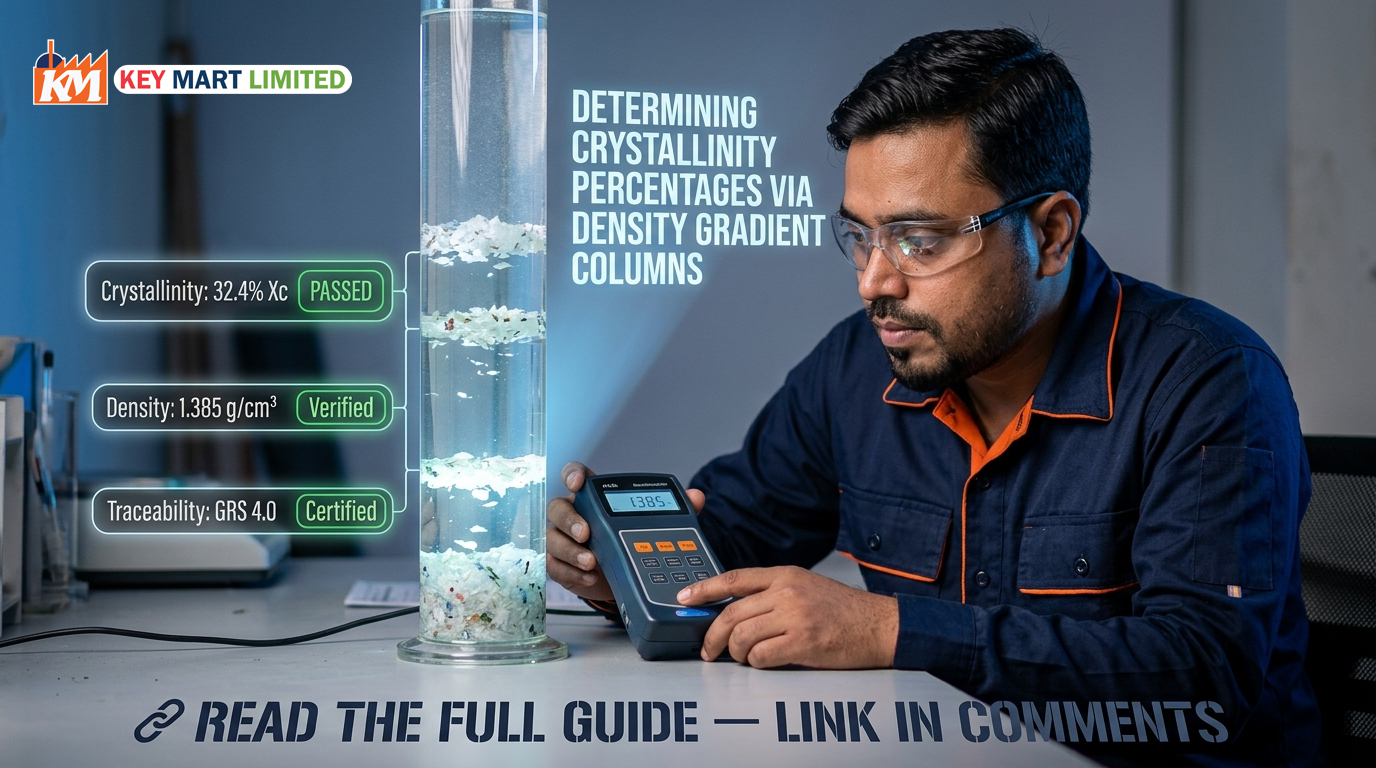
In contrast, Density Gradient Columns (governed by ASTM D1505 and ISO 1183-2) allow testing technicians to submerge dozens of individual flake specimens simultaneously across a representative lot.
       ┌─────────────────────────────────────────────────────────────┐
       │             Precision Density Column Construction           │
       │                                                             │
       │   Top: Low Density Liquid (e.g., 1.300 g/cm³)               │
       │     │                                                       │
       │     ├── [Calibrated Glass Float: 1.320 g/cm³]               │
       │     │                                                       │
       │     ├── [Amorphous PET Flakes Float Here: ~1.335 g/cm³]     │
       │     │                                                       │
       │     ├── [Calibrated Glass Float: 1.360 g/cm³]               │
       │     │                                                       │
       │     ├── [Biaxially Oriented Body Flakes: ~1.375 g/cm³]      │
       │     │                                                       │
       │     ├── [Opaque Neck Finish Flakes: ~1.400 g/cm³]           │
       │     │                                                       │
       │     └── [Calibrated Glass Float: 1.420 g/cm³]               │
       │     │                                                       │
       │   Bottom: High Density Liquid (e.g., 1.440 g/cm³)           │
       └─────────────────────────────────────────────────────────────┘
Operational Mechanics of the Gradient Column
A density gradient column consists of a precision-bore, water-jacketed glass tube maintained at an exact temperature (typically $23.0^\circ\text{C} \pm 0.1^\circ\text{C}$) via a circulating water bath.
1. Column Preparation and Solution Gradients
The column is filled with two miscible liquids of different densities using a specialized twin-vessel gradient mixer. For PET testing, common liquid pairings include:
-
Aqueous zinc chloride ($\text{ZnCl}_2 / \text{H}_2\text{O}$)
-
Aqueous sodium bromide ($\text{NaBr} / \text{H}_2\text{O}$)
-
Isopropanol / water or calcium nitrate solutions
The mixing apparatus fills the column from the bottom up, creating a continuous, linear vertical density gradient from roughly $1.300\ \text{g/cm}^3$ at the top to $1.430\ \text{g/cm}^3$ at the bottom.
2. Calibration with Standard Floats
A series of certified, hermetically sealed glass reference floats of known, calibrated densities (accurate to $\pm 0.0001\ \text{g/cm}^3$) are introduced into the column. Each float sinks until it reaches the exact height where the liquid density matches its own buoyant equilibrium. A precision cathetometer or optical scale records the float heights, establishing a linear regression curve ($y = mx + b$) of column height versus true density.
3. Sample Introduction and Equilibrium
Washed PET flakes are wetted in a light wetting agent to eliminate adhering air micro-bubbles, then gently placed into the top of the column. The flakes settle down the column over a 30 to 60-minute period until reaching buoyant equilibrium.
By noting where the flakes rest against the calibrated height scale, the laboratory technician immediately sees not just a single average density number, but the true distribution curve of crystalline vs. amorphous material in that specific batch.
Practical Impact: Tuning Dryer Residence Times
Why do extrusion and sheet processing managers care so deeply about this measurement?
+---------------------------------------------------------------------------------------------------+
|                        DRYING BEHAVIOR BASED ON MEASURED CRYSTALLINITY                            |
|                                                                                                   |
| Low Crystallinity (Xc < 18%, Density < 1.350 g/cm³):                                              |
| • Risk: High sticking and bridging in standard hopper dryers above 85°C.                          |
| • Required Action: Must pass through an agitated mechanical crystallizer (140°C–160°C for         |
|   15–20 minutes) to induce spherulitic crystallization before entering main desiccant hoppers.    |
|                                                                                                   |
| Balanced Semi-Crystalline (Xc = 25–32%, Density = 1.365–1.385 g/cm³):                             |
| • Risk: Standard predictable processing.                                                          |
| • Required Action: Direct desiccant drying at 160°C–175°C with dew point ≤ -40°C for 4–6 hours.    |
|                                                                                                   |
| High Crystallinity (Xc > 38%, Density > 1.400 g/cm³):                                             |
| • Risk: Entrapped moisture diffuses more slowly through dense crystalline lattices.                |
| • Required Action: Increase dryer residence time by 15–25% to prevent hydrolytic IV loss in       |
|   the extruder barrel.                                                                            |
+---------------------------------------------------------------------------------------------------+
When unmeasured amorphous flakes enter a standard hopper at $160^\circ\text{C}$, they soften instantly, bridge across the throat, and halt the entire extrusion line. Conversely, if high-crystallinity flakes are run on an aggressive, short-cycle drying profile, internal moisture cannot escape the crystalline domains in time.
The moment that under-dried material enters the extruder screw at $280^\circ\text{C}$, the residual water reacts with the polyester backbone via hydrolysis, breaking molecular chains and causing intrinsic viscosity (IV) to drop sharply from $0.80\ \text{dL/g}$ down to $0.65\ \text{dL/g}$. The result is brittle preforms, warped sheets, and high scrap rates.
Upstream Sourcing: The Foundation of Thermal Consistency
No extrusion line can run smoothly if every big bag oscillates wildly between amorphous thermoform scrap and dense injection bottle necks.
Securing a stable, predictable crystallinity profile requires partnering with mechanical recyclers who understand input sorting:
-
Rigid Bottle-Only Sorting: Eliminating thermoformed sheet waste and multilayer non-bottle scrap keeps the baseline crystallinity distribution within a narrow, predictable window.
-
Controlled Hot Washing: Consistent hot washing temperatures prevent localized, uncontrolled thermal annealing of flakes during the recycling stage.
-
Uniform Grinding and Screening: Consistent flake thickness and particle sizing ensure that heat transfers evenly during downstream crystallizing and drying cycles.
4. KEY MART LIMITED — BUYER SOLUTION
For international plastic processors, sheet manufacturers, and extrusion facilities, maintaining stable drying cycles and preventing hydrolytic IV loss requires clean, uniformly processed raw materials.
Key Mart Limited operates as a specialized pet flakes manufacturer and exporter from Bangladesh, producing thoroughly sorted, washed clear PET flakes for industrial buyers worldwide.
From an extrusion and polymer processing perspective, Key Mart Limited addresses core manufacturing demands through disciplined mechanical recycling:
-
Dedicated Post-Consumer Feedstock Segregation: Input streams are carefully sorted to isolate clean, clear beverage bottles from non-bottle packaging, ensuring consistent polymer origin and minimal thermal-history variance.
-
Multi-Stage Hot Washing & Friction Cleaning: Bottles pass through intensive hot washing and friction cycles to strip away surface sugars, labels, and glues, delivering clean flakes with high optical purity.
-
Flake Geometry & Fines Control: Controlled grinding and screening produce uniform flake dimensions with minimal dust and fines, promoting even airflow and predictable bulk density in drying silos and crystallizers.
As a reliable pet flakes company in Bangladesh, Key Mart Limited provides international converters with consistent raw flake consignments that feed cleanly into secondary extrusion, compounding, and sheet lines.
5. PARTNER WITH KEY MART LIMITED TODAY
Optimize your extrusion drying cycles, eliminate hopper bridging risks, and secure clean, consistent PET flakes from Bangladesh. Contact our Dhaka export management team today to discuss your technical specifications, flake sizing requirements, or long-term supply agreements.
Key Mart Limited
Head Office & Factory Address: Plot #31, Road #N-1, Block #K, Eastern Housing, Pallabi 2nd Phase, Rupnagar, Dhaka-1216, Bangladesh.
Official Website: www.keymartbd.com
Corporate Email: keymartltd@gmail.com | info@keymartbd.com
Direct Phone / WhatsApp: +8801760774499 | +8801864935478
Join our community today and stay connected with the future of PET recycling.
 Visit our YouTube channel: Key Mart Limited on YouTube
Visit our Facebook Page: Key Mart Limited on Facebook
Subscribe to see our latest factory tours, production updates, and export success stories.