Views: 3
Commercial marine operations place extreme demands on synthetic cordage. Deep-sea commercial trawling nets, mooring hawsers, and aquaculture lines operate continuously under heavy cyclic wave shock, abrasive deck friction, and saline exposure.
Traditionally, marine equipment manufacturers have relied on virgin high-tenacity nylon (PA6/PA66), polyester (PET), or polypropylene (PP). However, as international maritime bodies enforce circular economy mandates and commercial fleets face ESG procurement quotas, the industry is transitioning to post-consumer recycled Polyethylene Terephthalate (pet flakes).
Switching to recycled feedstock in marine applications presents mechanical challenges.
A standard low-grade flake causes monofilament diameter surging, micro-voids, and premature fiber snapping under tension.
Marine cordage demands high breaking tenacity ($> 7.5\text{–}8.5\text{ g/denier}$), low wet elongation, and proven resistance to saltwater hydrolysis.
Manufacturing high-tenacity rPET monofilament marine ropes and netting lines requires high-IV feedstock, solid-state draw ratios ($1:5.5\text{ to }1:6.8$), and uniform molecular weight distribution.
This technical guide examines the extrusion mechanics of marine-grade rPET monofilaments, evaluates saltwater degradation resistance, and demonstrates how Key Mart Limited delivers low-contaminant, high-tenacity rPET feedstock to marine cordage manufacturers worldwide.
1. Tensile Mechanics & Hydrolytic Resistance in Marine Environments
A marine rope or trawling net must maintain tensile stiffness and resist dimensional creep under dynamic wave loading:
Hot-Washed High-IV Flakes ➔ Continuous Monofilament Extrusion ➔ Water Quench Bath ➔ Multi-Stage Hot-Air Orientation (Draw Ratio 1:5.5–1:6.8) ➔ Inline Thermal Relaxation ➔ High-Tenacity Marine Cordage
A. Solid-State Molecular Orientation & Tenacity
-
High-Draw Ratio Spinning: Amorphous monofilament strands exiting the spinneret die pass through a temperature-controlled quench bath ($45^\circ\text{C}\text{–}55^\circ\text{C}$) before entering multi-stage hot-air drawing ovens ($160^\circ\text{C}\text{–}210^\circ\text{C}$).
-
Axial Alignment: Operating at draw ratios between $1:5.5\text{ and }1:6.8$ aligns the polymer chains axially along the fiber length, raising breaking tenacity to $> 7.5\text{–}8.5\text{ g/denier}$ and tensile modulus above $10.5\text{ GPa}$.
-
Diameter Uniformity: Maintaining melt viscosity without pressure fluctuations ensures monofilament diameter consistency ($\pm 0.01\text{ mm}$), preventing localized stress nodes that cause net fraying.
B. Resistance to Saltwater Hydrolysis & UV Degradation
-
Low Water Absorption: Unlike Nylon 6/66, which absorbs up to $8\%\text{–}10\%$ water by weight—losing up to 15% of its tensile strength when wet—PET absorbs less than $0.4\%$ moisture. Marine cordage made from rPET retains 100% of its dry breaking strength in open sea conditions.
-
Hydrolytic Stability: Flakes with an Intrinsic Viscosity ($IV$) of $0.78\text{–}0.82\text{ dL/g}$ and high crystallinity ($> 38\%$) resist saltwater ionic penetration, preventing ester bond cleavage during multi-year submerged service.
Read More: A Step-by-Step Guide to Importing PET Flakes from Bangladesh via Chittagong Port
Marine Cordage & Monofilament Material Benchmark Table
| Performance Parameter | Standard Virgin Nylon (PA6) | Unsorted Scrap rPET Monofilament | High-Tenacity rPET (Key Mart Standard) |
| Breaking Tenacity | $7.0\text{–}8.0\text{ g/denier}$ | $4.5\text{–}5.5\text{ g/denier}$ (Brittle) | 7.5 – 8.5 g/denier (High Tensile) |
| Wet Strength Retention | Drops by $10\%\text{–}15\%$ | Inconsistent | 100% Full Dry-Equivalent Strength |
| Saltwater Hydrolysis Resistance | High | Rapid Surface Pitting | Resistant (High Crystallinity >38%) |
| Elongation at Break (Wet) | $25\%\text{–}35\%$ (High stretch) | Variable | 12% – 16% (Controlled Low Creep) |
| Intrinsic Viscosity (IV) Baseline | N/A | $0.65\text{–}0.70\text{ dL/g}$ | 0.78 – 0.82 dL/g (Stable Spinning Standard) |
| PVC Contamination | $0\text{ PPM}$ | $> 150\text{–}300\text{ PPM}$ | < 25 – 50 PPM (Continuous Hot-Caustic) |
| Dust & Fines Content ($<500\,\mu\text{m}$) | N/A | $> 2.5\text{–}3.5\%$ | < 0.3% (Multi-Stage Air Elutriated) |
| Supply Traceability | Fossil Baseline | Unverified | GRS 4.0 Transaction Certified (TC) |
2. Preventing Spinneret Clogging and Filament Snapping
Extruding continuous high-tenacity monofilaments ($0.20\text{–}1.20\text{ mm}$ diameter) without line breaks requires three manufacturing controls:
-
Fine Melt Filtration ($25\text{–}40\,\mu\text{m}$): Sintered metal continuous screen packs filter out sub-micron carbonized specks before the melt enters the spin pack, preventing spinneret orifice blockages.
-
Moisture Control ($< 0.005\%$ Post-Drying): Because high-IV rPET hydrolyzes at extrusion temperatures ($280^\circ\text{C}$), flakes must be dried to below $50\text{ PPM}$ moisture to prevent molecular weight drop during drawing.
-
Sub-0.3% Fines Removal via Air Elutriation: Stripping fine dust ($< 500\,\mu\text{m}$) prevents early melting in extruder feed throats, stabilizing melt pressure at the gear pump.
3. How Key Mart Limited Supplies Marine-Grade rPET Feedstock
Manufacturing high-strength fishing nets and marine ropes requires an established bangladesh pet flakes manufacturer with institutional sorting and viscosity control.
As a premier pet flakes company bangladesh and trusted pet flakes exporter, Key Mart Limited delivers candidate rPET flakes engineered for high-tenacity monofilament spinning:
-
Source-Segregated Clear Bottle Selection in Dhaka: Operating as a leading pet flakes manufacturer dhaka, Key Mart Limited exclusively processes 100% post-consumer clear beverage containers, rejecting mixed post-industrial scrap and degraded polymers.
-
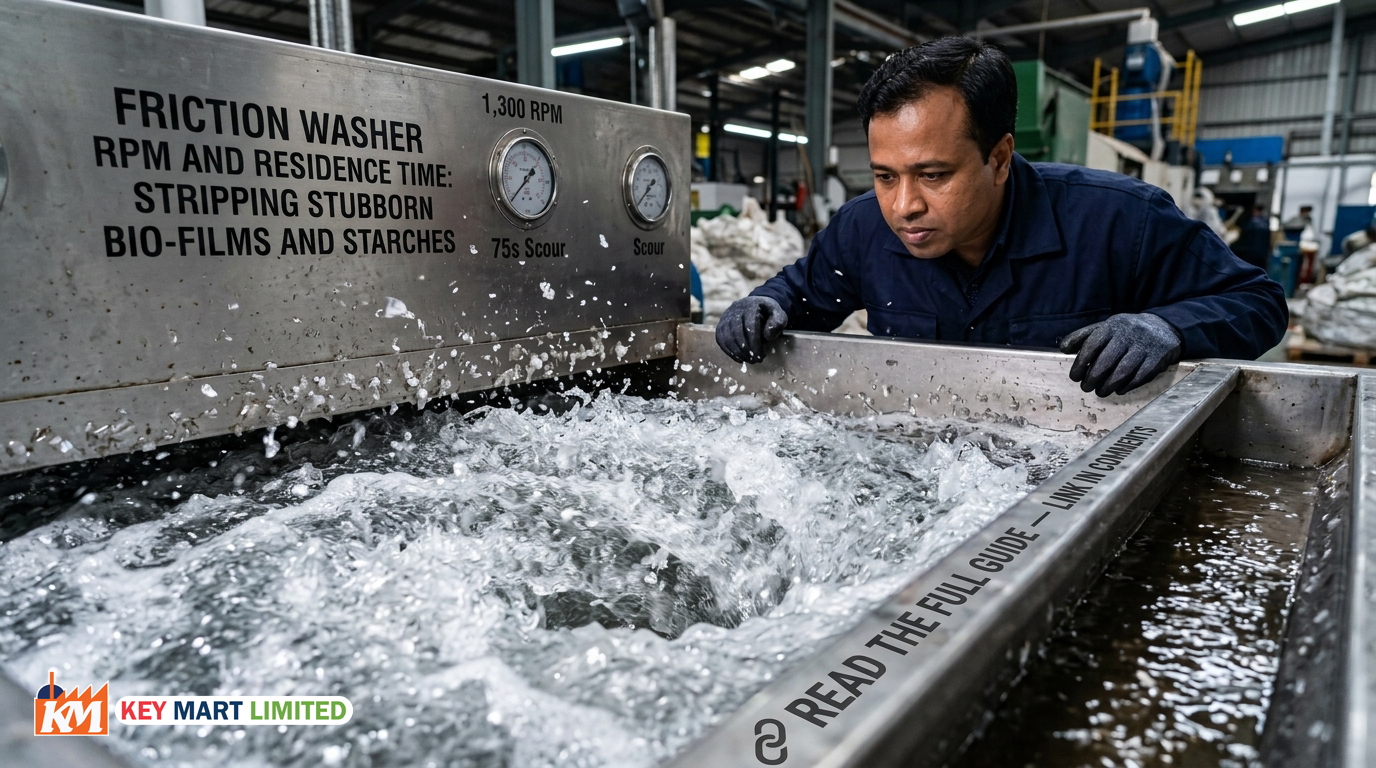
Continuous Multi-Stage Caustic Washing: As an established bangladesh pet flakes manufacturer, our facility subjects flakes to continuous hot-caustic friction washing ($85^\circ\text{C}-95^\circ\text{C}$) and automated NIR optical sorting, guaranteeing $\text{PVC} < 25\text{–}50\text{ PPM}$, zero glue residue, and moisture dried below 0.5%.
-
Sub-0.3% Fines Removal via Air Elutriation: Serving as an experienced pet flakes exporter, Key Mart Limited passes every batch through automated multi-stage zig-zag air classifiers, keeping dust and fines strictly below $0.3\%$ to eliminate spinning pressure surges and filament breakage.
-
High IV Stability for Marine Tenacity: Every export lot is tested in our Dhaka quality control laboratory for stable Intrinsic Viscosity ($0.78\text{–}0.82\text{ dL/g}$) and low ash content ($< 0.15\%$), backed by batch-specific Certificates of Analysis (CoA) and Global Recycled Standard (GRS 4.0) Transaction Certificates (TC).
-
Maximized 25–26 MT Container Logistics: We pack 25–26 Metric Tons into every 40ft High Cube container with heavy-duty 100-micron PE inner liners to preserve feedstock dryness during transit under FOB Chittagong, CFR, or CIF shipping terms.
Partner with Key Mart Limited Today
Upgrade your marine rope and netting lines, meet circular maritime sustainability mandates, and secure high-tenacity rPET flakes from Bangladesh. Contact our Dhaka export management team today to request Technical Data Sheets, order commercial testing samples, or reserve monthly container allocations.
-
Company Name: Key Mart Limited
-
Head Office & Factory Address: Plot #31, Road #N-1, Block #K, Eastern Housing, Pallabi 2nd Phase, Rupnagar, Dhaka-1216, Bangladesh.
-
Official Website: www.keymartbd.com
-
Corporate Email: keymartltd@gmail.com | info@keymartbd.com
-
Direct Phone / WhatsApp: +8801760774499, +8801864935478
Join our community today and stay connected with the future of PET recycling.
 Visit our YouTube channel: Key Mart Limited on YouTube
Visit our Facebook Page: Key Mart Limited on Facebook
Subscribe to see our latest factory tours, production updates, and export success stories.