Views: 7
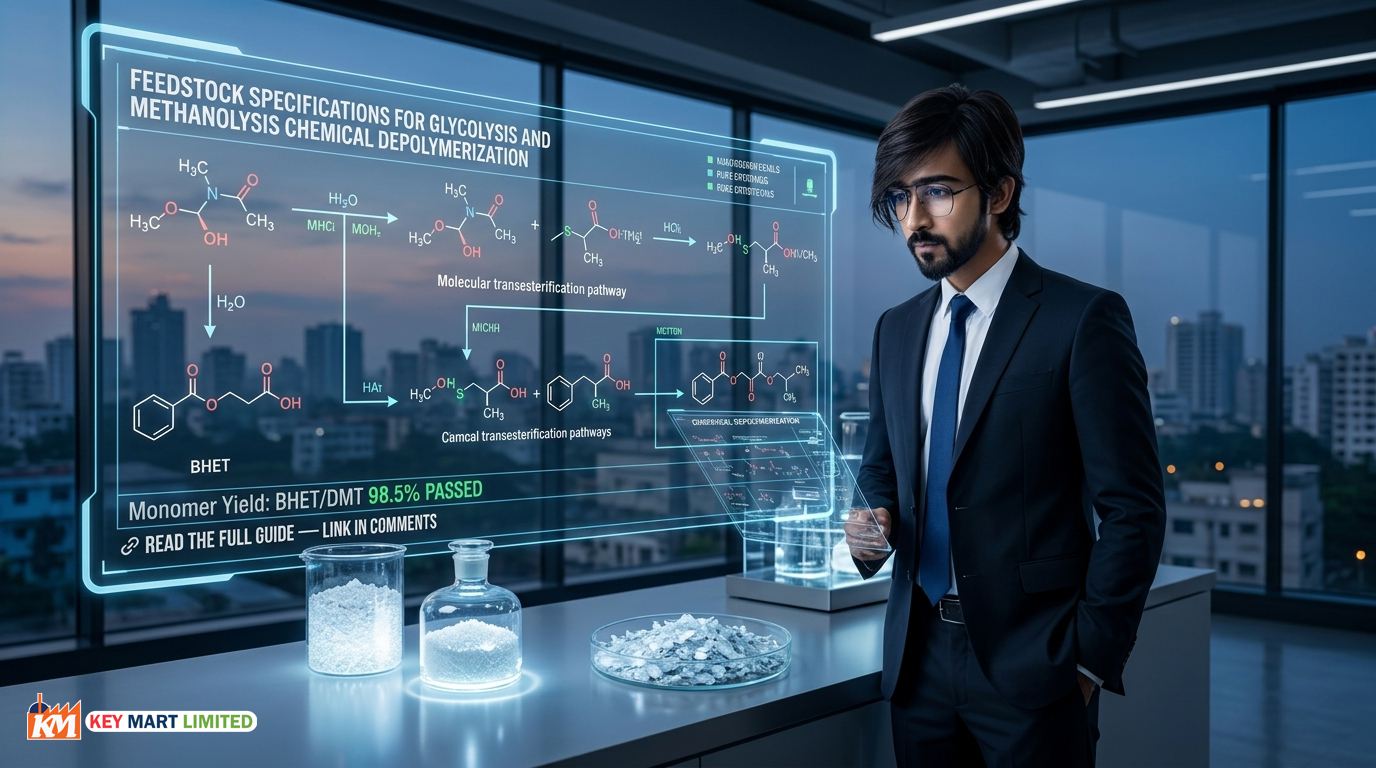
In commercial advanced recycling, chemical depolymerization technologies—primarily Glycolysis and Methanolysis—are revolutionizing the circular economy by breaking down post-consumer Polyethylene Terephthalate (pet flakes) back into virgin-equivalent monomer building blocks: Bis(2-Hydroxyethyl) Terephthalate (BHET) and Dimethyl Terephthalate (DMT).
While chemical recycling is often promoted as an omnivorous solution capable of handling lower-grade polymers, continuous depolymerization reactors are highly sensitive chemical systems.
Excessive moisture, foreign polyolefins, PVC, catalyst poisons, and heavy metal colorants directly deactivate transesterification catalysts (such as zinc acetate, titanium alkoxides, or ionic liquids), leading to incomplete reaction kinetics, tar formation, and high purification costs.
Securing scalable monomer yields requires sourcing raw materials that meet strict PET chemical recycling feedstock specifications.
This technical engineering guide explores the reaction chemistry of glycolysis and methanolysis, details statutory chemical purity thresholds, and illustrates how Key Mart Limited delivers low-contaminant, high-purity rPET feedstock to advanced recycling operators worldwide.
1. Chemical Reaction Mechanics: Glycolysis vs. Methanolysis
Both chemical routes cleave the ester bonds of PET, but their solvent dynamics and sensitivity to impurities differ:
Post-Consumer Flakes ➔ Continuous Reactor Intake ➔ Transesterification Cleavage ➔ Monomer Recovery (BHET / DMT) ➔ Ultra-Pure Virgin-Grade Repolymerization
A. Glycolysis (BHET Monomer Route)
In glycolysis, rPET flakes react with excess Ethylene Glycol (EG) at elevated temperatures ($180^\circ\text{C}\text{–}240^\circ\text{C}$) in the presence of transesterification catalysts:
-
Catalyst Poisoning: Trace Polyvinyl Chloride ($\text{PVC} > 50\text{ PPM}$) releases acidic $\text{HCl}$ at reactor temperatures, neutralizing alkaline/metal acetate catalysts and halting depolymerization.
-
Moisture Interference: Water content ($> 0.5\%$) hydrolyzes the system, producing unwanted Terephthalic Acid (PTA) oligomers that precipitate prematurely and foul heat exchangers.
B. Methanolysis (DMT Monomer Route)
Methanolysis subjects flakes to high-pressure supercritical or subcritical methanol ($200^\circ\text{C}\text{–}280^\circ\text{C}$, $2.0\text{–}4.0\text{ MPa}$):
-
Volatile Contaminant Risks: Residual adhesives and polyolefins (PP/PE bottle caps) crack into low-molecular-weight hydrocarbons, contaminating the recycled methanol recovery loop and requiring intensive distillation overhead.
Read More: A Step-by-Step Guide to Importing PET Flakes from Bangladesh via Chittagong Port
Chemical Recycling Feedstock Purity Benchmark Table
| Chemical & Physical Parameter | Low-Grade Baled Scrap | Typical Flake Scrap | Chemical Depolymerization Standard (Key Mart) | Impact on Monomer Yield |
| PVC Contamination | $> 1,000\text{ PPM}$ | $> 150\text{–}300\text{ PPM}$ | < 25 – 50 PPM (Continuous Hot-Washed) |
Prevents catalyst poisoning & reactor corrosion |
| Moisture Content (Pre-Reactor) | $> 2.0\%$ | $> 1.0\%$ | < 0.5% (Centrifugally & Heat Dried) |
Eliminates unwanted acid oligomer formation |
| Polyolefin Content (PP/PE) | $> 3.0\%$ | $> 0.5\%$ | < 50 PPM (High-Precision Float-Sink) |
Prevents tarring and methanol fouling |
| Dust & Fines ($< 500\,\mu\text{m}$) | $> 5.0\%$ | $> 2.0\%$ | < 0.3% (Multi-Stage Air Elutriated) |
Ensures steady feeding & prevents bridging |
| Heavy Metals (Sb, Ti, Co, Fe) | Variable / High | Unmonitored | < 10 PPM Controlled (Optical NIR Sorted) |
Protects downstream repolymerization catalysts |
| Intrinsic Viscosity (IV) Span | Irregular | $0.65\text{–}0.72\text{ dL/g}$ | 0.78 – 0.82 dL/g (Uniform Molecular Mass) |
Stabilizes reaction kinetics & residence time |
| Traceability & Certification | Unverified | Self-Declared | GRS 4.0 Transaction Certified (TC) | Audit-ready for EU PPWR & mass balance rules |
2. Managing Color Limits and Contaminants in Monomer Recovery
To produce crystal-clear, food-grade virgin PET from chemical depolymerization, advanced recycling facilities apply three core raw material controls:
-
Strict Float-Sink Specific Gravity Separation: Maintaining water bath specific gravity strictly at $1.00\text{–}1.02\text{ g/cm}^3$ ensures that polyolefin cap materials ($\text{density } 0.91\text{–}0.96\text{ g/cm}^3$) float out completely, preventing organic wax formation in chemical reactors.
-
Caustic De-Gluation ($85^\circ\text{C}-95^\circ\text{C}$): Hot-caustic washing saponifies label adhesives (EVA, acrylics), eliminating organic carbon impurities that degrade into color bodies during high-temperature transesterification.
-
Controlled Clear/Light-Blue Sourcing: While chemical recycling can handle colored material, utilizing segregated clear and light-blue feedstock reduces the need for expensive activated carbon bed filtration and vacuum distillation during BHET/DMT crystallization.
3. How Key Mart Limited Supplies Advanced Chemical Recycling Facilities
Meeting stringent depolymerization reactor standards requires an established bangladesh pet flakes manufacturer with institutional washing, optical sorting, and quality verification systems.
As a premier pet flakes company bangladesh and trusted pet flakes exporter, Key Mart Limited delivers candidate rPET flakes engineered specifically for glycolysis and methanolysis operations:
-
Source-Segregated Collection in Dhaka: Operating as a leading pet flakes manufacturer dhaka, Key Mart Limited selectively processes 100% post-consumer clear and light-blue beverage bottles, excluding heavy-metal-laden opaque plastics, multi-layer barrier bottles, and post-industrial scrap at the intake gate.
-
Continuous Multi-Stage Hot-Caustic Decontamination: As an established bangladesh pet flakes manufacturer, our facility subjects flakes to continuous hot-caustic friction washing ($85^\circ\text{C}-95^\circ\text{C}$) and automated NIR optical sorting, guaranteeing $\text{PVC} < 25\text{–}50\text{ PPM}$, zero glue residue, and moisture dried below 0.5%.
-
Sub-0.3% Fines Removal via Air Elutriation: Serving as an experienced pet flakes exporter, Key Mart Limited passes every batch through automated multi-stage zig-zag air classifiers, keeping dust and fines strictly below $0.3\%$ to eliminate feed hopper bridging and reactor filter fouling.
-
High Chemical Consistency & Batch Traceability: Every export batch is tested in our Dhaka quality control laboratory for stable Intrinsic Viscosity ($0.78\text{–}0.82\text{ dL/g}$) and purity parameters, backed by batch-specific Certificates of Analysis (CoA) and Global Recycled Standard (GRS 4.0) Transaction Certificates (TC).
-
Maximized 25–26 MT Container Logistics: We pack 25–26 Metric Tons into every 40ft High Cube container with heavy-duty 100-micron PE inner liners to preserve feedstock dryness during transit under FOB Chittagong, CFR, or CIF shipping terms.
Partner with Key Mart Limited Today
Protect your chemical recycling catalysts, maximize monomer recovery yields, and secure high-purity rPET flakes from Bangladesh. Contact our Dhaka export management team today to request Technical Data Sheets, order commercial trial samples, or reserve monthly container allocations.
-
Company Name: Key Mart Limited
-
Head Office & Factory Address: Plot #31, Road #N-1, Block #K, Eastern Housing, Pallabi 2nd Phase, Rupnagar, Dhaka-1216, Bangladesh.
-
Official Website: www.keymartbd.com
-
Corporate Email: keymartltd@gmail.com | info@keymartbd.com
-
Direct Phone / WhatsApp: +8801760774499, +8801864935478
Join our community today and stay connected with the future of PET recycling.
 Visit our YouTube channel: Key Mart Limited on YouTube
Visit our Facebook Page: Key Mart Limited on Facebook
Subscribe to see our latest factory tours, production updates, and export success stories.