Views: 3
When a post-consumer PET bottle containing citrus juice or flavored water sits on a shelf, its polymer wall behaves like a slow-motion sponge. Polyethylene terephthalate is an exceptional barrier to liquids, but non-polar volatile organic compounds—most notably monoterpenes like d-limonene and alpha-pinene—gradually dissolve into the amorphous regions of the plastic.
In packaging science, this process is known as flavor scalping.
For technical teams, quality managers, and packaging engineers in the food and beverage industry, flavor scalping creates a persistent challenge when bottles re-enter the recycling stream. Surface washing strips away syrups, sugars, and label adhesives, but absorbed aroma molecules remain locked within the solid polymer matrix. If these flakes pass into an extrusion line without proper verification, thermal processing desorbs the volatiles, causing pungent off-odors and bitter flavor carryover in finished preforms or thermoformed sheets.
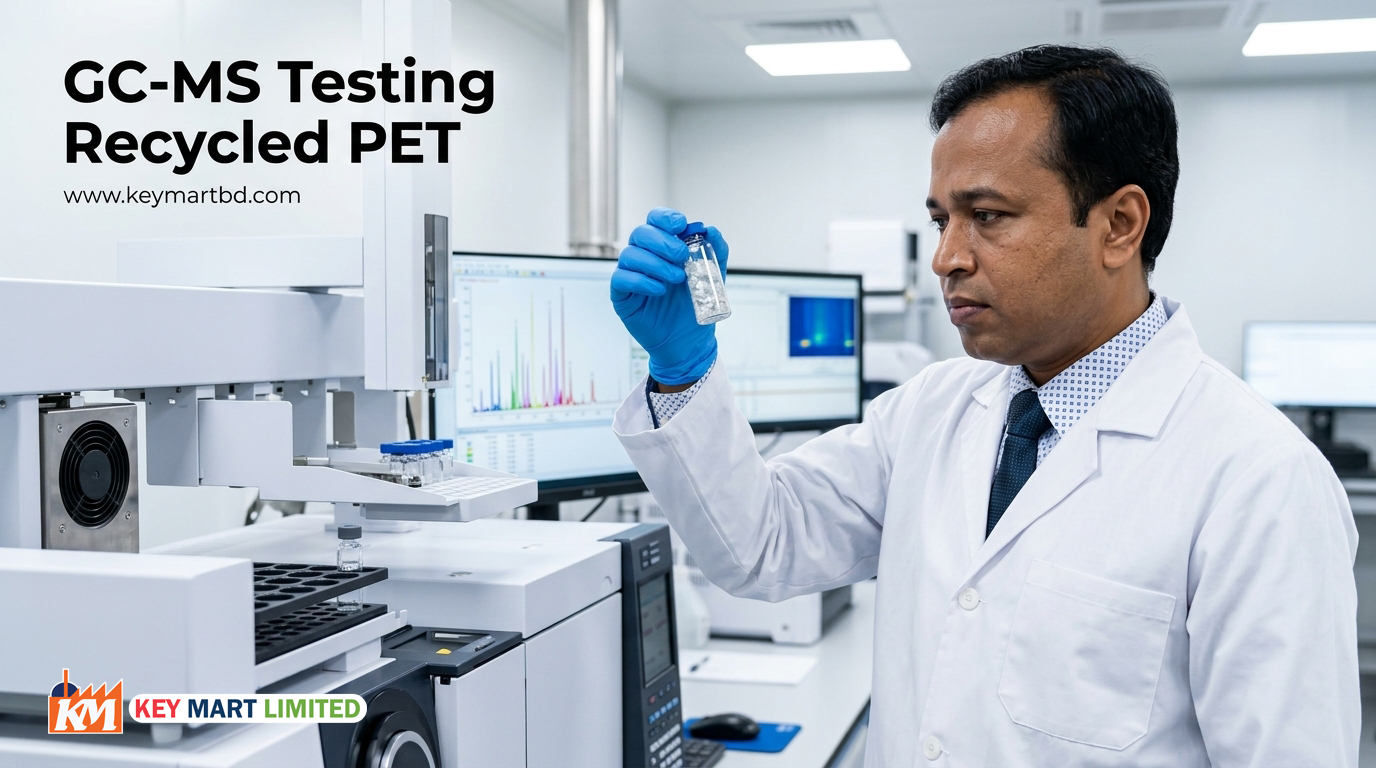
Confirming that recycled resin meets stringent organoleptic standards requires precise analytical separation. This is why GC-MS testing recycled PET has become an essential quality-control protocol for converters and brand technical teams.
        ┌─────────────────────────────────────────────────────────┐
        │       Post-Consumer PET Bottle (Flavored Beverage)      │
        └────────────────────────────┬────────────────────────────┘
                                     │
                                     ▼
        ┌─────────────────────────────────────────────────────────┐
        │   Flavor Scalping: Terpenes (d-Limonene, α-Pinene)      │
        │          Dissolve into Amorphous Polymer Chains         │
        └────────────────────────────┬────────────────────────────┘
                                     │
                                     ▼
        ┌─────────────────────────────────────────────────────────┐
        │            Mechanical Washing & Flake Sorting           │
        │           (Removes Surface Contaminants Only)           │
        └────────────────────────────┬────────────────────────────┘
                                     │
                     ┌───────────────┴───────────────┐
                     ▼                               ▼
     ┌───────────────────────────────┐   ┌────────────────────────────────┐
     │   Standard Melt Processing    │   │  GC-MS Testing & Decontamination │
     │  (Volatiles Desorb; Degrades  │   │  (HS/TD-GC-MS Quantifies Trace │
     │    Organoleptic Performance)  │   │   Migrated Terpenes to PPB)    │
     └───────────────────────────────┘   └────────────────────────────────┘
The Molecular Physics of Flavor Scalping in PET
Why do certain flavor compounds migrate deep into PET while others wash away with simple hot water?
PET is a semi-crystalline thermoplastic composed of tightly packed crystalline domains embedded within disordered amorphous regions. While crystalline structures are virtually impenetrable to small molecules under normal conditions, the amorphous chain segments have sufficient free volume to permit passive diffusion of low-molecular-weight organic compounds.
Beverage flavor formulations contain hydrophobic, low-polarity aroma compounds:
-
d-Limonene: The dominant cyclic terpene in citrus beverages, known for its persistent orange-peel odor and strong affinity for non-polar polymer phases.
-
Alpha- and Beta-Pinene: Bicyclic monoterpenes found in botanical extracts and flavor oils that resist degradation during typical ambient storage.
-
Octanal, Decanal, and Nonanal: Linear aldehydes with intense sensory thresholds, often detectable by human palates at concentrations below parts-per-billion (ppb).
Because these molecules possess low water solubility and favorable partition coefficients with polyester chains, they migrate across the bottle-liquid boundary over weeks of storage. Standard caustic washing systems operating at 70°C to 85°C effectively clean the flake surface, but they cannot reach the molecules locked inside the solid polymer structure.
Why Human Sensory Panels Fall Short
Historically, converters relied on jar-sniff tests to check for odors in recycled resin batches. A technician would heat washed flakes in a sealed glass vessel and conduct an organoleptic evaluation. While sensory panels provide real-world context, they carry severe operational weaknesses for industrial manufacturing:
-
Olfactory Fatigue: Testers quickly lose sensitivity when evaluating multiple consecutive samples.
-
Subjectivity: Human sensory thresholds for compounds like limonene vary across different operators.
-
Volatile Masking: A prominent citrus volatile can easily mask smaller concentrations of hazardous degradation compounds (such as acetaldehyde or 2-methyl-1,3-dioxolane).
-
No Quantitative Baseline: A sniff panel confirms whether a sample smells, but it cannot produce the numeric concentration values needed to validate decontamination cycles in Solid State Polycondensation (SSP) or vacuum degassing extruders.
To establish defensible, audit-ready raw material standards, brand laboratories rely on Gas Chromatography-Mass Spectrometry.
Analytical Mechanics: How GC-MS Evaluates Recycled PET
Gas Chromatography coupled with Mass Spectrometry allows laboratories to separate, identify, and quantify complex mixtures of volatile organic compounds (VOCs) and semi-volatile migrants extracted from polymer samples.
       ┌───────────────────────────────────────────────────────────┐
       │                1. Sample Extraction Method                │
       │    • Static Headspace (HS): Sealed vial heated to 150°C    │
       │    • Thermal Desorption (TD): Purge-and-trap concentration│
       │    • Micro-Solvent Extraction: Dichloromethane matrix dip │
       └─────────────────────────────┬─────────────────────────────┘
                                     │
                                     ▼
       ┌───────────────────────────────────────────────────────────┐
       │             2. Gas Chromatography (GC) Column             │
       │       • Capillary separation by boiling point & polarity  │
       │       • Inert carrier gas (He/H2) sweeps volatile mixture │
       │       • Distinct retention times for Limonene vs Pinene   │
       └─────────────────────────────┬─────────────────────────────┘
                                     │
                                     ▼
       ┌───────────────────────────────────────────────────────────┐
       │                3. Mass Spectrometry (MS)                  │
       │       • 70 eV Electron Ionization shatters molecules      │
       │       • Quadrupole separates ions by mass-to-charge (m/z) │
       │       • NIST database matching confirms exact PPM levels  │
       └───────────────────────────────────────────────────────────┘
The analytical workflow follows three distinct stages:
1. Sample Preparation & Thermal Extraction
Because solid PET cannot be directly injected into a GC column, analysts employ non-destructive thermal release or solvent extraction:
-
Static Headspace (HS-GC-MS): Flakes are sealed in a 20 mL vial and heated to between 130°C and 160°C. Migrated volatiles partition into the gas phase above the sample, and an automated syringe injects a precise aliquot of this gas into the chromatograph.
-
Thermal Desorption (TD-GC-MS): A carrier gas purges heated flakes inside a desorption tube, sweeping volatiles onto an adsorbent trap (such as Tenax TA). Rapid reheating releases a concentrated pulse of analytes into the column, enabling sub-ppb sensitivity.
-
Solvent Extraction: Flakes are extracted using high-purity solvents like dichloromethane or hexafluoroisopropanol for comprehensive non-volatile migrant characterization.
2. Chromatographic Separation
The vaporized sample enters a capillary column coated with a stationary phase (typically 5% phenyl / 95% dimethylpolysiloxane or polyethylene glycol). As an oven program ramps the temperature steadily, compounds travel through the column at rates determined by their boiling points and chemical polarity. Lighter aldehydes elute first, followed by monoterpenes like pinene and limonene, cleanly resolving overlapping volatile peaks.
3. Mass Spectrometric Identification
As compounds exit the column, they enter the mass spectrometer’s ionization chamber. High-energy electrons (70 eV) ionize and fragment the molecules. A quadrupole or time-of-flight mass analyzer separates these fragments according to their mass-to-charge ratio ($m/z$), generating a characteristic fragmentation fingerprint.
By cross-referencing mass spectra against reference databases (such as NIST or Wiley libraries) and calibrating against internal standards, the instrument identifies individual chemical species and calculates precise concentrations down to parts-per-billion levels.
Read More: A Step-by-Step Guide to Importing PET Flakes from Bangladesh via Chittagong Port
Primary Target Analytes in Recycled PET
| Target Compound | Contamination Source | Chemical Class | Downstream Processing Risk |
| d-Limonene | Citrus sodas, juices, flavored waters | Monoterpene hydrocarbon | Lingering citrus off-flavor; noticeable at trace levels in plain drinking water |
| $\alpha$-Pinene / $\beta$-Pinene | Botanical flavorings, cleaning agents | Bicyclic monoterpene | Sharp pine or turpentine notes; persistent through re-extrusion |
| Octanal / Decanal | Citrus beverage emulsions, fat oxidation | Aliphatic aldehyde | Waxy, orange-rind, or stale sensory notes |
| Acetaldehyde (AA) | Thermal degradation of PET chains | Volatile aldehyde | Pungent, sweet-apple note; strictly capped in mineral water packaging |
| 2-Methyl-1,3-dioxolane | Byproduct of thermal reactions | Cyclic acetal | Sweet ether-like odor; indicator of severe previous thermal degradation |
The Operational Impact on Conversion Lines
Allowing high-volatile rPET flakes into production lines introduces operational and economic risks:
-
Organoleptic Packaging Failures: Sensitive products like spring water and premium dairy alternatives cannot tolerate flavor carryover. A single shipment of unverified flakes can compromise hundreds of thousands of blown bottles.
-
Extrusion Splay and Outgassing: During injection molding at 275°C to 290°C, trapped volatile terpenes vaporize rapidly inside the barrel. This causes splay marks, micro-voids in bottle preforms, and hazing in extruded thermoforming sheets.
-
Vent Fouling and Equipment Downtime: Volatiles condense on cooler mold vents, vacuum lines, and chill rolls, creating residue build-ups that require frequent line shutdowns for manual cleaning.
Raw Material Sourcing: Upstream Quality Controls
Preventing flavor scalping complications begins with input selection long before material reaches high-vacuum decontamination equipment. A converter cannot easily decontaminate flakes that were poorly collected or contaminated with non-packaging industrial plastics.
When sourcing pet flakes, procurement and technical teams focus on three essential upstream controls:
-
Source Segregation: Dedicated post-consumer sorting to isolate clear beverage containers from detergent bottles, motor oil jugs, and heavily fragranced chemical packaging.
-
Intensive Hot Friction Washing: High-temperature caustic washes strip away surface-bound fruit syrups, glues, and label inks before grinding, preventing external residues from fusing into the polymer during friction heat.
-
Flake Size Uniformity: Even flake geometry ensures predictable drying and gas flow, allowing downstream thermal reactors to extract residual volatiles efficiently.
4. KEY MART LIMITED — BUYER SOLUTION
For converters and packaging manufacturers producing food-grade rPET pellets, sheets, and preforms, volatile management begins with disciplined mechanical processing. Sourcing raw flakes from a dependable pet flakes manufacturer in Bangladesh ensures a clean, properly sorted material foundation.
Key Mart Limited is an established pet flakes exporter based in Dhaka, processing post-consumer PET bottles into clean, washed, and sorted PET flakes.
Key Mart Limited supports the quality requirements of converters through rigorous primary processing:
-
Targeted Feedstock Sorting: Strict manual and mechanical sorting eliminates non-PET polymers, chemical containers, and colored impurities before grinding.
-
Intensive Multi-Stage Washing: Bottles pass through sequential washing stages that remove surface-bound beverage residues, sugars, and adhesives, minimizing volatile precursors prior to downstream thermal processing.
-
Consistent Flake Dimensions: Uniform flake sizing supports consistent bulk density, optimizing airflow and residence time in drying hoppers and decontamination units.
By focusing on feedstock purity and systematic washing, Key Mart Limited provides international buyers with consistent, dependable flake streams that integrate cleanly into secondary recycling and extrusion lines.
5. Partner with Key Mart Limited Today
If you are sourcing PET flakes from Bangladesh and need material suited to your processing requirements, contact Key Mart Limited to discuss your specifications and supply needs.
Key Mart Limited
Head Office & Factory: Plot #31, Road #N-1, Block #K, Eastern Housing, Pallabi 2nd Phase, Rupnagar, Dhaka-1216, Bangladesh.
Website: www.keymartbd.com
Email: keymartltd@gmail.com | info@keymartbd.com
Phone / WhatsApp: +8801760774499 | +8801864935478
Join our community today and stay connected with the future of PET recycling.
 Visit our YouTube channel: Key Mart Limited on YouTube
Visit our Facebook Page: Key Mart Limited on Facebook
Subscribe to see our latest factory tours, production updates, and export success stories.