Views: 8
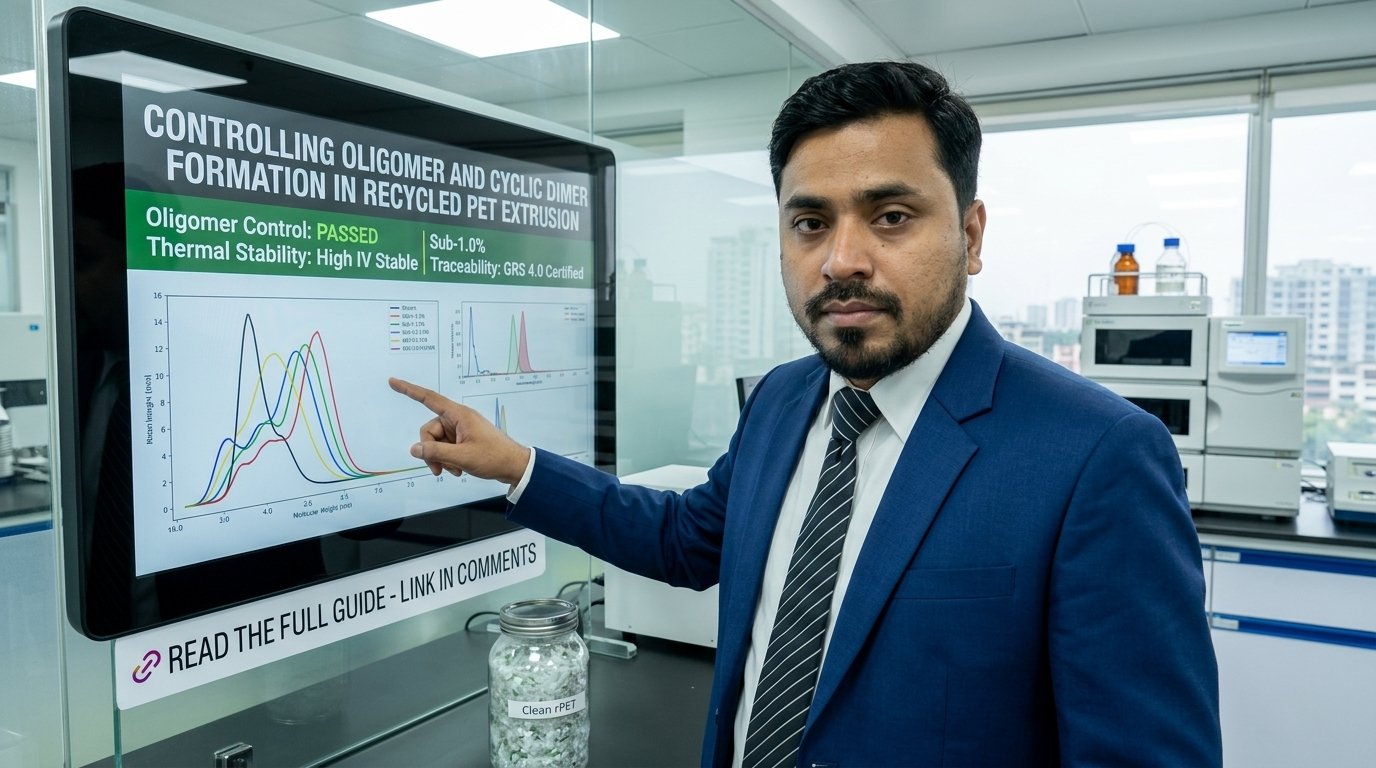
In high-speed processing of recycled Polyethylene Terephthalate (pet flakes) for fiber spinning, bottle preforms, and optical sheet extrusion, plant engineers frequently encounter a persistent defect: white, powdery residue building up on extrusion dies, vacuum vent ports, and chill rolls.
This chalky deposit is not external dirt or unwashed label glue; it is caused by the migration and crystallization of low-molecular-weight oligomers, predominantly cyclic trimers, dimers, and monomers.
When processing post-consumer rPET, multiple thermal cycles and residual moisture accelerate polymer chain scission. This increases oligomer concentration, leading to die drool, frequent filter pack blinding, plate-out on thermoforming molds, and spinning breaks in fine-denier fibers.
This technical guide examines the chemical mechanisms of oligomer and cyclic dimer formation, outlines extrusion mitigation strategies, and demonstrates how Key Mart Limited delivers low-degradation feedstock to global convertors.
1. The Chemistry of Oligomer Generation in rPET Melt Processing
Polyethylene Terephthalate polymerization inherently produces an equilibrium concentration ($1.0\%\text{–}1.5\%$) of low-molecular-weight linear and cyclic oligomers. Among these, cyclic trimers make up the largest share ($\approx 85\%$), followed by cyclic dimers and tetramers.
Thermal Stress & Hydrolysis ➔ Ester Bond Cleavage ➔ Ring-Closure Side Reactions ➔ Cyclic Dimer/Trimer Volatilization ➔ Die Drool & Mold Plate-Out
A. Thermal and Hydrolytic Degradation
During extrusion ($260^\circ\text{C}\text{–}280^\circ\text{C}$), if incoming pet flakes contain residual moisture ($> 0.005\%$ or $50\text{ PPM}$), rapid hydrolysis cleaves ester bonds. This chain scission creates short polymer chains with reactive hydroxyl ($-\text{OH}$) and carboxyl ($-\text{COOH}$) end groups.
B. Ring-Closure and Depolymerization
Under elevated melt temperatures and prolonged residence times, these short chains undergo intramolecular transesterification (backbiting), closing into stable cyclic dimers and trimers.
C. Volatilization and Plate-Out Mechanics
Unlike long PET polymer chains, cyclic oligomers possess low molecular weight and melt at different temperatures (cyclic trimer melts at $\approx 315^\circ\text{C}$). As molten rPET exits the die lip into atmospheric pressure, these volatile oligomers vaporize, instantly cooling and sublimating onto cold metal surfaces as a white crystalline powder (die drool and roll deposit).
Technical Purity and Oligomer Control Benchmark Table
| Material & Process Parameter | Standard Industrial Grade Flakes | Low-Oligomer Extrusion Standard | Impact on Extrusion Line |
| Residual Moisture (Pre-Dryer) | $> 1.0\%$ | < 0.5% (Pre-Dryer Target) |
Minimizes hydrolytic chain scission |
| PVC Contamination | $< 150\text{–}300\text{ PPM}$ | < 25 – 50 PPM |
Prevents acid-catalyzed oligomerization |
| Intrinsic Viscosity (IV) | $0.65\text{–}0.72\text{ dL/g}$ (Variable) | 0.78 – 0.82 dL/g (Stable) |
Reduces low-molecular-weight polymer fractions |
| Fines & Dust ($< 500\,\mu\text{m}$) | $> 2.0\%$ | < 0.3% (Sub-0.1% Target) |
Eliminates premature melting and thermal degradation |
| Volatile Content & VOCs | Variable | Zero (Hot-Caustic Washed) |
Prevents vacuum clogging & surface plate-out |
| Traceability Audit | Unverified | GRS 4.0 Transaction Certified |
Ensures consistent, source-controlled feedstock |
2. Engineering Strategies to Suppress Oligomers During Extrusion
To minimize cyclic dimer and trimer formation and prevent line shutdowns, convertors implement four core engineering controls:
-
Intensive Dew-Point Pre-Drying: Drying flakes to $< 50\text{ PPM}$ moisture using desiccant dryers operating at a dew point of $-40^\circ\text{C}$ prevents hydrolytic degradation in the feed throat.
-
High-Efficiency Multi-Stage Vacuum Degassing: Utilizing twin-screw extruders with deep-vacuum degassing zones ($\le 10\text{ mbar}$) extracts volatilized cyclic monomers and dimers before they reach the die head.
-
Optimized Screw Geometry & Gentle Shear: Lowering melt residence time and avoiding localized shear hotspots suppresses the thermal transesterification reactions that create cyclic structures.
-
Solid-State Polycondensation (SSP): Operating an SSP reactor elevates Intrinsic Viscosity ($0.80\text{–}0.88\text{ dL/g}$), diffusing residual oligomers out of the flake matrix under vacuum and high heat.
Read More: A Step-by-Step Guide to Importing PET Flakes from Bangladesh via Chittagong Port
3. How Key Mart Limited Fulfills Global Demand for High-Stability Feedstock
Minimizing oligomer risk begins with clean, thermally stable raw materials from an established bangladesh pet flakes manufacturer.
As a premier pet flakes company bangladesh and trusted pet flakes exporter, Key Mart Limited delivers candidate rPET feedstock engineered to resist thermal degradation:
-
Source-Segregated Collection in Dhaka: Operating as a leading pet flakes manufacturer dhaka, Key Mart Limited selectively processes post-consumer beverage bottles, eliminating degraded, multi-pass industrial polymers before processing begins.
-
Continuous Hot-Caustic Decontamination: As an established bangladesh pet flakes manufacturer, our facility subjects crushed flakes to multi-stage continuous hot-caustic washing ($85^\circ\text{C}-95^\circ\text{C}$) and automated NIR optical sorting, guaranteeing $\text{PVC} < 25\text{–}50\text{ PPM}$, zero organic residues, and dried moisture below $0.5\%$.
-
Uniform Particle Geometry & De-Dusting: Serving as an experienced pet flakes exporter, Key Mart Limited uses automated air elutriation to reduce dust and fines below $0.3\%$. This homogeneous $8\text{–}12\text{ mm}$ flake geometry prevents localized overheating in the extruder barrel, stabilizing melt pressure and suppressing oligomer generation.
-
GRS 4.0 Certified Traceability & Lab Testing: Every production lot is tested in our Dhaka laboratory for stable Intrinsic Viscosity ($0.78\text{–}0.82\text{ dL/g}$) and accompanied by batch-specific Certificates of Analysis (CoA) and Global Recycled Standard (GRS 4.0) Transaction Certificates (TC).
-
Maximized 25–26 MT Container Payloads: We pack 25–26 Metric Tons into every 40ft High Cube container with heavy-duty 100-micron PE inner liners to protect against transoceanic moisture during shipping under FOB Chittagong, CFR, or CIF terms.
Partner with Key Mart Limited Today
Eliminate die drool, reduce mold plate-out, and secure high-stability rPET flakes from Bangladesh. Contact our Dhaka export management team today to request Technical Data Sheets, order laboratory testing samples, or reserve container allocation schedules.
-
Company Name: Key Mart Limited
-
Head Office & Factory Address: Plot #31, Road #N-1, Block #K, Eastern Housing, Pallabi 2nd Phase, Rupnagar, Dhaka-1216, Bangladesh.
-
Official Website: www.keymartbd.com
-
Corporate Email: keymartltd@gmail.com | info@keymartbd.com
-
Direct Phone / WhatsApp: +8801760774499, +8801864935478
Join our community today and stay connected with the future of PET recycling.
 Visit our YouTube channel: Key Mart Limited on YouTube
Visit our Facebook Page: Key Mart Limited on Facebook
Subscribe to see our latest factory tours, production updates, and export success stories.