Views: 2
In the mechanical recycling and melt extrusion of post-consumer Polyethylene Terephthalate (pet flakes), preserving polymer chain length and molecular weight is the ultimate engineering challenge. Every time PET is collected, hot-washed, dried, and remelted, it is exposed to chemical and thermodynamic forces that actively degrade its structural integrity.
When processing recycled PET for bottle preforms, industrial strapping, or high-clarity packaging sheet, two distinct degradation pathways threaten production uptime: hydrolytic degradation and thermal degradation.
While both mechanisms result in an undesirable drop in Intrinsic Viscosity (IV) and mechanical embrittlement, their reaction kinetics, activation energies, and operational remedies are fundamentally different.
This technical guide analyzes the degradation kinetics of hydrolytic versus thermal breakdown, compares their molecular mechanisms, and demonstrates how Key Mart Limited delivers stable, low-degradation feedstock to global convertors.
1. Molecular Kinetics: Hydrolytic vs. Thermal Breakdown
Understanding how PET chains cleave at the molecular level allows process engineers to pinpoint where polymer breakdown occurs inside the extrusion line:
Hydrolytic Breakdown: High Moisture + Elevated Heat (≥150°C) ➔ Rapid Random Chain Scission (Immediate IV Drop)

Thermal Breakdown: Excessive Extruder Heat (≥280°C) + High Shear ➔ β-Elimination & Radical Cleavage (Acetaldehyde/Color Shift)
A. Hydrolytic Degradation Kinetics (Water-Driven Cleavage)
Hydrolysis is a bimolecular reaction occurring when molten or pre-heated PET reacts with residual moisture ($H_2O$). Water molecules attack the ester linkage ($-\text{COO}-$), splitting the polymer chain into a shorter carboxylic acid ($-\text{COOH}$) chain and a hydroxyl ($-\text{OH}$) terminated chain:
-
Reaction Rate & Activation Energy: Hydrolysis has a relatively low activation energy ($E_a \approx 80\text{–}100\text{ kJ/mol}$). It begins at temperatures as low as $150^\circ\text{C}$ and accelerates exponentially in the melt state.
-
Impact on Processing: Hydrolysis occurs almost instantaneously inside the extruder feed throat if flakes are inadequately dried ($> 50\text{ PPM}$ moisture), causing a rapid, catastrophic drop in Intrinsic Viscosity ($0.10\text{–}0.25\text{ dL/g}$ loss).
B. Thermal & Thermo-Oxidative Degradation (Heat & Shear Driven)
Thermal degradation occurs purely through excessive thermal energy and mechanical shear, even in an entirely dry system. At temperatures exceeding $280^\circ\text{C}$, the ester bonds undergo thermal scission via a six-membered cyclic transition state ($\beta$-elimination), generating vinyl ester and carboxylic acid end groups:
-
By-Product Formation: The vinyl ester decomposes further into acetaldehyde (AA) and oligomers, leading to yellowing ($b^*$-value increase), cross-linking, and gel formation.
-
Kinetics: Thermal degradation has a significantly higher activation energy ($E_a \approx 180\text{–}240\text{ kJ/mol}$), making it strongly dependent on barrel residence time and shear heating.
Degradation Kinetics & Performance Benchmark Table
| Kinetic & Chemical Parameter | Hydrolytic Degradation | Thermal / Thermo-Oxidative Degradation | Key Mart Quality Standard |
| Primary Trigger | Residual moisture ($H_2O$) | High melt temp ($> 280^\circ\text{C}$) & high shear | < 0.5% Moisture at Packing |
| Activation Energy ($E_a$) | Lower ($\approx 80\text{–}100\text{ kJ/mol}$) | Higher ($\approx 180\text{–}240\text{ kJ/mol}$) | Stable molecular weight baseline |
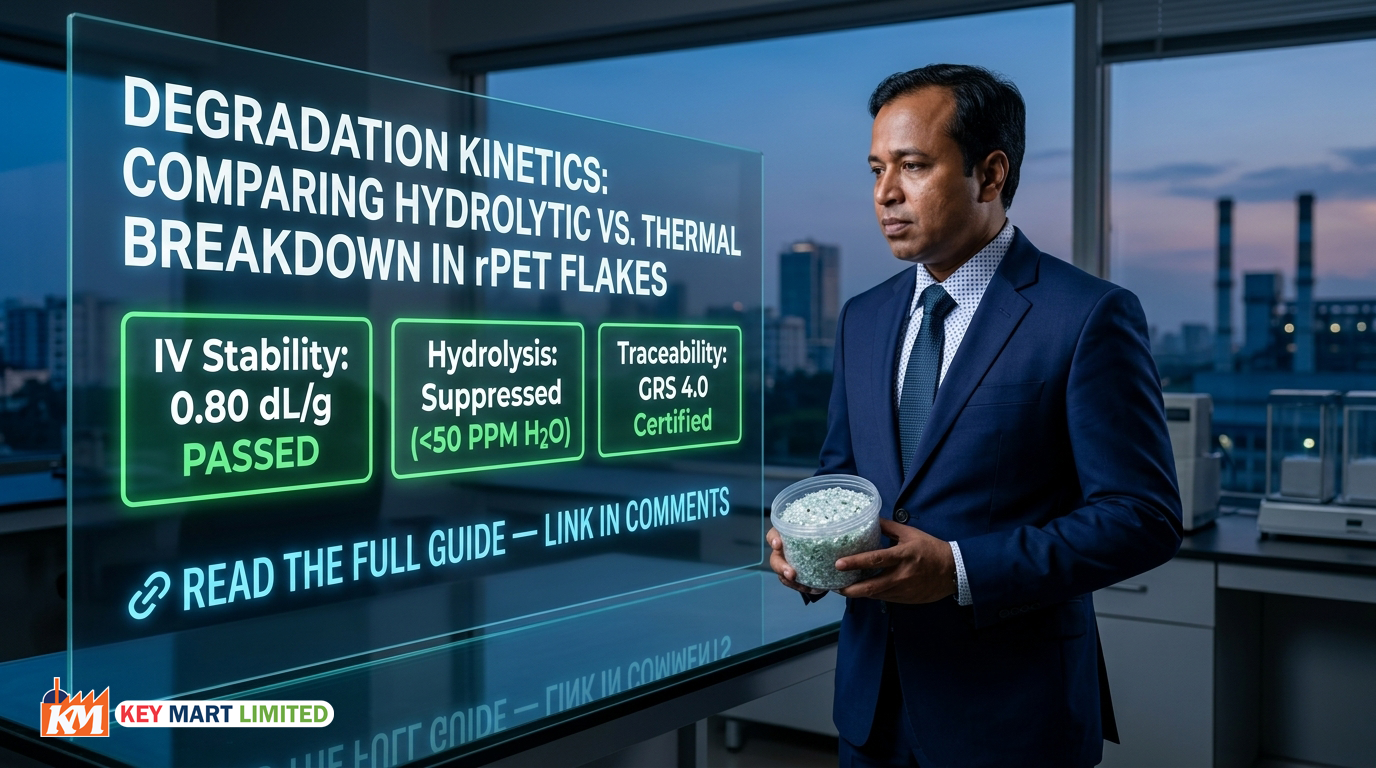
| Primary Impact on Melt | Instantaneous IV drop | Acetaldehyde (AA), yellowing & gels | Stable IV ($0.78 – 0.82\text{ dL/g}$) |
| PVC Sensitivity | Indirect | High (PVC accelerates thermal charring) | Guaranteed < 25 – 50 PPM PVC |
| Primary Plant Remedy | Desiccant pre-drying ($-40^\circ\text{C}$ dew point) | Low-shear screws & short residence time | Uniform $8\text{–}12\text{ mm}$ flake sizing |
| Traceability Audit | Unverified supply risks | Process instability risks | GRS 4.0 Transaction Certified |
2. Engineering Solutions to Inhibit Polymer Breakdown
To prevent both degradation pathways from compromising final product tenacity, color, and melt stability, processors apply three strict operational controls:
-
Pre-Extrusion Moisture Titration: Feedstock must be dried to below $0.005\%$ ($< 50\text{ PPM}$) moisture using desiccant dryers operating at $-40^\circ\text{C}$ dew point, completely halting hydrolytic cleavage during melting.
-
De-Dusting and Fine Removal: Sub-millimeter fines ($< 500\,\mu\text{m}$) have a high surface-area-to-volume ratio, causing them to melt prematurely and overheat along extruder barrel walls. Sourcing de-dusted flakes ($< 0.3\%$ fines) prevents thermal degradation spots.
-
PVC-Free Purity Thresholds: Eliminating PVC ($< 25\text{–}50\text{ PPM}$) prevents the formation of hydrochloric acid ($\text{HCl}$), which acts as a corrosive catalyst accelerating both thermal discoloration and chain degradation.
Read More: A Step-by-Step Guide to Importing PET Flakes from Bangladesh via Chittagong Port
3. How Key Mart Limited Meets Global Demand for Thermally Stable Feedstock
Minimizing degradation during extrusion starts with clean, dry, and structurally uniform raw materials from an established bangladesh pet flakes manufacturer.
As a premier pet flakes company bangladesh and trusted pet flakes exporter, Key Mart Limited supplies high-stability rPET flakes engineered to resist processing degradation:
-
Source-Segregated Collection in Dhaka: Operating as a leading pet flakes manufacturer dhaka, Key Mart Limited selectively processes post-consumer beverage bottles, avoiding multi-pass degraded plastics to preserve intrinsic molecular weight.
-
Continuous Hot-Caustic Washing & Optical Sorting: As an established bangladesh pet flakes manufacturer, our facility subjects crushed flakes to continuous hot-caustic washing ($85^\circ\text{C}-95^\circ\text{C}$) and automated NIR optical sorting, guaranteeing $\text{PVC} < 25\text{–}50\text{ PPM}$, zero adhesive residue, and moisture dried below $0.5\%$.
-
Automated Elutriation & Fines Removal: Serving as an experienced pet flakes exporter, Key Mart Limited uses multi-stage air classification to reduce fines below $0.3\%$. This homogeneous $8\text{–}12\text{ mm}$ flake geometry ensures even heat transfer and predictable feeding, eliminating localized shear overheating.
-
GRS 4.0 Certified Traceability & Lab Testing: Every production lot is tested in our Dhaka laboratory for consistent Intrinsic Viscosity ($0.78\text{–}0.82\text{ dL/g}$) and documented with batch-specific Certificates of Analysis (CoA) and Global Recycled Standard (GRS 4.0) Transaction Certificates (TC).
-
Maximized 25–26 MT Container Logistics: We pack 25–26 Metric Tons into every 40ft High Cube container with heavy-duty 100-micron PE inner liners to protect against ocean humidity ingress under FOB Chittagong, CFR, or CIF shipping terms.
Partner with Key Mart Limited Today
Eliminate hydrolytic IV loss, protect your melt lines from thermal degradation, and secure high-stability rPET flakes from Bangladesh. Contact our Dhaka export management team today to request Technical Data Sheets, order laboratory testing samples, or reserve monthly container allocations.
-
Company Name: Key Mart Limited
-
Head Office & Factory Address: Plot #31, Road #N-1, Block #K, Eastern Housing, Pallabi 2nd Phase, Rupnagar, Dhaka-1216, Bangladesh.
-
Official Website: www.keymartbd.com
-
Corporate Email: keymartltd@gmail.com | info@keymartbd.com
-
Direct Phone / WhatsApp: +8801760774499, +8801864935478
Join our community today and stay connected with the future of PET recycling.
 Visit our YouTube channel: Key Mart Limited on YouTube
Visit our Facebook Page: Key Mart Limited on Facebook
Subscribe to see our latest factory tours, production updates, and export success stories.