Views: 2
For sustainability directors, ESG executives, and polymer procurement managers in Europe and North America, assessing the environmental impact of raw material sourcing requires rigorous scrutiny. Under the EU Corporate Sustainability Due Diligence Directive (CSDDD), Scope 3 GHG protocol accounting, and statutory recycled content mandates, global packaging convertors must verify the full cradle-to-gate carbon footprint of their feedstocks.
A common question arises during supply chain audits: Does importing post-consumer recycled Polyethylene Terephthalate (pet flakes) across thousands of nautical miles negate its environmental benefits due to maritime shipping emissions?
According to empirical Life Cycle Assessment (LCA) data, the answer is a definitive no.
The massive carbon savings achieved by mechanical recycling over fossil-based virgin PET synthesis far outweigh the modest emissions generated during transoceanic container shipping.
This technical guide evaluates the lifecycle carbon balance sheet of imported rPET, analyzes freight logistics emissions, and demonstrates how Key Mart Limited optimizes container payload density to maximize net carbon reductions.
1. The Carbon Balance Sheet: Virgin PET vs. Imported rPET
To evaluate the net carbon impact, LCA methodology compares the total greenhouse gas emissions ($kg\text{ CO}_2e$) generated across the complete production and logistics lifecycle:
Virgin PET: Crude Oil Extraction ➔ Petrochemical Cracking (PTA/MEG) ➔ High-Heat Polymerization ➔ High Carbon Footprint (~2.15-2.50 kg CO2e/kg)

Imported rPET: Local Bottle Collection ➔ Hot Washing & Optical Sorting ➔ Transoceanic Sea Freight ➔ Net Low Carbon Footprint (~0.45-0.65 kg CO2e/kg)
A. The Embodied Carbon of Virgin Resin Synthesis
Manufacturing virgin PET is energy- and carbon-intensive. Synthesizing Purified Terephthalic Acid (PTA) and Monoethylene Glycol (MEG) from crude oil generates approximately $2.15\text{–}2.50\text{ kg CO}_2e\text{ per kg}$ of resin produced.
B. Mechanical Recycling Carbon Intensity
Processing post-consumer beverage bottles through mechanical sorting, continuous hot-caustic washing, and optical flake purification consumes significantly less energy than chemical synthesis, generating roughly $0.33\text{–}0.45\text{ kg CO}_2e\text{ per kg}$ of rPET. This delivers an immediate $\approx 75\%\text{–}80\%$ baseline reduction in carbon emissions at the factory gate.
C. Maritime Freight Carbon Addition
Modern container vessels are the most carbon-efficient long-haul freight mode, emitting approximately $10\text{–}18\text{ grams of CO}_2e\text{ per ton-kilometer}$ ($\text{g/t-km}$). Shipping a 40ft container across a 10,000 km maritime corridor adds only $0.10\text{–}0.18\text{ kg CO}_2e\text{ per kg}$ of transported material.
Lifecycle Carbon & Environmental Impact Benchmark Table
| Lifecycle & Environmental Metric | Virgin Fossil PET Resin | Standard Export rPET (Unoptimized) | Key Mart Limited Maximized rPET Standard |
| Cradle-to-Gate Carbon | $2.15\text{–}2.50\text{ kg CO}_2e/\text{kg}$ | $0.40\text{–}0.50\text{ kg CO}_2e/\text{kg}$ | 0.33 – 0.38 kg CO2e/kg (High-Efficiency Washing) |
| Transoceanic Freight Carbon | Negligible (Local) / Variable | $+0.22\text{ kg CO}_2e/\text{kg}$ ($18\text{ MT}$ load) | +0.12 – 0.15 kg CO2e/kg (Maximized 25–26 MT) |
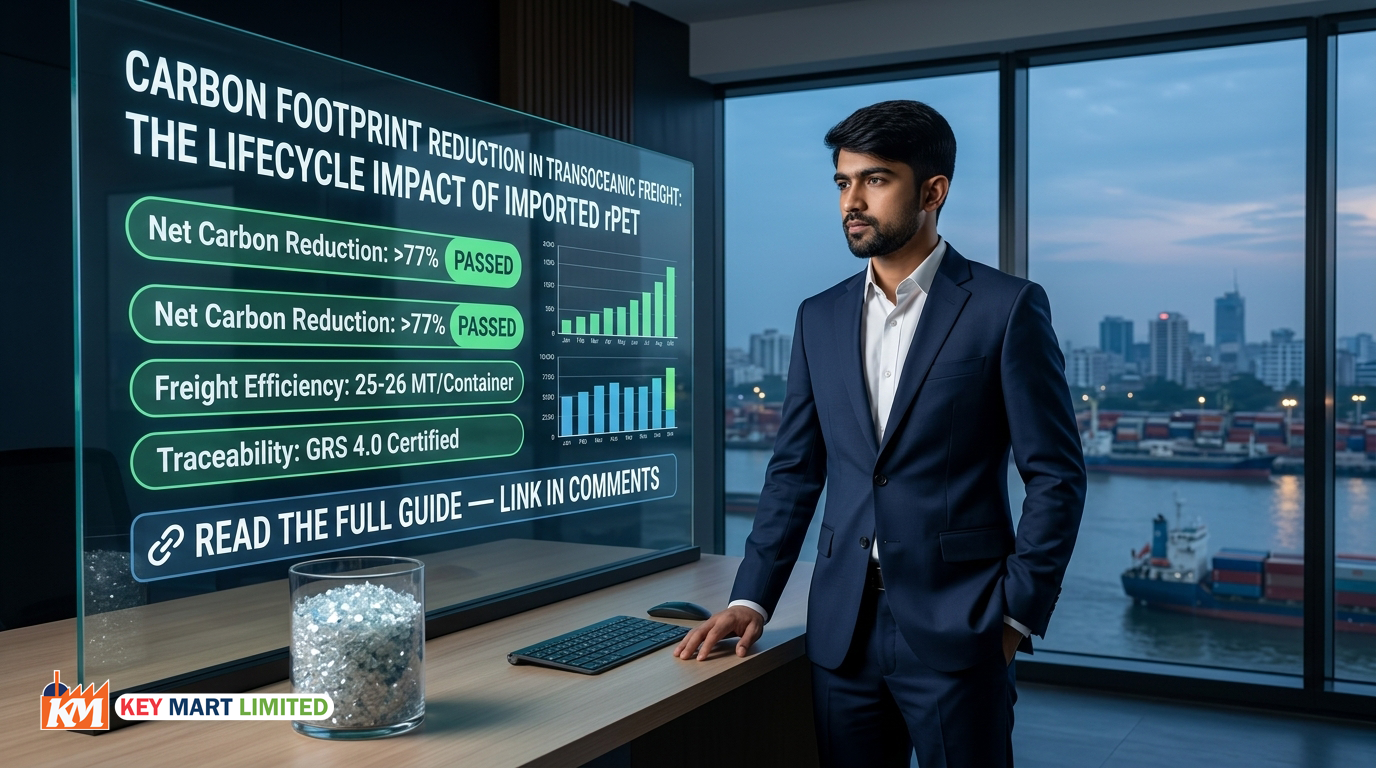
| Net Life-Cycle Footprint | $\approx 2.30\text{ kg CO}_2e/\text{kg}$ | $\approx 0.65\text{ kg CO}_2e/\text{kg}$ | 0.45 – 0.52 kg CO2e/kg (Over 77% Net Reduction) |
| Non-Renewable Energy Use | $100\%$ Fossil Fuel Sourced | Reduced by $65\%$ | Reduced by over $75\%$ in processing |
| Water & Chemical Audit | Petrochemical refining | Unmonitored discharge | Closed-loop Effluent Treatment Plant (ETP) |
| Scope 3 ESG Verification | Fossil baseline | Incomplete chain of custody | GRS 4.0 Transaction Certificate (TC) Audited |
2. Maximizing Freight Efficiency: The 25–26 MT Advantage
The single largest operational factor determining maritime carbon intensity is container payload density.
When an exporter ships under-loaded containers ($18\text{–}20\text{ Metric Tons}$), the vessel’s fuel consumption and fixed container tare weight are distributed over fewer kilograms of cargo, inflating the carbon penalty per ton by up to $30\%$.
By packing 25–26 Metric Tons into every 40ft High Cube container using high-compaction Baffle FIBC bags or bulk container liners, the freight emissions factor drops to its lowest possible theoretical value.
3. How Key Mart Limited Delivers Low-Carbon rPET to Global Markets
Supplying verified, low-carbon feedstock requires an established bangladesh pet flakes manufacturer with modern environmental infrastructure and optimized export logistics.
As a premier pet flakes company bangladesh and trusted pet flakes exporter, Key Mart Limited helps international buyers achieve aggressive Scope 3 decarbonization targets:
-
Energy-Efficient Mechanical Processing in Dhaka: Operating as a leading pet flakes manufacturer dhaka, Key Mart Limited utilizes high-throughput sorting, continuous hot-caustic washing, and closed-loop water treatment systems, minimizing energy consumption and process emissions per ton of output.
-
Maximized 25–26 MT Payload Logistics: As an established bangladesh pet flakes manufacturer, our loading teams pack 25–26 Metric Tons into every 40ft High Cube container, reducing ocean freight carbon emissions and ocean freight costs per ton under FOB Chittagong, CFR, or CIF terms.
-
GRS 4.0 Certified Carbon & Chain-of-Custody Traceability: Serving as an experienced pet flakes exporter, Key Mart Limited provides official Global Recycled Standard (GRS 4.0) Transaction Certificates (TCs), giving sustainability auditors auditable proof of 100% post-consumer provenance.
-
Guaranteed Technical Purity: Every shipment is certified with $\text{PVC} < 25\text{–}50\text{ PPM}$, moisture $< 0.5\%$, and uniform $8\text{–}12\text{ mm}$ flake sizing, verified batch-by-batch in our Dhaka laboratory and accompanied by official Certificates of Analysis (CoA).
Partner with Key Mart Limited Today
Accelerate your Scope 3 decarbonization, satisfy EU PPWR and California AB 793 mandates, and secure high-purity rPET flakes from Bangladesh. Contact our Dhaka export management team today to request LCA carbon balance sheets, Technical Data Sheets, or reserve monthly container allocations.
-
Company Name: Key Mart Limited
-
Head Office & Factory Address: Plot #31, Road #N-1, Block #K, Eastern Housing, Pallabi 2nd Phase, Rupnagar, Dhaka-1216, Bangladesh.
-
Official Website: www.keymartbd.com
-
Corporate Email: keymartltd@gmail.com | info@keymartbd.com
-
Direct Phone / WhatsApp: +8801760774499, +8801864935478
Join our community today and stay connected with the future of PET recycling.
 Visit our YouTube channel: Key Mart Limited on YouTube
Visit our Facebook Page: Key Mart Limited on Facebook
Subscribe to see our latest factory tours, production updates, and export success stories.