Views: 3
For decades, the universal chasing arrows recycling symbol (Möbius loop) was stamped onto nearly every consumer plastic package without a second thought. If an item was made of synthetic resin, resin identification codes routinely sat inside three triangular arrows, signaling to consumers that the material was inherently recyclable.
In California, that era is over.
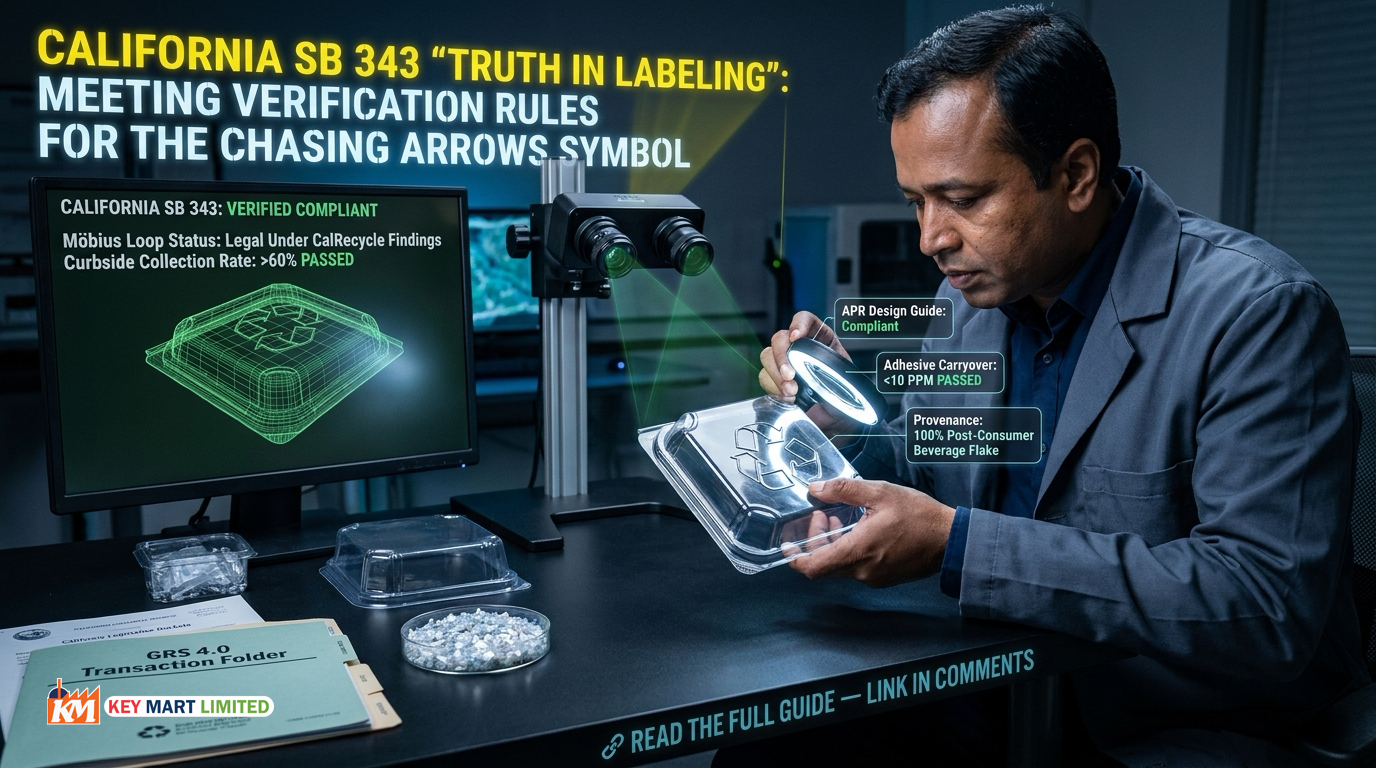
Under California Senate Bill 343 (SB 343)—widely known as the “Truth in Labeling for Recyclable Materials” law—the state has established the most aggressive anti-greenwashing regulatory framework in North America.
The law targets deceptive on-pack environmental claims. Under SB 343, putting chasing arrows or any other recycling claim on a package is legally prohibited unless the packaging meets strict statutory criteria established by the Department of Resources Recycling and Recovery (CalRecycle).
CalRecycle rules state that a package is not considered recyclable simply because it has the theoretical potential to be reprocessed in an isolated laboratory.
It must be routinely collected by municipal curbside recycling programs serving at least 60% of the state’s population, successfully sorted into commercial bales by municipal recovery facilities (MRFs), and directed to active conversion markets with verified end-use infrastructure.
Violating SB 343 is not just an administrative hiccup. False claims expose brand owners to civil penalties of up to $2,500 per day per violation under the California Business and Professions Code, alongside class-action greenwashing lawsuits in state courts.
Meeting California SB 343 recyclable packaging requirements while protecting your corporate reputation requires verifiable material provenance.
By integrating clean, single-origin recycled Polyethylene Terephthalate (pet flakes) with unbroken mass-balance traceability, brand owners and packaging engineers can justify their environmental labeling, fulfill PCR blend thresholds, and navigate California’s courts without liability.
This legal and materials engineering guide breaks down SB 343 verification criteria, explains the technical differences between resin codes and recyclability claims, and illustrates how Key Mart Limited delivers audit-ready rPET flakes to global packaging converters.
1. The Anatomy of SB 343: What Makes a Package Legally Recyclable?
CalRecycle’s Material Characterization Study sets clear operational benchmarks for on-pack recycling symbols:
Clear Post-Consumer Bottle Infeed ➔ 60% Curbside Collection Validation ➔ MRF Optical Sortability Verification ➔ GRS 4.0 Chain of Custody ➔ SB 343 Compliant Chasing Arrows
A. The 60% Curbside Threshold
To qualify for the chasing arrows symbol without qualification:
-
The container material, format, and color must be accepted by curbside programs serving at least $60\%$ of California residents.
-
Clear PET beverage bottles and rigid containers comfortably meet this threshold, but multi-layer barrier bottles, carbon-black plastics, or unwashed colored PET fractions face restriction or mandatory disqualification.
B. Separation of Resin Codes from Chasing Arrows
-
Historically, ASTM D7611 resin identification codes placed numbers (such as “1” for PET) inside triangular chasing arrows.
-
The SB 343 Change: SB 343 decouples resin identification from recycling claims. Placing arrows around a number is considered an explicit claim of recyclability. If the specific format is not broadly recyclable under state findings, the symbol must be removed, replaced with an unadorned solid equilateral triangle, or supplemented with explicit qualifying disclaimers.
C. Freedom from Disruptive Additives and Contaminants
Even a clear PET container loses its legal recyclable status under SB 343 if it incorporates components that contaminate the reclamation stream:
-
Non-releasable pressure-sensitive adhesives that fail APR design guidelines.
-
Opaque or heavy shrink sleeves with a specific gravity $> 1.0\text{ g/cm}^3$ that sink with PET during float-sink separation.
-
Direct-printed inks, problematic barrier layers (such as non-delaminating EVOH/nylon blends), or PVC seals.
California SB 343 Labeling & Material Integrity Matrix
Read More: A Step-by-Step Guide to Importing PET Flakes from Bangladesh via Chittagong Port
| Compliance & Material Metric | Non-Verified Commercial Scrap | Basic Mechanical Flakes | Key Mart Certified rPET Standard |
| SB 343 Audit Documentation | High Legal Exposure (Class Actions) | Incomplete Provenance | 100% CalRecycle & SB 343 Audit Ready |
| Recycling Claims Substantiation | Unverified Self-Declaration | Third-Party Broker Guess | Backed by GRS 4.0 Transaction Audits |
| Collection Feedstock Source | Uncontrolled Post-Industrial/Mixed | Municipal Scrap Blend | 100% Post-Consumer Beverage Bottles |
| PVC Contamination Ceiling | $> 150\text{–}300\text{ PPM}$ | $50\text{–}100\text{ PPM}$ | < 25 – 50 PPM (Continuous Hot-Caustic) |
| Label Adhesive Carryover | $> 200\text{ PPM}$ (Adhesive Gels) | $50\text{–}100\text{ PPM}$ | < 10 PPM (Alkaline Saponified) |
| Micro-Dust & Fines ($<500\,\mu\text{m}$) | $> 2.5\text{–}3.5\%$ | $1.0\text{–}1.5\%$ | < 0.3% (Multi-Stage Air Elutriated) |
| Flake Intrinsic Viscosity (IV) | $0.65\text{–}0.70\text{ dL/g}$ (Unstable) | $0.72\text{–}0.75\text{ dL/g}$ | 0.78 – 0.82 dL/g (Stable Preform Grade) |
| Supply Chain Traceability | None | Basic Bill of Lading | Unbroken Mass-Balance Chain of Custody |
2. Mitigating Greenwashing Litigation in Packaging Design
Packaging engineers and legal counsel can shield consumer brands against California deceptive trade litigation by executing three core design controls:
-
Conduct an APR Design for Recyclability Audit: Review container components—closures, liners, label adhesives, and masterbatch colorants—against the Association of Plastic Recyclers (APR) Design Guide. Ensuring your total bottle assembly cleanly separates in commercial wash baths provides foundational evidence to defend against greenwashing lawsuits.
-
Eliminate Non-Compliant Symbols from Secondary Formats: If your package uses multi-layer films or specialized cosmetic barrier layers that do not meet the 60% curbside collection mandate, strip the chasing arrows symbol immediately. Replace it with text-only material disclosures or certified How2Recycle “Not Yet Recycled” drop-off tiles.
-
Secure Independent Chain-of-Custody Certification: If claiming recycled content alongside recyclability markings (such as “Made with 50% Post-Consumer Recycled Plastic”), substantiate every percentage point with accredited third-party Global Recycled Standard (GRS 4.0) transaction certificates to survive statutory discovery in court audits.
3. How Key Mart Limited Protects Enterprise Brands from Regulatory Risk
Safeguarding your packaging lines against false advertising claims requires sourcing from an established bangladesh pet flakes manufacturer that pairs industrial throughput with verified post-consumer collection.
As a premier pet flakes company bangladesh and trusted pet flakes exporter, Key Mart Limited supplies verified, high-IV clear rPET flakes engineered to help global brand owners substantiate their environmental claims:
-
100% Post-Consumer Collection in Dhaka: Operating as a leading pet flakes manufacturer dhaka, Key Mart Limited exclusively processes 100% post-consumer clear beverage containers, rejecting mixed industrial scrap, colored packaging, and non-PET plastics at intake gates.
-
Continuous Multi-Stage Caustic Washing ($85^\circ\text{C}-95^\circ\text{C}$): As an established bangladesh pet flakes manufacturer, our facility subjects flakes to continuous hot-caustic friction washing and automated NIR optical sorting, fully saponifying label glues and stripping organic residues to guarantee $\text{PVC} < 25\text{–}50\text{ PPM}$ and zero adhesive carryover.
-
Sub-0.3% Fines Removal via Air Elutriation: Serving as an experienced pet flakes exporter, Key Mart Limited passes every batch through automated multi-stage zig-zag air classifiers, keeping dust and fines strictly below $0.3\%$ to eliminate premature burning, screw surging, and preform haze.
-
Full Chain-of-Custody Certification for Legal Defense: Every export batch is tested in our Dhaka quality control laboratory for stable Intrinsic Viscosity ($0.78\text{–}0.82\text{ dL/g}$) and high luminance ($L^* \ge 74.0, b^* \le +1.2$), backed by batch-specific Certificates of Analysis (CoA) and official Global Recycled Standard (GRS 4.0) Transaction Certificates to withstand third-party scrutiny.
-
Maximized 25–26 MT Container Logistics: We pack 25–26 Metric Tons into every 40ft High Cube container with heavy-duty 100-micron PE inner liners to preserve feedstock dryness during transit under FOB Chittagong, CFR, or CIF shipping terms, with contractually secured extended free time at major US ports (Long Beach, Oakland, Los Angeles).
Partner with Key Mart Limited Today
Protect your brand from California greenwashing litigation, substantiate your on-pack recycling symbols, and secure verified rPET flakes from Bangladesh. Contact our Dhaka export management team today to request Technical Data Sheets, order commercial testing samples, or reserve monthly container allocations.
-
Company Name: Key Mart Limited
-
Head Office & Factory Address: Plot #31, Road #N-1, Block #K, Eastern Housing, Pallabi 2nd Phase, Rupnagar, Dhaka-1216, Bangladesh.
-
Official Website: www.keymartbd.com
-
Corporate Email: keymartltd@gmail.com | info@keymartbd.com
-
Direct Phone / WhatsApp: +8801760774499, +8801864935478
Join our community today and stay connected with the future of PET recycling.
 Visit our YouTube channel: Key Mart Limited on YouTube
Visit our Facebook Page: Key Mart Limited on Facebook
Subscribe to see our latest factory tours, production updates, and export success stories.
About Key Mart Limited – Leading PET Flakes Manufacturer & Exporter
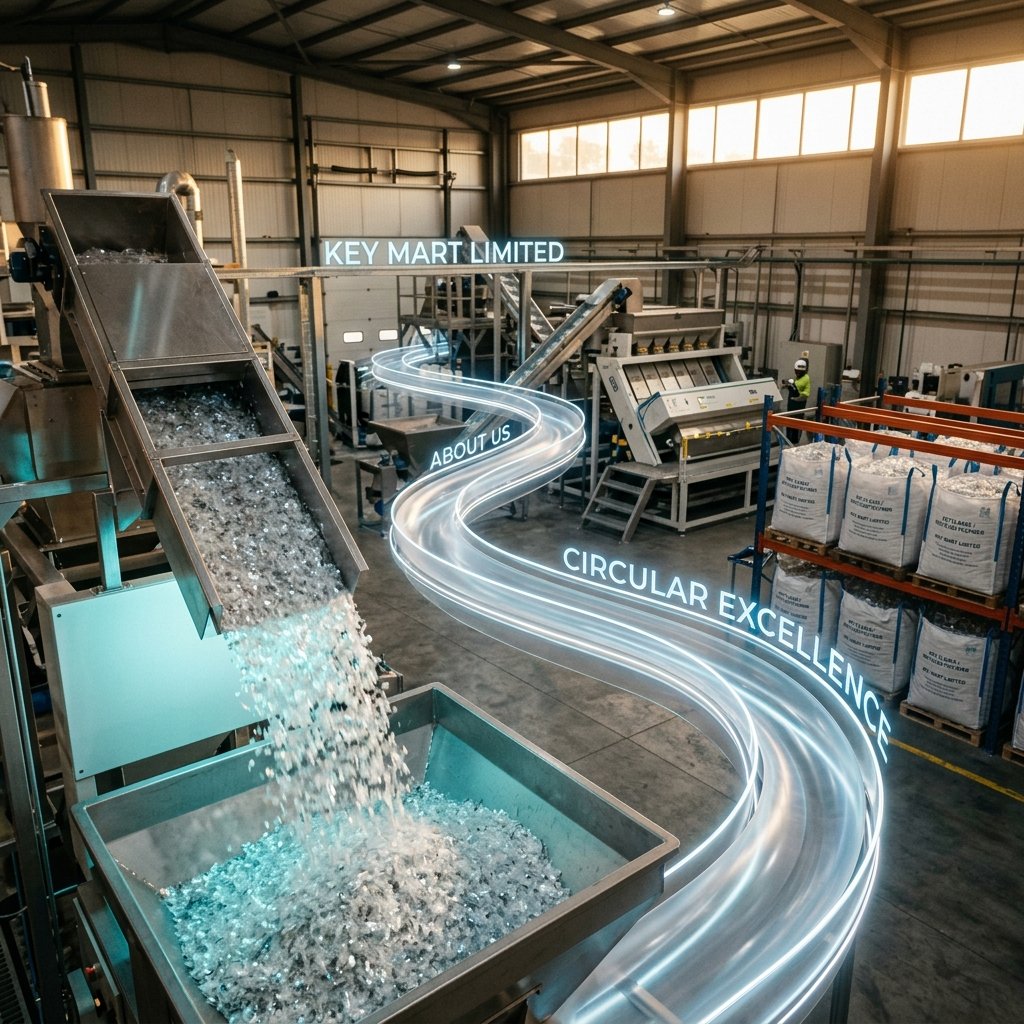
At Key Mart Limited, we are committed to powering the global circular economy through the sustainable recycling and processing of post-consumer plastics. Based in Dhaka, Bangladesh, we specialize in manufacturing and exporting high-purity PET flakes engineered to meet the stringent technical demands of international convertors, textile mills, and packaging manufacturers.