Views: 5
If you oversee packaging procurement, supply chain strategy, or corporate regulatory affairs for an enterprise consumer brand, your compliance map just got significantly more complicated. While California’s landmark mandates often grab the national headlines, the regulatory landscape for rigid plastics has fractured across the United States.
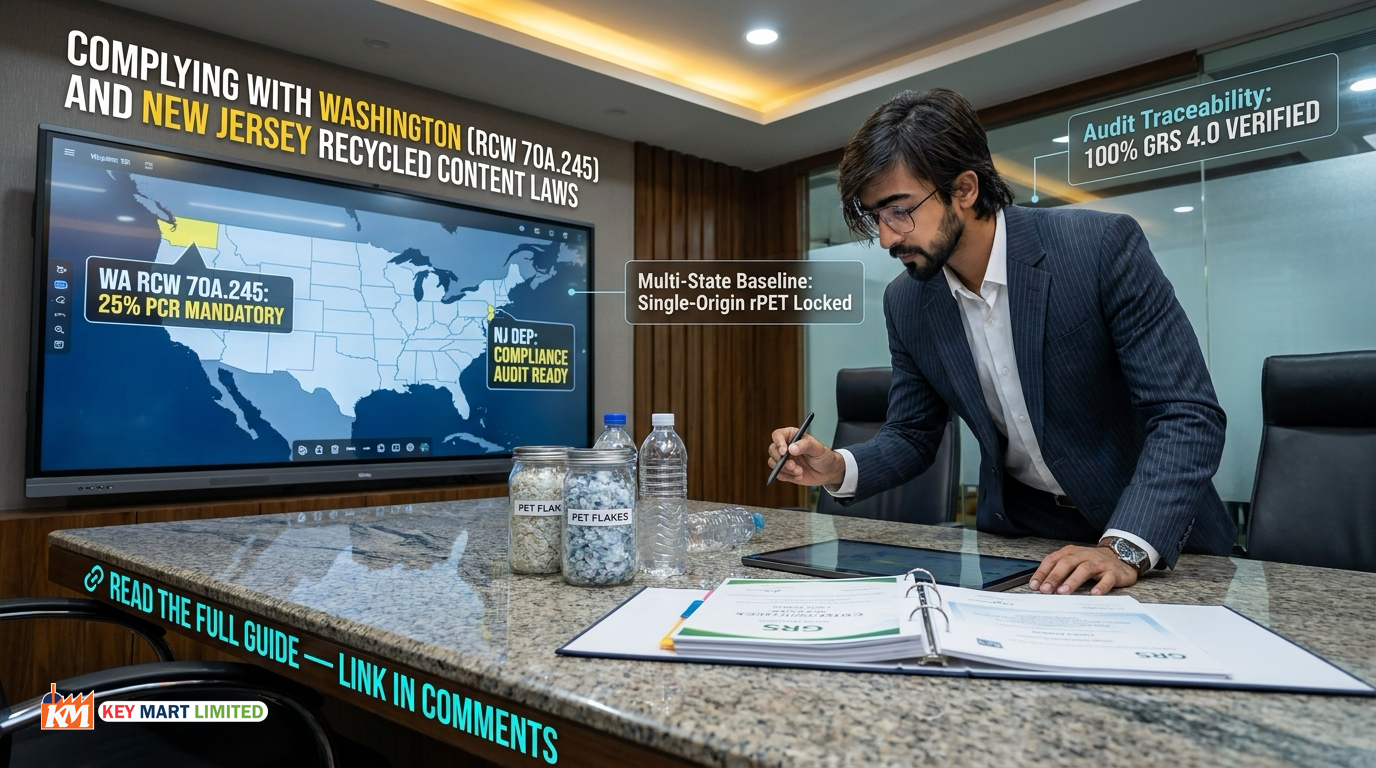
Two major legislative powerhouses on opposite coasts—Washington State with RCW 70A.245 and New Jersey with P.L. 2021, c. 391—have enacted strict, legally binding Post-Consumer Recycled (PCR) content mandates.
Managing brand portfolios across divergent state frameworks creates operational headaches for multi-state consumer packaged goods (CPG) companies:
-
Washington State (RCW 70A.245): Mandates escalating PCR minimums across beverage containers, household cleaning products, and personal care packaging, scaling from $15\%$ up to $50\%$ through 2031, with direct civil fines of up to $\$0.20\text{ per pound}$ on compliance shortfalls.
-
New Jersey (P.L. 2021, c. 391): Imposes mandatory PCR percentages across rigid plastic containers, beverage bottles, and plastic trash bags, establishing independent annual audits, certified mass-balance disclosures, and steep non-compliance penalties.
Attempting to run separate production batches with different resin formulations for individual states creates warehousing chaos and skews unit economics.
Achieving multi-state compliance efficiently requires mastering US state minimum recycled content laws.
By shifting to a standardized, single-origin supply of certified, high-viscosity recycled Polyethylene Terephthalate (pet flakes), national converters can establish a universal raw material baseline that satisfies both West Coast and Mid-Atlantic state mandates in a single extrusion run.
This legal and procurement guide analyzes the core differences between Washington and New Jersey PCR frameworks, outlines compliance strategies, and explains how Key Mart Limited supplies audit-proof rPET feedstock to enterprise packaging manufacturers.
1. Comparing Washington (RCW 70A.245) and New Jersey Statutory Mandates
Both states enforce strict statutory minimums, but their target product categories and phase-in schedules differ:
Clear Bottle Collection Gate ➔ Mass Balance Auditing ➔ GRS 4.0 Transaction Certification ➔ Multi-State Unified Filing ➔ Multi-State Compliance (Zero Shortfall Fines)
A. Washington State (RCW 70A.245)
-
Scope: Encompasses plastic beverage containers ($180\text{ mL to }5\text{ Gallons}$), plastic trash bags ($0.7\text{ mil}$ and greater), and rigid plastic containers for household cleaning and personal care products.
-
Escalation Schedule: Beverage containers require $15\%$ minimum PCR, ramping up to $25\%$ and ultimately reaching a strict $50\%$ statutory requirement. Household cleaning and personal care containers scale toward $50\%$ compliance by 2031.
-
Enforcement: Administered by the Washington State Department of Ecology, which enforces annual registration, self-reporting audits, and direct civil penalties calculated per pound of shortfall.
B. New Jersey (P.L. 2021, c. 391)
-
Scope: Covers rigid plastic containers, plastic beverage bottles, glass containers, paper carryout bags, and plastic trash bags sold or offered for sale in the state.
-
Rigid Container Thresholds: Mandates an initial $10\%$ to $15\%$ PCR minimum across rigid plastic packaging, scaling steadily toward $50\%$ over a multi-year horizon.
-
Enforcement: Overseen by the New Jersey Department of Environmental Protection (NJDEP), requiring independent third-party audit verifications and formal manufacturer compliance registration.
Multi-State Regulatory Comparison Matrix
Read More: A Step-by-Step Guide to Importing PET Flakes from Bangladesh via Chittagong Port
| Statutory & Quality Parameter | Fragmented Spot Sourcing | Regional Broker Sourcing | Key Mart Standardized Multi-State Baseline |
| Washington State (RCW 70A.245) | High Shortfall Penalty Risk | Partial Compliance | 100% Ecology Audit Compliant |
| New Jersey (P.L. 2021, c. 391) | Audit Non-Compliance Risk | Inconsistent Provenance | 100% NJDEP Verification Ready |
| Feedstock Chain of Custody | Self-Declared / Unverified | Broker Estimates | GRS 4.0 Transaction Certified (TC) |
| Flake Intrinsic Viscosity (IV) | $0.65\text{–}0.70\text{ dL/g}$ (Unstable) | $0.72\text{–}0.75\text{ dL/g}$ | 0.78 – 0.82 dL/g (Stable Baseline) |
| PVC Contamination Ceiling | $> 150\text{–}300\text{ PPM}$ | $50\text{–}100\text{ PPM}$ | < 25 – 50 PPM (Continuous Hot-Caustic) |
| Micro-Dust & Fines ($<500\,\mu\text{m}$) | $> 2.5\text{–}3.5\%$ | $1.0\text{–}1.5\%$ | < 0.3% (Multi-Stage Air Elutriated) |
| Color Coordinates ($L^*, b^*$) | $L^* < 70.0, b^* > +4.0$ | $L^* \approx 72\text{–}75, b^* < +2.5$ | L* ≥ 74.0 to 84.0+, b* ≤ +1.2 |
| Container Logistics Efficiency | $21\text{–}23\text{ MT}$ | Truckload Spot Rates | 25.0 – 26.0 MT Maximized 40ft HC Payload |
2. Procurement Strategies for Enterprise Brand Owners
Managing divergent state recycling legislation requires moving away from piecemeal, localized scrap purchases:
-
Adopt the “Highest Common Denominator” Strategy: Instead of segmenting production lines into different blends for Washington, New Jersey, and California, formulate your preforms and sheet runs to meet the most stringent regional requirement across your distribution footprint. This eliminates inventory mix-ups and reduces administrative overhead.
-
Lock In Single-Origin Feedstock with Unbroken Chain-of-Custody: Multi-state auditors examine mass-balance calculations. Sourcing material from multiple unverified scrap dealers increases your audit exposure. Working with a dedicated primary manufacturer provides clean traceability back to raw bottle collection gates.
-
Verify Thermal Properties to Avoid Production Surges: Scaling up recycled content to $25\%\text{–}50\%$ across commercial blow molding or thermoforming tooling requires consistent material performance. Ensure your rPET flakes maintain a tight $IV$ tolerance of $0.78\text{–}0.82\text{ dL/g}$ to prevent preform gate crystallization and sidewall defects.
3. How Key Mart Limited Supports Multi-State Compliance
Meeting the regulatory demands of state environmental agencies requires partnering with an established bangladesh pet flakes manufacturer that pairs industrial capacity with rigorous quality control.
As a premier pet flakes company bangladesh and trusted pet flakes exporter, Key Mart Limited delivers audit-proof, high-IV clear rPET flakes engineered to help US packaging converters maintain compliance:
-
100% Post-Consumer Collection in Dhaka: Operating as a leading pet flakes manufacturer dhaka, Key Mart Limited selectively processes 100% post-consumer clear beverage containers, rejecting mixed industrial scrap, colored packaging, and non-PET plastics at our collection gates.
-
Continuous Multi-Stage Caustic Washing ($85^\circ\text{C}-95^\circ\text{C}$): As an established bangladesh pet flakes manufacturer, our facility subjects flakes to continuous hot-caustic friction washing and automated NIR optical sorting, fully saponifying label glues and stripping organic residues to guarantee $\text{PVC} < 25\text{–}50\text{ PPM}$ and zero adhesive carryover.
-
Sub-0.3% Fines Removal via Air Elutriation: Serving as an experienced pet flakes exporter, Key Mart Limited passes every batch through automated multi-stage zig-zag air classifiers, keeping dust and fines strictly below $0.3\%$ to eliminate premature burning and melt pressure surges during extrusion.
-
Laboratory-Backed GRS 4.0 Traceability: Every export batch is tested in our Dhaka quality control laboratory for stable Intrinsic Viscosity ($0.78\text{–}0.82\text{ dL/g}$) and high luminance ($L^* \ge 74.0, b^* \le +1.2$), supported by batch-specific Certificates of Analysis (CoA) and official Global Recycled Standard (GRS 4.0) Transaction Certificates (TC) accepted by state regulatory bodies.
-
Maximized 25–26 MT Container Payloads: We pack 25–26 Metric Tons into every 40ft High Cube container with heavy-duty 100-micron PE inner liners to preserve feedstock dryness during transit under FOB Chittagong, CFR, or CIF shipping terms, with contractually secured extended free time at major US ports (Seattle/Tacoma, New York/New Jersey, Philadelphia).
Partner with Key Mart Limited Today
Streamline your multi-state compliance strategy, eliminate civil shortfall penalties, and secure high-purity rPET flakes from Bangladesh. Contact our Dhaka export management team today to request Technical Data Sheets, order commercial testing samples, or reserve monthly container allocations.
-
Company Name: Key Mart Limited
-
Head Office & Factory Address: Plot #31, Road #N-1, Block #K, Eastern Housing, Pallabi 2nd Phase, Rupnagar, Dhaka-1216, Bangladesh.
-
Official Website: www.keymartbd.com
-
Corporate Email: keymartltd@gmail.com | info@keymartbd.com
-
Direct Phone / WhatsApp: +8801760774499, +8801864935478
Join our community today and stay connected with the future of PET recycling.
 Visit our YouTube channel: Key Mart Limited on YouTube
Visit our Facebook Page: Key Mart Limited on Facebook
Subscribe to see our latest factory tours, production updates, and export success stories.