Views: 4
For consumer packaged goods (CPG) brands, food manufacturers, and beverage bottlers distributing across the United States, packaging is no longer just a procurement line item. It is a direct regulatory liability.
A wave of state-level Extended Producer Responsibility (EPR) legislation—led by Oregon (Plastic Pollution and Recycling Modernization Act), Colorado (HB 22-1355), California (SB 54), and Maine (LD 1541)—is shifting the full lifecycle cost of packaging waste onto the companies that put it into the market.
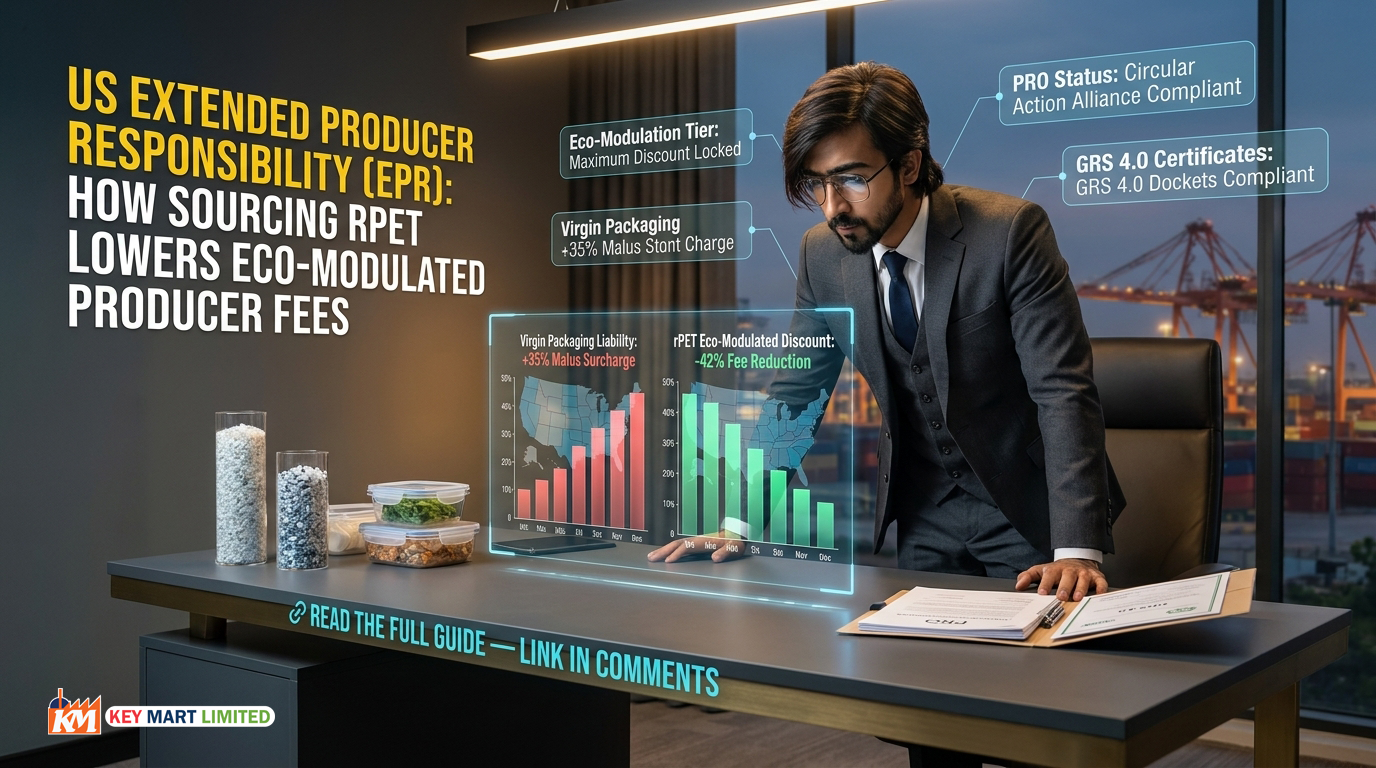
Under these laws, brand owners must join a state-approved Producer Responsibility Organization (PRO), such as Circular Action Alliance (CAA), and pay annual producer fees on every pound of packaging introduced into each state.
These fees are not flat taxes. They operate on eco-modulation.
If a brand packages products in virgin fossil-based plastic, uses hard-to-recycle barrier layers, or ignores post-consumer content, the PRO hits them with severe financial maluses (surcharges).
Conversely, brands that incorporate verified, high-ratio post-consumer recycled Polyethylene Terephthalate (pet flakes) qualify for significant fee discounts and eco-modulated rebates.
Achieving meaningful US plastics EPR fee reduction requires aligning corporate sustainability targets with financial balance sheets.
By integrating clean, certified rPET flakes with unbroken mass-balance traceability, CSOs and CFOs can lower packaging fees, comply with state mandates, and protect operating margins.
This executive strategy guide breaks down the mechanics of eco-modulated fee formulas, calculates real-world cost savings across early-adopter EPR states, and explains how Key Mart Limited delivers audit-ready rPET flakes to multinational consumer brands.
1. How Eco-Modulation Works: The Math Behind EPR Packaging Fees
Producer Responsibility Organizations calculate annual brand contributions using a dynamic formula designed to incentivize circular design:
Annual Brand Packaging Tonnage (Lbs)
   ├── Base Material Fee Rate ($/Lb by Resin Class)
   ├── Eco-Modulation Multiplier (Malus Penalty for Virgin Resin / Problematic Additives)
   └── Eco-Modulation Discount (Credit for Certified Post-Consumer Recycled Content)
         └── Total Net Annual PRO Fee Liability
A. The Base Fee vs. Eco-Modulated Multipliers
Every packaging material starts with a baseline fee rate per pound, reflecting the actual municipal cost to collect, sort, and process that material.
-
The Virgin Surcharge (Malus): Packages relying on 100% virgin fossil resin face penalty multipliers of $1.2\times\text{ to }1.5\times$ the baseline rate to disincentivize virgin plastic consumption.
-
The Recycled Content Credit (Bonus): State statutes explicitly require PRO fee schedules to reward post-consumer recycled (PCR) resin. Incorporating verified rPET yields tiered discounts proportional to the percentage of recycled material blended into the container:
B. State-by-State Regulatory Rollout
-
Oregon (SB 582): Operational fee structures require producers to report exact packaging compositions, offering discounted rates for high-PCR formats and recyclability performance.
-
Colorado (HB 22-1355): Requires producers to fund statewide recycling infrastructure through tiered dues that reward post-consumer content and high-yield mechanical reclamation.
-
California (SB 54): Combines EPR funding mechanisms with rigid minimum PCR mandates ($25\%$ scaling to $50\%$), penalizing brands that fail to hit recycled content baselines.
-
Maine (LD 1541): Assesses direct municipal reimbursement fees based on net packaging weight, offering fee reductions for packaging designed with post-consumer recycled resin.
Brand EPR Packaging Fee Impact & Savings Matrix
Read More: A Step-by-Step Guide to Importing PET Flakes from Bangladesh via Chittagong Port
| Packaging Configuration | 100% Virgin Fossil PET | Unverified Scrap Blend | Certified High-PCR rPET (Key Mart Standard) |
| Eco-Modulation Fee Status | Full Malus Surcharge ($1.2\times\text{–}1.5\times$) | Disqualified from Credits | Maximum Eco-Modulation Discount Tier |
| PRO Audit & Verification | Basic Weight Disclosures | Rejected (Unverified) | 100% GRS 4.0 Transaction Audited |
| Feedstock Provenance | Virgin Petrochemical | Inconsistent Scrap Mix | 100% Post-Consumer Beverage Bottles |
| Intrinsic Viscosity (IV) Baseline | $0.78\text{–}0.80\text{ dL/g}$ | $0.65\text{–}0.70\text{ dL/g}$ (Unstable) | 0.78 – 0.82 dL/g (Stable Preform Grade) |
| PVC Contamination Ceiling | $0\text{ PPM}$ | $> 150\text{–}300\text{ PPM}$ | < 25 – 50 PPM (Continuous Hot-Caustic) |
| Micro-Dust & Fines ($<500\,\mu\text{m}$) | $< 0.1\%$ | $> 2.5\text{–}3.5\%$ | < 0.3% (Multi-Stage Air Elutriated) |
| Color Coordinates ($L^*, b^*$) | $L^* \ge 88.0, b^* \le 0.5$ | $L^* < 70.0, b^* > +4.0$ | L* ≥ 74.0 to 84.0+, b* ≤ +1.2 |
| Annual EPR Fee Liability | Maximum Financial Exposure | Non-Compliance Fines | Lowest Net Tiered Operating Cost |
2. Three Actions for CSOs and CFOs to Lower Packaging Costs
Corporate leadership teams can turn regulatory compliance into a competitive advantage by executing three strategic packaging moves:
-
Calculate Net Cost Parity with Eco-Credits: When procurement teams compare virgin resin spot prices against recycled feedstocks, they often look only at raw material invoices. Factoring in eco-modulated fee reductions and avoiding non-compliance penalties frequently makes high-PCR packaging more cost-effective on a total-delivered-cost basis.
-
Standardize on Clear rPET to Maximize Modulation Discounts: PRO fee schedules heavily penalize opaque or heavily colored containers because they have low market value in secondary recycling. Transitioning product lines to crystal-clear rPET unlocks the highest tier of recyclability bonuses.
-
Secure Independent Chain-of-Custody Certification: PRO compliance auditors reject self-declared PCR claims. To claim fee rebates legally, every pound of recycled resin must be substantiated by accredited third-party Global Recycled Standard (GRS 4.0) transaction certificates that trace feedstock directly to post-consumer collection sources.
3. How Key Mart Limited Supplies Audit-Ready rPET Flakes to US Brands
Lowering state EPR liabilities requires partnering with an established bangladesh pet flakes manufacturer that delivers verified post-consumer provenance, continuous hot-caustic washing, and consistent containerized volume.
As a premier pet flakes company bangladesh and trusted pet flakes exporter, Key Mart Limited delivers audit-proof, high-IV clear rPET flakes engineered to help global CPG brands secure maximum eco-modulation fee credits:
-
100% Post-Consumer Collection in Dhaka: Operating as a leading pet flakes manufacturer dhaka, Key Mart Limited selectively processes 100% post-consumer clear beverage containers, rejecting mixed industrial scrap, colored packaging, and non-PET plastics at our collection gates.
-
Continuous Multi-Stage Caustic Washing ($85^\circ\text{C}-95^\circ\text{C}$): As an established bangladesh pet flakes manufacturer, our facility subjects flakes to continuous hot-caustic friction washing and automated NIR optical sorting, fully saponifying label glues and stripping organic residues to guarantee $\text{PVC} < 25\text{–}50\text{ PPM}$ and zero adhesive carryover.
-
Sub-0.3% Fines Removal via Air Elutriation: Serving as an experienced pet flakes exporter, Key Mart Limited passes every batch through automated multi-stage zig-zag air classifiers, keeping dust and fines strictly below $0.3\%$ to eliminate premature burning and melt pressure surges during extrusion.
-
Laboratory-Backed GRS 4.0 Traceability: Every export batch is tested in our Dhaka quality control laboratory for stable Intrinsic Viscosity ($0.78\text{–}0.82\text{ dL/g}$) and high luminance ($L^* \ge 74.0, b^* \le +1.2$), supported by batch-specific Certificates of Analysis (CoA) and official Global Recycled Standard (GRS 4.0) Transaction Certificates (TC) that satisfy state PRO compliance audits.
-
Maximized 25–26 MT Container Payloads: We pack 25–26 Metric Tons into every 40ft High Cube container with heavy-duty 100-micron PE inner liners to preserve feedstock dryness during transit under FOB Chittagong, CFR, or CIF shipping terms, with contractually secured extended free time at major US destination ports.
Partner with Key Mart Limited Today
Lower your US Extended Producer Responsibility fee exposure, unlock eco-modulation discounts, and secure high-purity rPET flakes from Bangladesh. Contact our Dhaka export management team today to request Technical Data Sheets, order commercial testing samples, or reserve monthly container allocations.
-
Company Name: Key Mart Limited
-
Head Office & Factory Address: Plot #31, Road #N-1, Block #K, Eastern Housing, Pallabi 2nd Phase, Rupnagar, Dhaka-1216, Bangladesh.
-
Official Website: www.keymartbd.com
-
Corporate Email: keymartltd@gmail.com | info@keymartbd.com
-
Direct Phone / WhatsApp: +8801760774499, +8801864935478
Join our community today and stay connected with the future of PET recycling.
 Visit our YouTube channel: Key Mart Limited on YouTube
Visit our Facebook Page: Key Mart Limited on Facebook
Subscribe to see our latest factory tours, production updates, and export success stories.