Views: 14
In the recycled Polyethylene Terephthalate (pet flakes) industry, procurement managers and extrusion engineers often evaluate material quality based on Intrinsic Viscosity (IV), moisture content, and PVC contamination. However, one fundamental physical parameter directly dictates hourly manufacturing efficiency, melt stability, and energy consumption: Bulk Density ($\text{kg/m}^3$ or $\text{lbs/ft}^3$).
For international buyers operating high-speed polyester staple fiber (PSF) spinning lines, sheet extruders, or strapping machinery, variations in flake bulk density can cause feed throat bridging, output fluctuations, and severe melt surges. Understanding the science behind bulk density enables extrusion plant operators to maximize throughput and ensure consistent production yields.
What is Bulk Density and Why Does It Matter in Extrusion?
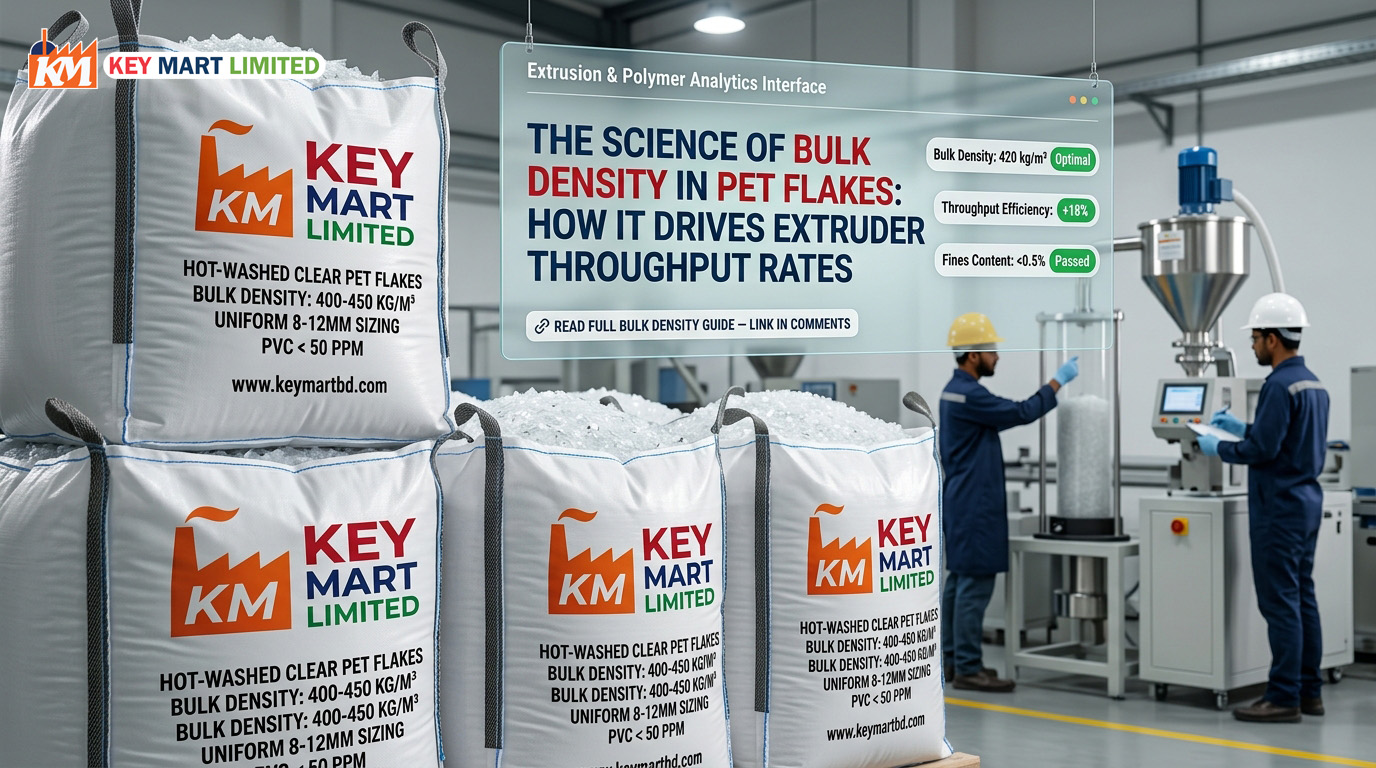
Bulk density is the mass of pet flakes divided by the total volume they occupy, including the air voids between individual flakes. While the true particle density of solid PET resin is approximately $1.38 – 1.40 \text{ g/cm}^3$, uncompacted recycled PET flakes typically exhibit a bulk density ranging from $250 \text{ kg/m}^3$ to $450 \text{ kg/m}^3$.
Low Bulk Density (< 300 kg/m³) ➔ Entrapped Air ➔ Feed Throat Bridging & Melt Surging ➔ Low Throughput
High Bulk Density (> 400 kg/m³) ➔ Uniform Screw Filling ➔ Stable Volumetric Feeding ➔ Maximum Extruder Output
When flakes are fed into an extruder hopper, low bulk density creates several operational challenges:
-
Inconsistent Volumetric Feeding: Extruder feed screws rely on gravity and consistent bulk volume to fill screw flights. Low bulk density flakes contain high volumes of entrapped air, reducing the actual weight of polymer delivered per screw revolution.
-
Screw Bridging & Funneling: Flakes with irregular, thin, or oversized geometry interlock inside feed hoppers, forming air pockets and “bridges” that temporarily starve the extruder screw.
-
Melt Surging & Pressure Instability: Fluctuations in mass flow cause barrel pressure drops and melt surges, leading to thickness variation in thermoformed sheets or fiber yarn breakage.
-
Elevated Energy Consumption: Extruders must run at higher RPMs to maintain target mass output when processing fluffy, low-density material, increasing specific energy consumption per kilogram of output.
Read More: A Step-by-Step Guide to Importing PET Flakes from Bangladesh via Chittagong Port
Factors Influencing the Bulk Density of PET Flakes
Achieving optimal bulk density requires precise mechanical processing during bottle flake manufacturing. Three main factors determine the final bulk density of a batch:
1. Particle Size Distribution & Geometry
Flake geometry plays a critical role. Flakes that are too large, curved, or irregularly shaped create high air void ratios. A controlled flake size distribution (typically $8\text{ mm} – 12\text{ mm}$) allows smaller flakes to pack efficiently between larger ones, increasing overall bulk density without generating excessive fine dust.
2. Flake Thickness & Wall Geometry
Post-consumer bottles vary in wall thickness (e.g., lightweight water bottles vs. thick carbonated soft drink bottles). High-density batches feature a balanced mix of wall thicknesses that resist curling during high-temperature caustic hot-washing.
3. Fines & Dust Elimination
Fine particles ($< 500\,\mu\text{m}$) cause melting issues, screen pack clogging, and thermal degradation. Advanced air elutriation systems strip fines and light film fragments, ensuring a uniform, high-density flake stream.
Technical Bulk Density & Extrusion Performance Table
| Quality Parameter | Low Density Flakes | High Density Flakes (Export Standard) | Operational Advantage |
| Bulk Density | $< 300 \text{ kg/m}^3$ | 400 – 450 kg/m³ |
Maximizes kg/hour feed rate without forcing feed modification |
| Flake Size Range | Irregular ($> 15\text{ mm}$) | 8 – 12 mm Uniform Sizing |
Prevents hopper bridging & ensures smooth screw filling |
| Fines Content (<500 µm) | $> 1.5\%$ | < 0.5% |
Reduces screen pack pressure spikes & polymer degradation |
| Container Payload | $\approx 18 – 20 \text{ MT / 40′ HC}$ | 25 – 26 MT / 40' HC |
Slashes ocean freight cost per metric ton |
How Key Mart Limited Fulfills Global Buyer Demand
Sourcing high-bulk-density recycled PET requires a manufacturing partner with engineered granulating, washing, and air elutriation systems.
As a premier pet flakes company bangladesh and trusted pet flakes exporter, Key Mart Limited delivers export-grade feedstock engineered for maximum extrusion throughput:
-
Engineered Granulation in Dhaka: Operating as a leading pet flakes manufacturer dhaka, Key Mart Limited utilizes precision rotary granulators to produce uniform 8–12 mm flakes with an optimized bulk density benchmark of $400 – 450 \text{ kg/m}^3$, ensuring stable melt feeds in high-speed extruders.
-
State-of-the-Art Washing & Elutriation: As an established bangladesh pet flakes manufacturer, our high-temperature caustic hot-washing and Z-Box air elutriation systems eliminate fines ($< 0.5\%$), light films, and label dust, delivering clean, high-density flakes with sub-50 PPM PVC and Polyolefin limits.
-
Maximizing Freight Efficiency: Functioning as an experienced pet flakes exporter, Key Mart Limited packages products in moisture-protected, form-stable Baffle FIBC jumbo bags fitted with 100 $\mu\text{m}$ PE liners. High bulk density allows us to pack up to 25–26 Metric Tons per 40ft High Cube container, reducing landed logistics costs for buyers.
-
Full Batch Traceability & Compliance: Every order is backed by batch-specific Certificates of Analysis (CoA), Technical Data Sheets (TDS), and complete GRS (Global Recycled Standard) traceability under FOB Chittagong or CFR/CIF terms.
Partner with Key Mart Limited Today
Optimize your extrusion line throughput, lower energy consumption per kilogram, and secure consistent high-density rPET feedstock. Contact our export management desk today to request Technical Data Sheets, order commercial samples, or schedule container allocation schedules.
-
Company Name: Key Mart Limited
-
Head Office & Factory Address: Plot #31, Road #N-1, Block #K, Eastern Housing, Pallabi 2nd Phase, Rupnagar, Dhaka-1216, Bangladesh.
-
Official Website: www.keymartbd.com
-
Corporate Email: keymartltd@gmail.com | info@keymartbd.com
-
Direct Phone / WhatsApp: +8801760774499, +8801864935478
Join our community today and stay connected with the future of PET recycling.
👉 Visit our YouTube channel: Key Mart Limited on YouTube
👉 Visit our Facebook Page: Key Mart Limited on Facebook
Subscribe to see our latest factory tours, production updates, and export success stories.