Views: 6
For global buyers sourcing recycled Polyethylene Terephthalate (pet flakes) for high-end applications like polyester staple fiber (PSF), strapping, sheet extrusion, or food-grade packaging, chemical purity is non-negotiable. While removing labels, caps, and obvious dirt is fundamental, the critical challenge in producing premium rPET lies in eliminating invisible chemical contaminants, specifically Benzene and other Volatile Organic Compounds (VOCs).
If these hazardous compounds are not rigorously screened out, they can lead to strong odors, discoloration during high-temperature processing, and severe regulatory non-compliance in finished goods. This detailed overview explores the advanced industrial processes required to eliminate invisible VOCs and ensure the production of export-grade PET feedstock.
1. The Invisible Threat: Where Do Benzene and VOCs Come From?
Volatile Organic Compounds (VOCs), including toxic compounds like Benzene, Toluene, and Ethylbenzene, do not originate from the PET polymer itself. Instead, they migrate into the plastic matrix during the first life of the post-consumer bottle.
Primary sources include:
-
Contained Goods: Bottles previously used to store chemical solvents, pesticides, fertilizers, or industrial liquids.
-
Adhesives & Printing Inks: Solvents used in labels and glues can penetrate the PET material.
-
Environmental Exposure: Bottles collected from contaminated sites, industrial areas, or stored improperly can absorb VOCs.
Because VOCs have a high vapor pressure and migrate easily at elevated temperatures, standard washing often fails to fully eliminate them, necessitating advanced screening and processing.
2. Advanced Industrial Processes to Screen Out VOCs
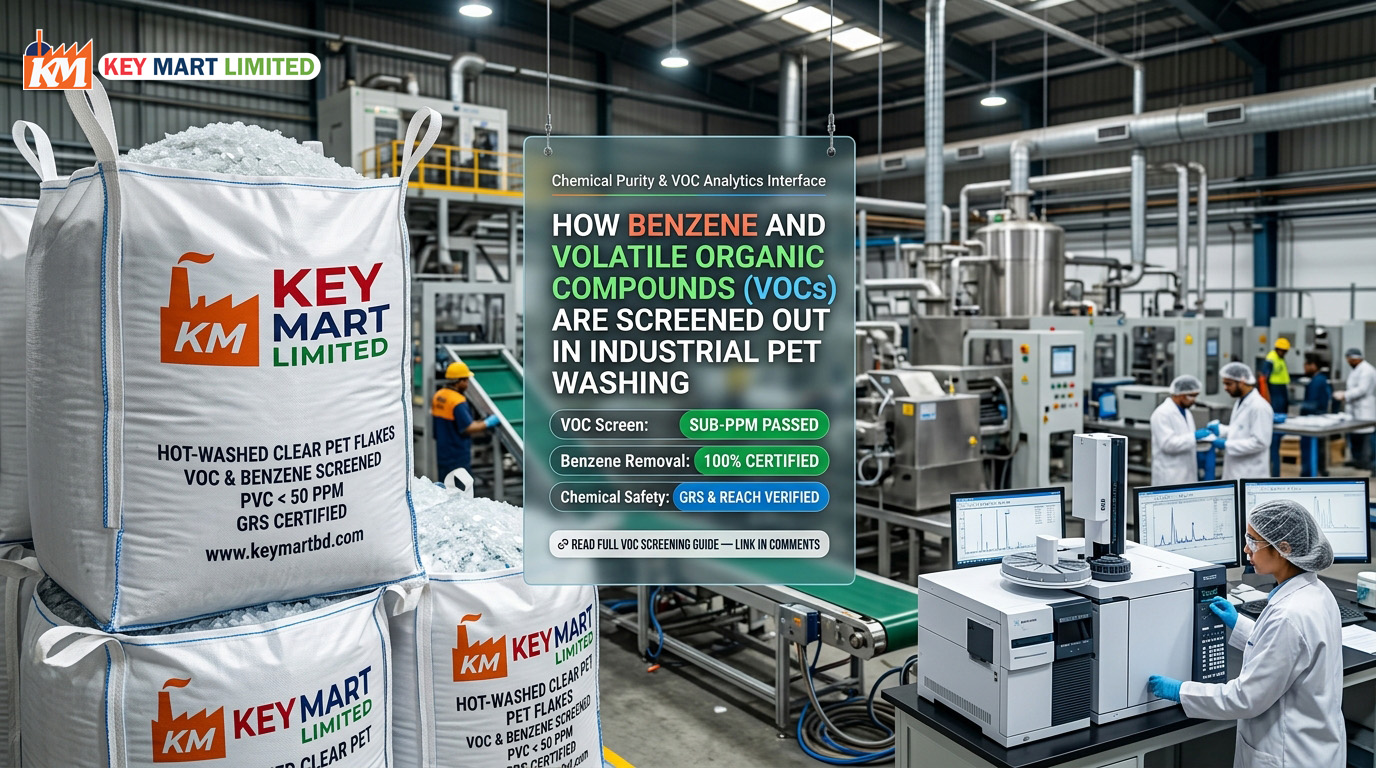
To consistently achieve the chemical purity required by international standard GRS (Global Recycled Standard), industrial wash plants utilize a multi-faceted approach involving pre-sorting, high-temperature thermal washing, and final moisture elutriation.
Dry De-Labeling & Pre-Sorting: The First Defense
Effective VOC removal starts before granulation. Industrial mechanical de-labelers strip off film labels (PP/PE/PVC) and the majority of external adhesives. Following this, advanced Near-Infrared (NIR) optical sorters identify and eject entire non-PET containers, contaminated bottles, or aged, yellowed bottles that are statistically more likely to have absorbed VOCs.
Caustic Hot-Washing: The Chemical Strip
This is the most critical step. The granulated pet flakes undergo intensive caustic hot-washing at temperatures between 85°C and 95°C, using sodium hydroxide (NaOH) and specialized surfactants. This high-temperature, alkaline environment:
-
Neutralizes and Dissolves Adhesives: It breaks down the chemical bonds of adhesives, stripping invisible glue residues and ink binders.
-
Surfactant Action: Surfactants isolate dissolved organic compounds, including migrating VOCs, preventing them from re-contaminating the clean flakes.
Thermal Volatilization & Steam Injection
In highly advanced systems, particularly those producing food-grade rPET or flakes for high-tenacity fiber, the washed flakes pass through a thermal elutriator or steam stripper. High-temperature steam or hot, dry air is introduced, heating the flakes. Because the boiling points of Benzene (80°C) and other target VOCs are lower than the PET matrix breakdown temperature, these compounds are volatilized (turned into gas) and efficiently vented from the system.
Z-Box Air Elutriation & Final Drying
Following the thermal treatments, the flake stream enters a Z-Box air elutriator. A powerful upward airflow separates lightweight dust, fine particles, and volatile compounds, simultaneously cooling the flakes and eliminating the final traces of surface-level and internal VOCs.
Read More: A Step-by-Step Guide to Importing PET Flakes from Bangladesh via Chittagong Port
3. Verification: Measuring Benzene & VOC Purity
To ensure compliance under global safety and food-contact regulations (REACH/FDA), accredited laboratories utilize Gas Chromatography-Mass Spectrometry (GC-MS) to analyze flake batches.
This standard testing ensures that Benzene and specific VOCs are below measurable regulatory thresholds (often in the low parts per million or even parts per billion), guaranteeing that the pet flakes do not present odor problems, discoloration, or safety hazards during melt processing.
4. Technical Purity & VOC Benchmark Table
| Quality Parameter | Testing Protocol | Export Purity Benchmark | Impact on Extrusion/Spinning |
| Volatile Organic Compounds (VOCs) | GC-MS Analysis | Sub-PPM (Parts Per Million) Trace | Eliminates odors, phase separation, and discoloration |
| PVC Contamination | Thermal Colorimetric / Solvent | < 50 PPM |
Prevents equipment corrosion, yellowing, and black specks |
| Intrinsic Viscosity (IV) | ASTM D4603 / Ubbelohde | 0.72 – 0.78 dL/g |
Retains mechanical tenacity and tensile strength |
| Moisture Content | Karl Fischer Titration | < 1.0% |
Eliminates hydrolytic degradation in transit and processing |
| Fine Content (<500 µm) | Mesh Sieve Analysis | < 0.5% |
Ensures uniform extrusion and reduces screen pack clogging |
5. How Key Mart Limited Fulfills Global Buyer Demand
Sourcing chemically pure, VOC-screened recycled PET requires a manufacturing partner with advanced processing technology and strict laboratory verification.
As a premier pet flakes company bangladesh and trusted pet flakes exporter, Key Mart Limited delivers premium, export-ready rPET feedstock engineered to meet the stringent technical and chemical demands of global importers:
-
Advanced Industrial Processing in Dhaka: Operating as a leading pet flakes manufacturer dhaka, Key Mart Limited operates state-of-the-art caustic hot-washing lines and Z-Box elutriation systems designed to effectively eliminate Benzene, VOCs, heavy metals, and adhesive residues.
-
Guaranteed Sub-50 PPM PVC & High Purity: As an established bangladesh pet flakes manufacturer, our flakes consistently achieve sub-50 PPM PVC limits, sub-500 PPM color contamination, and compliant low VOC levels verified via batch-specific analysis.
-
In-House & Independent QA Verification: Every shipment produced by Key Mart Limited is backed by batch-specific Certificates of Analysis (CoA), Technical Data Sheets (TDS), and full GRS traceability.
-
Optimized Export Packaging & Logistics: Functioning as an experienced pet flakes exporter, Key Mart Limited packages products in heavy-duty Baffle FIBC jumbo bags fitted with PE moisture liners. We maximize payloads in 40ft High Cube containers up to 25–26 Metric Tons per shipment, lowering the carbon footprint and landed cost per ton.
Partner with Key Mart Limited Today
Lower your supply chain risk and ensure peak chemical safety and material performance with chemically pure, VOC-free rPET flakes from Bangladesh. Connect with Key Mart Limited today to request Technical Data Sheets, order commercial samples, or discuss container allocation schedules.
-
Company Name: Key Mart Limited
-
Factory Address: [Insert Factory Address in Dhaka]
-
Official Website: www.keymartbd.com
-
Corporate Email: info@keymartbd.com | keymartltd@gmail.com
-
Contact Phone / WhatsApp: +8801760774499, +8801864935478
Join our community today and stay connected with the future of PET recycling.
👉 Visit our YouTube channel: Key Mart Limited on YouTube
👉 Visit our Facebook Page: Key Mart Limited on Facebook
Subscribe to see our latest factory tours, production updates, and export success stories.