Views: 3
In modern civil engineering, precast concrete manufacturing, and industrial flooring, traditional steel mesh reinforcement faces persistent operational challenges: heavy dead-weight, high logistics costs, and progressive chloride-induced corrosion. To improve structural longevity and reduce carbon footprints, construction material manufacturers are turning to synthetic macro-fibers derived from post-consumer recycled Polyethylene Terephthalate (pet flakes).
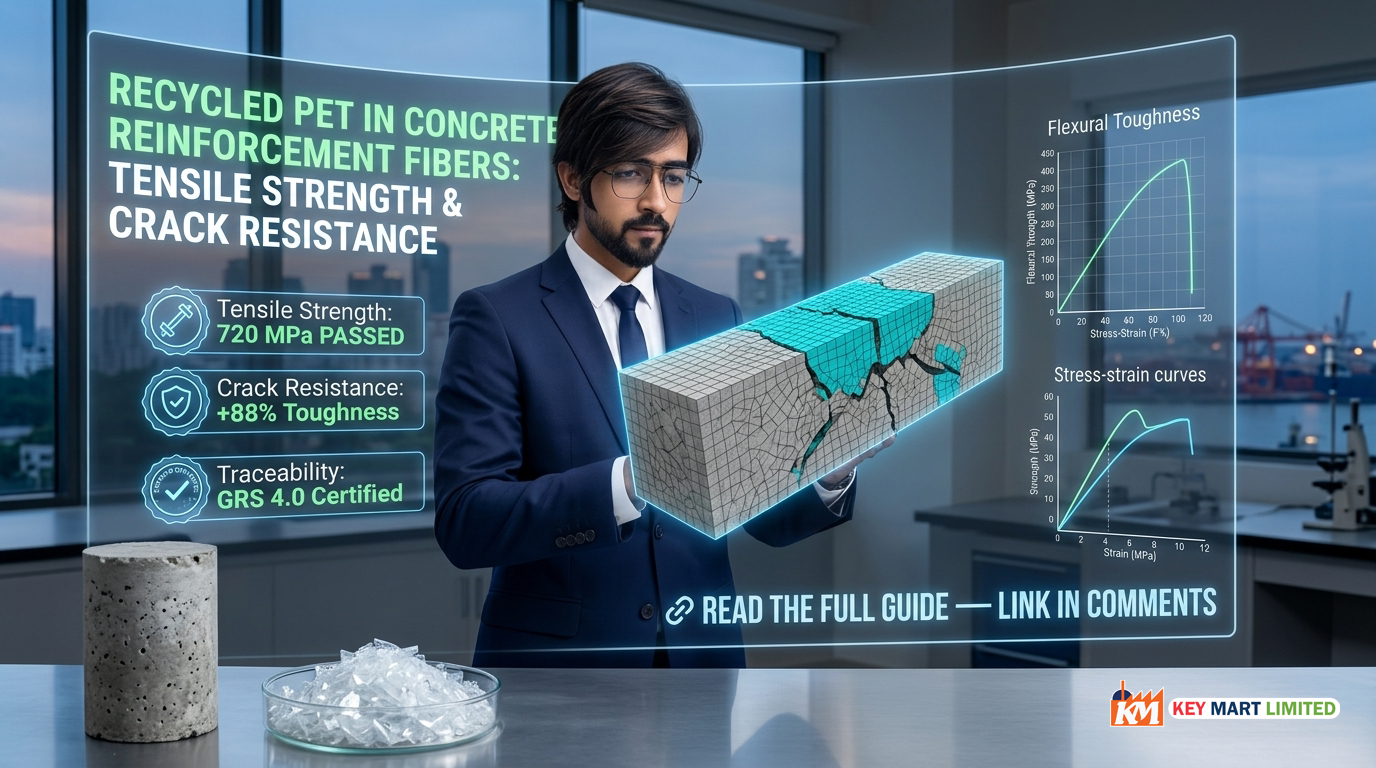
Integrating engineered rPET fibers concrete reinforcement into cementitious matrices provides an effective solution to plastic shrinkage cracking, enhances post-crack flexural toughness, and eliminates corrosion degradation.
However, substituting virgin polypropylene (PP) or steel fibers with recycled PET requires high material integrity.
Construction fibers demand high tensile strength ($> 600\text{–}750\text{ MPa}$), stable Intrinsic Viscosity ($IV \ge 0.78\text{ dL/g}$), and proven resistance to the alkaline pore solution of hydrating cement ($\text{pH } 12.5\text{–}13.5$).
This technical guide examines the mechanics of rPET macro-fiber reinforcement, analyzes alkali-resistance stabilization methods, and demonstrates how Key Mart Limited delivers low-contaminant, high-tenacity rPET feedstock for fiber extrusion.
1. Mechanics of Crack Bridging and Flexural Toughness
Concrete is strong in compression but weak in tension. Micro-cracks develop rapidly during the early plastic shrinkage phase (first 24 hours) and expand under dynamic mechanical loading:
Early Cement Hydration ➔ Plastic Shrinkage Stress ➔ Micro-Crack Initiation ➔ rPET Macro-Fibers Intercept & Bridge Cracks ➔ Stress Redistribution & Energy Absorption
A. Crack-Bridging Mechanics
When dispersed uniformly in the mix ($3.0\text{ to }9.0\text{ kg/m}^3$), embossed or crimped rPET macro-fibers intercept micro-cracks as they propagate. The high tensile strength and mechanical interlock of the fibers arrest crack growth, transitioning brittle failure into a ductile failure mode with high residual flexural strength (ASTM C1609).
B. Overcoming Alkaline Hydrolysis in Cement Matrices
A primary technical concern for construction engineers is the alkaline environment of concrete pore solutions ($\text{Ca(OH)}_2$ with $\text{pH } 12.5\text{–}13.5$), which can attack ester linkages in PET.
-
Hydrolytic Resistance: Extruding fibers from rPET flakes with a high, uniform Intrinsic Viscosity ($0.78\text{–}0.82\text{ dL/g}$) ensures dense molecular packing and high crystallinity ($> 40\%$), preventing alkaline ingress.
-
Surface Texturing: Mechanical embossing creates physical anchoring along the fiber length, ensuring high pull-out resistance without relying on chemical bonding that could degrade over time.
Read More: A Step-by-Step Guide to Importing PET Flakes from Bangladesh via Chittagong Port
Concrete Reinforcement Fiber Performance Benchmark Table
| Performance & Material Metric | Virgin Polypropylene (PP) Fiber | Unsorted Scrap rPET Fiber | High-Tenacity rPET Fiber (Key Mart Standard) |
| Tensile Strength | $500\text{–}650\text{ MPa}$ | $350\text{–}450\text{ MPa}$ (Brittle) | 650 – 780 MPa (High Structural Tenacity) |
| Elastic Modulus | $3.5\text{–}5.0\text{ GPa}$ | $6.0\text{–}7.5\text{ GPa}$ | 9.0 – 11.5 GPa (Superior Stiffness vs PP) |
| Alkali Resistance (pH 13) | Chemically Inert | Surface Pitting / Fast Degradation | Resistant (High Crystallinity >40%) |
| Plastic Shrinkage Crack Reduction | $70\text{–}85\%$ | $40\text{–}55\%$ | > 85% – 92% (High Aspect Ratio Dispersion) |
| PVC Contamination | $0\text{ PPM}$ | $> 150\text{–}300\text{ PPM}$ | < 25 – 50 PPM (Continuous Hot-Caustic) |
| Intrinsic Viscosity (IV) Baseline | N/A | $0.65\text{–}0.70\text{ dL/g}$ | 0.78 – 0.82 dL/g (Stable Spinning Standard) |
| Supply Traceability | Fossil Baseline | Unverified | GRS 4.0 Transaction Certified (TC) |
2. Engineering Direct Extrusion for Concrete Macro-Fibers
Producing alkali-resistant synthetic macro-fibers directly from unpelletized flakes requires strict extrusion and drawing controls:
-
High-Draw Ratio Solid-State Orientation: Extruded monofilaments must pass through multi-stage hot-air drawing ovens with total draw ratios of $1:5.5\text{ to }1:7.0$, orienting polymer chains axially to achieve tensile strengths exceeding $700\text{ MPa}$.
-
Surface Embossing & Crimping: In-line embossing rolls apply continuous diamond or sinusoidal indentations to maximize mechanical friction and pull-out resistance inside the concrete matrix.
-
Moisture Control & De-Dusting: Flakes must be dried below $0.5\%$ moisture and de-dusted ($<0.3\%$ fines) to prevent filament breaks and die-hole blockages during high-speed monofilament spinning.
3. How Key Mart Limited Supplies Construction-Grade rPET Feedstock
Manufacturing high-performance concrete reinforcement fibers requires an established bangladesh pet flakes manufacturer with institutional purity and viscosity control.
As a premier pet flakes company bangladesh and trusted pet flakes exporter, Key Mart Limited delivers candidate rPET flakes engineered for synthetic fiber spinning:
-
Source-Segregated 100% Clear Bottle Selection in Dhaka: Operating as a leading pet flakes manufacturer dhaka, Key Mart Limited selectively processes post-consumer beverage bottles, excluding PVC, labels, and degraded polymers at the intake gate.
-
Continuous Multi-Stage Caustic Washing: As an established bangladesh pet flakes manufacturer, our facility subjects flakes to continuous hot-caustic friction washing ($85^\circ\text{C}-95^\circ\text{C}$) and automated NIR optical sorting, guaranteeing $\text{PVC} < 25\text{–}50\text{ PPM}$, zero glue residue, and moisture dried below $0.5\%$.
-
Sub-0.3% Fines Removal via Air Elutriation: Serving as an experienced pet flakes exporter, Key Mart Limited removes micro-fines through multi-stage zig-zag classifiers, preventing filter clogging and melt pressure fluctuations in fiber extrusion lines.
-
High IV Stability for High Tensile Tenacity: Every export batch is tested in our Dhaka quality control laboratory for stable Intrinsic Viscosity ($0.78\text{–}0.82\text{ dL/g}$), backed by batch-specific Certificates of Analysis (CoA) and Global Recycled Standard (GRS 4.0) Transaction Certificates (TC).
-
Maximized 25–26 MT Container Logistics: We pack 25–26 Metric Tons into every 40ft High Cube container with heavy-duty 100-micron PE inner liners to preserve feedstock dryness during transit under FOB Chittagong, CFR, or CIF shipping terms.
Partner with Key Mart Limited Today
Upgrade your concrete reinforcement fiber formulations, lower embodied carbon in civil infrastructure, and secure high-purity rPET flakes from Bangladesh. Contact our Dhaka export management team today to request Technical Data Sheets, order commercial testing samples, or reserve monthly container allocations.
-
Company Name: Key Mart Limited
-
Head Office & Factory Address: Plot #31, Road #N-1, Block #K, Eastern Housing, Pallabi 2nd Phase, Rupnagar, Dhaka-1216, Bangladesh.
-
Official Website: www.keymartbd.com
-
Corporate Email: keymartltd@gmail.com | info@keymartbd.com
-
Direct Phone / WhatsApp: +8801760774499, +8801864935478
Join our community today and stay connected with the future of PET recycling.
 Visit our YouTube channel: Key Mart Limited on YouTube
Visit our Facebook Page: Key Mart Limited on Facebook
Subscribe to see our latest factory tours, production updates, and export success stories.