Views: 5
In the manufacturing of industrial paint brushes, cosmetic applicators, street-sweeper brooms, and technical monofilaments, synthetic bristles must meet strict mechanical performance standards: high bend recovery, tensile stiffness, straightness retention, and uniform diameter. While brush manufacturers face increasing brand and regulatory pressure to replace virgin Polybutylene Terephthalate (PBT) and Polyamide (PA6/PA66) with recycled feedstock, processing post-consumer pet flakes directly into precision monofilaments presents technical hurdles.
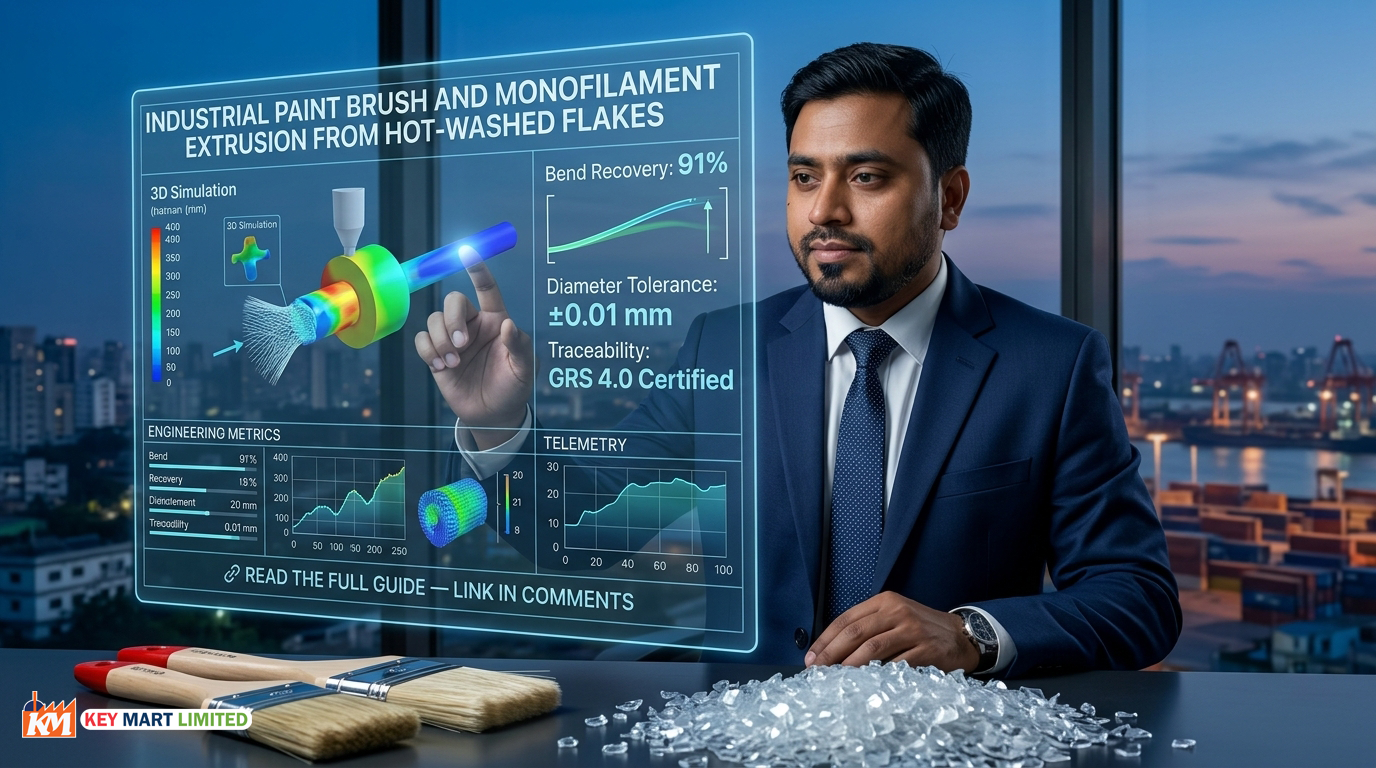
Unlike heavy-denier staple fibers, precision monofilament extrusion requires tight diameter tolerances ($\pm 0.01\text{ mm}$), consistent melt viscosity, and zero non-melting inclusions.
Using substandard flake feedstock causes filament diameter surging, frequent spinneret hole clogging, fiber snapping during high-ratio drawing, and bristle curvature distortion (poor straightness retention).
Achieving structural stiffness and uniform filament geometry requires sourcing premium PET monofilament extrusion flakes paired with optimized multi-stage orientation and thermal relaxation processes.
This technical engineering guide examines the mechanics of extruding monofilaments from hot-washed flakes, defines bristle stabilization protocols, and illustrates how Key Mart Limited delivers low-contaminant, high-IV feedstock to technical brush manufacturers worldwide.
1. Mechanics of Monofilament Stiffness, Straightness, and Bend Recovery
A commercial paint brush bristle must withstand repeated lateral flexural fatigue without developing permanent plastic deformation (curling or flagging):
Hot-Washed Flakes ➔ Continuous Extrusion ➔ Water Bath Quenching ➔ Multi-Stage Hot-Air Orientation (Draw Ratio 1:4.5–1:5.8) ➔ Thermal Annealing ➔ High Bend Recovery Bristles
A. Axial Molecular Orientation & Draw Ratio
During precision monofilament spinning, extruded polymer strands pass through temperature-controlled water quench tanks ($40^\circ\text{C}\text{–}50^\circ\text{C}$) to freeze the PET in an amorphous state. The strands are then fed into multi-stage hot-air drawing ovens ($140^\circ\text{C}\text{–}180^\circ\text{C}$) with draw ratios of $1:4.5\text{ to }1:5.8$:
-
Tensile Stiffness: High draw ratios align polymer chains along the fiber axis, raising tensile strength ($> 600\text{–}750\text{ MPa}$) and flexural modulus ($> 9.0\text{ GPa}$).
-
Straightness Retention: Proper molecular alignment prevents localized stress concentrations that cause bristles to bow or flare inside brush ferrules.
B. Thermal Relaxation & Annealing (Preventing Shrinkage)
Following axial stretching, the monofilaments pass through an inline annealing zone ($160^\circ\text{C}\text{–}190^\circ\text{C}$) under controlled relaxation ($2\%\text{–}5\%$). This heat-setting step releases frozen internal stresses, increasing crystallinity ($> 35\%$) and lowering boiling-water shrinkage below $< 3.0\%$, ensuring bristles stay straight during liquid paint application.
Read More: A Step-by-Step Guide to Importing PET Flakes from Bangladesh via Chittagong Port
Monofilament & Feedstock Quality Benchmark Table
| Material & Extrusion Parameter | Standard Scrap Flakes (High Breakage) | Technical Monofilament Standard | Impact on Finished Brush Bristles |
| Intrinsic Viscosity (IV) Baseline | $0.65\text{–}0.70\text{ dL/g}$ (Degraded) | 0.78 – 0.82 dL/g (Tight ±0.02 Span) |
Prevents filament snapping during drawing |
| PVC Contamination | $> 150\text{–}300\text{ PPM}$ | < 25 – 50 PPM (Target < 25 PPM) |
Eliminates spinneret die-hole clogging |
| Diameter Tolerance Control | $\pm 0.05\text{ mm}$ (Surging) | ± 0.01 mm (Uniform Extrusion) |
Ensures smooth paint pickup and laydown |
| Bend Recovery (ASTM D1203) | $< 65\%$ (Permanent Curl) | ≥ 88% – 92% (High Elastic Memory) |
Prevents brush splaying under heavy use |
| Dust & Fines Content ($<500\,\mu\text{m}$) | $> 2.0\text{–}3.5\%$ | < 0.3% (Multi-Stage Air Elutriated) |
Prevents melt pressure surging |
| Pre-Dryer Moisture Content | $> 1.0\%$ (Uncontrolled) | < 0.5% (Centrifugally & Heat Dried) |
Protects polymer chains from hydrolysis |
| Traceability & Certification | Unverified supply | GRS 4.0 Transaction Certified |
Fully compliant with EPR & PPWR regulations |
2. Engineering Controls to Prevent Spinneret Fouling and Snapping
To maintain 24/7 continuous spinning without filament breaks or diameter variations, monofilament plant operators implement three core processing controls:
-
Fine Sintered Metal Melt-Filtration ($25\text{–}40\,\mu\text{m}$): Because individual spinneret orifices are small ($0.15\text{–}0.60\text{ mm}$ diameter), installing fine continuous auto-backflush filters upstream of the spin pack catches sub-micron carbonized particles before they block capillary holes.
-
Precision Positive-Displacement Melt Pumps: Placing a high-accuracy gear pump directly before the spinneret pack isolates the die from extruder pressure variations, maintaining stable mass-flow rates and diameter tolerances within $\pm 0.01\text{ mm}$.
-
Multi-Stage Air Elutriation ($< 0.3\%$ Fines): Feeding de-dusted flakes into the extruder prevents uneven melting and premature degradation along screw flights, stabilizing melt temperature.
3. How Key Mart Limited Supplies Technical Monofilament Manufacturers
Sourcing raw material capable of meeting industrial bristle specifications requires an established bangladesh pet flakes manufacturer with precision cleaning and classification systems.
As a premier pet flakes company bangladesh and trusted pet flakes exporter, Key Mart Limited delivers candidate rPET flakes engineered for high-tenacity monofilament spinning:
-
Source-Segregated Clear Bottle Selection in Dhaka: Operating as a leading pet flakes manufacturer dhaka, Key Mart Limited selectively processes 100% post-consumer clear beverage bottles, excluding tinted plastics, multi-layer barrier bottles, and degraded polymers.
-
Continuous Multi-Stage Caustic Washing: As an established bangladesh pet flakes manufacturer, our facility subjects crushed flakes to continuous hot-caustic friction washing ($85^\circ\text{C}-95^\circ\text{C}$) and automated NIR optical sorting, guaranteeing $\text{PVC} < 25\text{–}50\text{ PPM}$, zero glue residue, and moisture dried below 0.5%.
-
Sub-0.3% Fines Removal via Air Elutriation: Serving as an experienced pet flakes exporter, Key Mart Limited passes every batch through automated multi-stage zig-zag air classifiers, keeping dust and fines strictly below $0.3\%$ to eliminate melt pressure spikes and spinneret clogging.
-
High IV Stability for High Tensile Tenacity: Every export batch is tested in our Dhaka quality control laboratory for stable Intrinsic Viscosity ($0.78\text{–}0.82\text{ dL/g}$), backed by batch-specific Certificates of Analysis (CoA) and Global Recycled Standard (GRS 4.0) Transaction Certificates (TC).
-
Maximized 25–26 MT Container Logistics: We pack 25–26 Metric Tons into every 40ft High Cube container with heavy-duty 100-micron PE inner liners to preserve feedstock dryness during ocean transit under FOB Chittagong, CFR, or CIF shipping terms.
Partner with Key Mart Limited Today
Upgrade your industrial brush bristles, stabilize your monofilament spinning lines, and secure high-purity rPET flakes from Bangladesh. Contact our Dhaka export management team today to request Technical Data Sheets, order commercial testing samples, or reserve monthly container allocations.
-
Company Name: Key Mart Limited
-
Head Office & Factory Address: Plot #31, Road #N-1, Block #K, Eastern Housing, Pallabi 2nd Phase, Rupnagar, Dhaka-1216, Bangladesh.
-
Official Website: www.keymartbd.com
-
Corporate Email: keymartltd@gmail.com | info@keymartbd.com
-
Direct Phone / WhatsApp: +8801760774499, +8801864935478
Join our community today and stay connected with the future of PET recycling.
 Visit our YouTube channel: Key Mart Limited on YouTube
Visit our Facebook Page: Key Mart Limited on Facebook
Subscribe to see our latest factory tours, production updates, and export success stories.