Views: 4
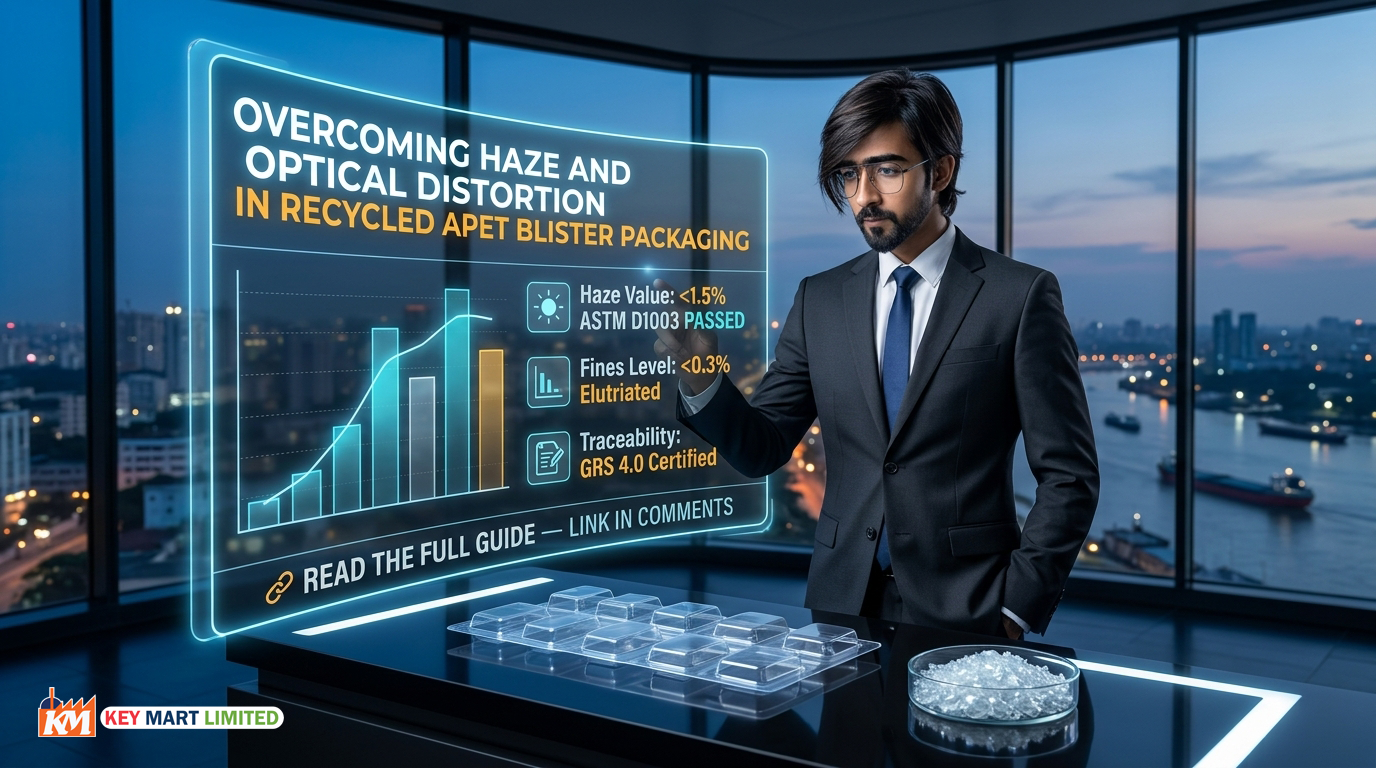
In consumer electronics, medical devices, and retail display thermoforming, packaging aesthetics drive consumer trust. For packaging engineers formulating thermoformed rigid blisters, achieving optical clarity recycled APET packaging is often challenged by structural optical defects: light scattering haze, milky cloudiness, and visual distortion.
While brand owners mandate higher post-consumer recycled content, plant engineers frequently observe that rPET-rich blends fail to match virgin amorphous PET (APET) clarity.
These optical inconsistencies stem from two primary material phenomena: micro-fines inducing nucleating crystal formation and uncontrolled Intrinsic Viscosity (IV) variance altering crystallization kinetics.
When unwashed fines ($< 500\,\mu\text{m}$) or fluctuating polymer chains enter the sheet extrusion line, they act as heterogeneous nucleation sites, triggering rapid, uncontrolled spherulitic crystallization during thermoforming mold contact.
This technical packaging guide analyzes the physical mechanisms of optical haze, defines crystallization control protocols, and demonstrates how Key Mart Limited delivers ultra-low-dust, high-clarity post-consumer pet flakes for glass-like blister packaging.
1. The Physics of Haze: Nucleation, Fines, and Spherulitic Growth
Amorphous Polyethylene Terephthalate achieves transparency because its molecular chains are quenched rapidly, freezing the polymer in an amorphous, non-crystalline state. Optical distortion occurs when this amorphous phase is disrupted:
Unseparated Micro-Fines / Contaminants ➔ Heterogeneous Nucleation Sites ➔ Rapid Spherulitic Crystal Formation ➔ Light Scattering (>2.5% Haze) ➔ Visual Blister Cloudiness
A. Heterogeneous Nucleation from Dust and Micro-Fines
Micro-fines ($< 0.5\%$) carry high surface charge and thermal degradation precursors. During melt processing and subsequent thermoforming heating ($130^\circ\text{C}\text{–}150^\circ\text{C}$), these micro-particles serve as crystal nuclei. Instead of remaining amorphous, spherulites grow larger than the wavelength of visible light ($400\text{–}700\text{ nm}$), scattering light and creating a milky visual haze.
B. Intrinsic Viscosity Variance and Crystallization Speed
Recycled feedstock with wide IV fluctuations ($0.65\text{ to }0.82\text{ dL/g}$) exhibits irregular melt flow indexes (MFI). Lower-molecular-weight fractions crystallize significantly faster, creating localized crystalline zones across the thermoformed pocket sidewalls that cause visual optical distortion and uneven wall thinning.
Read More: A Step-by-Step Guide to Importing PET Flakes from Bangladesh via Chittagong Port
Optical Clarity & Feedstock Purity Benchmark Table
| Packaging & Material Metric | High-Haze Scrap Flakes | Optical-Grade APET Standard | Impact on Thermoformed Blisters |
| Micro-Fines & Dust ($< 500\,\mu\text{m}$) | $> 2.5\%$ (High Nucleation) | < 0.3% – 0.5% (Elutriated Standard) |
Eliminates heterogeneous crystal cloudiness |
| Haze Value (ASTM D1003) | $> 4.5\text{–}6.0\%$ (Cloudy) | < 1.5% – 2.0% (Glass-Like Transparency) |
Provides high-clarity retail product display |
| Color Coordinates ($L^*$ / $b^*$) | $L^* < 68,\; b^* > +3.0$ | L* ≥ 74.0, b* ≤ +1.2 (Neutral Clear) |
Prevents yellowing under retail lighting |
| Intrinsic Viscosity (IV) Stability | $\pm 0.08\text{ dL/g}$ (Unstable) | 0.78 – 0.82 dL/g (Tight ±0.02 Span) |
Guarantees uniform thermoforming draw ratios |
| PVC Contamination | $> 150\text{–}300\text{ PPM}$ | < 25 – 50 PPM (Target < 25 PPM) |
Prevents acidic degrading and yellow haze |
| Residual Pre-Dryer Moisture | $> 1.0\%$ | < 0.5% (Centrifugally & Heat Dried) |
Prevents hydrolytic IV loss and bubble haze |
| Traceability Audit | Unverified supply | GRS 4.0 Transaction Certified |
Fulfills brand owner ESG and PPWR audits |
2. Engineering Parameters for Glass-Like Thermoformed Blisters
To maintain optical clarity below $1.5\%\text{–}2.0\%$ haze during continuous thermoforming, packaging engineers rely on three processing parameters:
-
Air Elutriation De-Dusting ($< 0.3\%$): Raw flakes must undergo multi-stage counter-current air classification to extract micro-fines before entering the extruder feed hopper, removing over 95% of prospective nucleation points.
-
Optimized Thermoforming Temperature Windows: Formers should heat APET sheet strictly within the $125^\circ\text{C}\text{–}140^\circ\text{C}$ window. Exceeding $145^\circ\text{C}$ initiates thermal crystallization, locking permanent haze into the blister pockets.
-
High-Speed Mold Chill Quenching: Aluminum thermoforming mold cavity temperatures must be actively cooled to $15^\circ\text{C}\text{–}20^\circ\text{C}$ using chilled water circulation, ensuring the formed part quenches instantly below the glass transition temperature ($T_g \approx 78^\circ\text{C}$) before crystals can grow.
3. How Key Mart Limited Delivers Optical-Grade Feedstock for US & Global Converters
Achieving glass-like transparency in recycled thermoforming requires an established, quality-focused bangladesh pet flakes manufacturer with precision cleaning and classification systems.
As a premier pet flakes company bangladesh and trusted pet flakes exporter, Key Mart Limited delivers optical-grade rPET flakes engineered for premium blister packaging:
-
Source-Segregated 100% Clear Bottle Selection in Dhaka: Operating as a leading pet flakes manufacturer dhaka, Key Mart Limited exclusively processes post-consumer clear beverage bottles, excluding tinted plastics, multi-layer barrier bottles, and post-industrial scrap at our collection centers.
-
Continuous Multi-Stage Caustic Decontamination: As an established bangladesh pet flakes manufacturer, our facility subjects flakes to continuous hot-caustic friction washing ($85^\circ\text{C}-95^\circ\text{C}$) and automated NIR optical sorting, guaranteeing $\text{PVC} < 25\text{–}50\text{ PPM}$, zero label glue residue, and moisture dried below $0.5\%$.
-
Sub-0.3% Fines Removal via Zig-Zag Classifiers: Serving as an experienced pet flakes exporter, Key Mart Limited passes every batch through automated multi-stage air elutriation systems, keeping dust and fines strictly below $0.3\%$ to eliminate heterogeneous nucleation haze during extrusion.
-
Tight Intrinsic Viscosity Control & Color Purity: Every export lot is verified in our Dhaka quality control laboratory for stable Intrinsic Viscosity ($0.78\text{–}0.82\text{ dL/g}$), high lightness ($L^* \ge 74$), and low yellow shift ($b^* \le +1.2$), backed by batch-specific Certificates of Analysis (CoA) and Global Recycled Standard (GRS 4.0) Transaction Certificates (TC).
-
Maximized 25–26 MT Container Logistics: We pack 25–26 Metric Tons into every 40ft High Cube container with heavy-duty 100-micron PE inner liners to preserve feedstock dryness during transit under FOB Chittagong, CFR, or CIF shipping terms.
Partner with Key Mart Limited Today
Eliminate blister haze, stabilize your thermoforming mold cycle times, and secure optical-grade, glass-clear rPET flakes from Bangladesh. Contact our Dhaka export management team today to request Technical Data Sheets, order commercial trial samples, or reserve monthly container allocations.
-
Company Name: Key Mart Limited
-
Head Office & Factory Address: Plot #31, Road #N-1, Block #K, Eastern Housing, Pallabi 2nd Phase, Rupnagar, Dhaka-1216, Bangladesh.
-
Official Website: www.keymartbd.com
-
Corporate Email: keymartltd@gmail.com | info@keymartbd.com
-
Direct Phone / WhatsApp: +8801760774499, +8801864935478
Join our community today and stay connected with the future of PET recycling.
 Visit our YouTube channel: Key Mart Limited on YouTube
Visit our Facebook Page: Key Mart Limited on Facebook
Subscribe to see our latest factory tours, production updates, and export success stories.