Views: 9
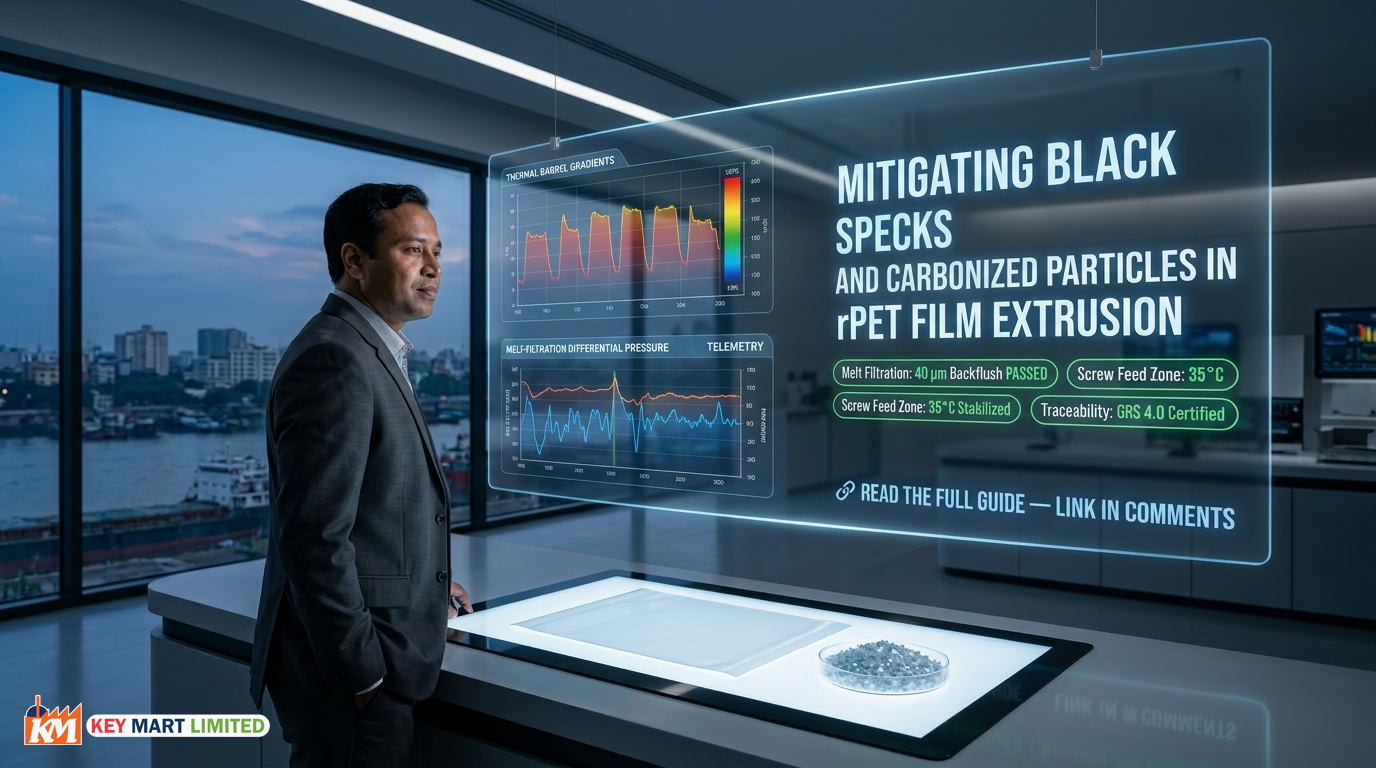
In the manufacturing of thermoformable packaging sheet, blister packs, and high-clarity APET/RPET films, surface aesthetics directly dictate commercial acceptance. While converters are integrating higher percentages of post-consumer recycled Polyethylene Terephthalate (pet flakes) to meet statutory sustainability goals, plant operators frequently battle a severe quality defect: black specks rPET extrusion contamination.
Black specks and carbonized gels cause cosmetic rejection, pinholes, web punctures, and high scrap rates.
Unlike virgin resin synthesis, extrusion of recycled PET introduces foreign polymers, residual adhesives, and cross-linked gels that easily char under standard melt temperatures ($260^\circ\text{C}\text{–}280^\circ\text{C}$).
Eliminating black specks requires an integrated operational approach: pairing ultra-pure incoming feedstock with optimized melt-filtration micron ratings, screw-cooling temperature profiles, and residence-time management.
This technical extrusion guide explores the root mechanisms of particle carbonization, details machinery optimization protocols for plant engineers, and demonstrates how Key Mart Limited delivers low-contaminant rPET feedstock for defect-free film production.
1. Root Causes of Black Specks in rPET Sheet Extrusion
Carbonized inclusions and optical specks originate from three distinct chemical and mechanical pathways:
Feedstock Impurities (PVC/Glue) + Thermal Dead Zones ➔ Polymer Cleavage & Charring ➔ Melt Stream Shearing ➔ Black Specks in Extruded Film
A. PVC Thermal Degradation and Carbonization
Polyvinyl Chloride (PVC) is the primary chemical trigger of black specks. PVC decomposes at temperatures above $160^\circ\text{C}$—well below the melting point of PET ($250^\circ\text{C}\text{–}260^\circ\text{C}$).
-
When trace PVC flakes enter the high-heat barrel, they release acidic hydrochloric gas ($\text{HCl}$) and rapidly degrade into hard, carbonized black char.
-
These rigid carbon particles do not melt and migrate directly into the sheet die, causing prominent visual defects and die lip lines.
B. Thermal Stagnation in Extruder Dead Zones
Molten PET exposed to prolonged residence times in internal “dead zones”—such as un-streamlined adapter pipes, breaker plates, filter housing corners, or degraded screw flights—undergoes thermal oxidation and cross-linking. Over time, these static polymer layers bake into black crusts that periodically break free into the melt stream.
C. Residual Bottle Adhesives and Organic Contaminants
Inadequately washed flakes containing hot-melt label adhesives (EVA, acrylics) or organic sugar residues carbonize inside the compression and metering zones of the screw, turning into burnt gels and dark spots.
Read More: A Step-by-Step Guide to Importing PET Flakes from Bangladesh via Chittagong Port
Extrusion Parameter & Feedstock Purity Benchmark Table
| Processing & Material Parameter | Standard Scrap Flakes (High Defect Risk) | Film-Grade Operational Standard | Impact on Finished Film Line |
| PVC Contamination | $> 150\text{–}300\text{ PPM}$ | < 25 – 50 PPM (Target < 25 PPM) |
Eliminates carbon black specks & barrel corrosion |
| Melt-Filtration Rating | $150\text{–}250\,\mu\text{m}$ Coarse Mesh | 40 – 75 µm Continuous Auto-Backflush |
Captures micro-inclusions before T-die entry |
| Screw Feed-Throat Cooling | Ambient / Unregulated ($>60^\circ\text{C}$) | 35°C – 45°C (Chilled Water Controlled) |
Prevents premature flake bridging and scorching |
| Residual Moisture (Pre-Dryer) | $> 1.0\%$ | < 0.5% (Pre-Dryer Target < 50 PPM) |
Prevents hydrolytic degradation and bubble specks |
| Flake Sizing & Fines | Irregular / Fines $> 2.0\%$ | Uniform 8–12 mm (Fines < 0.3%) |
Ensures steady melt pressure and uniform plasticization |
| Residual Glue & Organics | Variable / Sticky residue | Zero (Hot-Caustic Saponified) |
Prevents adhesive cross-linking and burnt gels |
| Traceability & Audit | Unverified supply | GRS 4.0 Transaction Certified |
Fulfills brand owner ESG and PPWR audits |
2. Engineering Protocols to Eliminate Resin Burning on Film Lines
To stop black specks and carbonized gels during continuous APET/RPET sheet extrusion, plant operators should implement four core machinery and process controls:
A. Selecting Optimal Melt-Filtration Micron Ratings
Standard single-layer wire mesh filters often allow sub-millimeter carbon specks to pass through under high melt pressure.
-
Utilize continuous automatic backflushing screen changers or rotary disc filters equipped with sintered metal fiber media rated between $40\,\mu\text{m}$ and $75\,\mu\text{m}$.
-
Maintain differential pressure ($\Delta P$) across the screen pack below $50\text{–}70\text{ bar}$ to prevent pressure spikes from forcing flexible carbonized gels through the filter media.
B. Optimizing Screw-Cooling and Temperature Profiles
-
Feed-Throat Cooling: Keep feed-zone water cooling precisely at $35^\circ\text{C}\text{–}45^\circ\text{C}$. If the throat runs too hot, rPET flakes soften prematurely and stick to the screw root, creating a stagnant layer that burns over time.
-
Inverted Temperature Profiling: Run the initial barrel zones slightly higher ($265^\circ\text{C}\text{–}275^\circ\text{C}$) for rapid melting, but taper down the metering and adapter zones to $255^\circ\text{C}\text{–}260^\circ\text{C}$ to reduce melt temperature and prevent thermal degradation before entering the T-die.
C. Eliminating Stagnation Zones and Routine Purging
-
Ensure all melt pipes, screen changer diverters, and flat-die manifolds feature streamlined, rheologically polished flow channels with zero sharp internal corners.
-
Execute scheduled dynamic purging with high-molecular-weight, thermally stable purging compounds during line stops to sweep out oxidized polymer before it bakes into carbon.
3. How Key Mart Limited Meets Global Demand for Optical-Grade Feedstock
Preventing black specks starts with sourcing clean, thermally stable raw materials from an established bangladesh pet flakes manufacturer.
As a premier pet flakes company bangladesh and trusted pet flakes exporter, Key Mart Limited delivers candidate rPET flakes engineered specifically for high-clarity sheet and film extrusion:
-
Source-Segregated Clear Bottle Processing: Operating as a leading pet flakes manufacturer dhaka, Key Mart Limited selectively processes 100% post-consumer clear beverage bottles, excluding multi-layer barrier containers and degraded industrial scrap at the collection gate.
-
Continuous Hot-Caustic De-Gluation: As an established bangladesh pet flakes manufacturer, our facility subjects crushed feedstock to continuous multi-stage hot-caustic washing ($85^\circ\text{C}-95^\circ\text{C}$) and automated NIR optical sorting, guaranteeing $\text{PVC} < 25\text{–}50\text{ PPM}$, zero glue residue, and moisture dried below $0.5\%$.
-
Automated Elutriation & Fines Removal: Serving as an experienced pet flakes exporter, Key Mart Limited uses multi-stage air classifiers to reduce dust and fines below $0.3\%$ ($8\text{–}12\text{ mm}$ flake sizing), preventing premature melting and thermal charring along extruder screw flights.
-
GRS 4.0 Certified Traceability & Lab Testing: Every lot is tested in our Dhaka laboratory for stable Intrinsic Viscosity ($0.78\text{–}0.82\text{ dL/g}$), high $L^*$-value brightness ($\ge 72\text{–}75$), and low yellowness ($b^* \le +1.5$), accompanied by batch-specific Certificates of Analysis (CoA) and Global Recycled Standard (GRS 4.0) Transaction Certificates (TC).
-
Maximized 25–26 MT Container Logistics: We pack 25–26 Metric Tons into every 40ft High Cube container with heavy-duty 100-micron PE inner liners to preserve feedstock dryness during transit under FOB Chittagong, CFR, or CIF shipping terms.
Partner with Key Mart Limited Today
Eliminate black specks in your rPET extrusion line, reduce sheet scrap rates, and secure high-purity optical-grade flakes from Bangladesh. Contact our Dhaka export management team today to request Technical Data Sheets, order commercial testing samples, or reserve monthly container allocations.
-
Company Name: Key Mart Limited
-
Head Office & Factory Address: Plot #31, Road #N-1, Block #K, Eastern Housing, Pallabi 2nd Phase, Rupnagar, Dhaka-1216, Bangladesh.
-
Official Website: www.keymartbd.com
-
Corporate Email: keymartltd@gmail.com | info@keymartbd.com
-
Direct Phone / WhatsApp: +8801760774499, +8801864935478
Join our community today and stay connected with the future of PET recycling.
 Visit our YouTube channel: Key Mart Limited on YouTube
Visit our Facebook Page: Key Mart Limited on Facebook
Subscribe to see our latest factory tours, production updates, and export success stories.