Views: 3
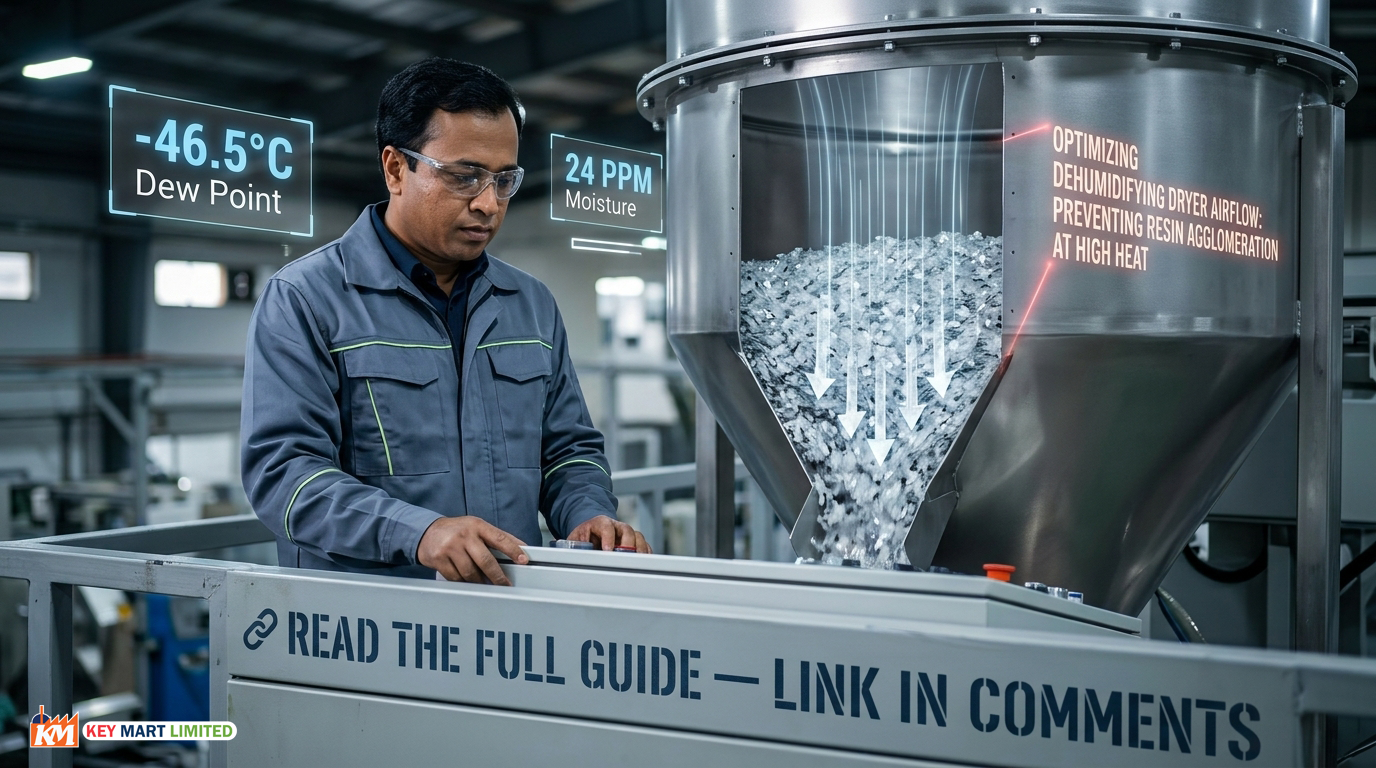
If you run high-capacity sheet extrusion, bottle preforms, or strapping lines using post-consumer recycled Polyethylene Terephthalate (pet flakes), you know that the drying hopper is where your process either succeeds or grinds to a halt. Squeezing moisture out of recycled PET to levels strictly below $30\text{–}50\text{ PPM}$ demands high heat ($160^\circ\text{C}\text{ to }180^\circ\text{C}$) and deep desiccant dew points ($\le -40^\circ\text{C}$).
However, pushing high temperatures into a packed column of post-consumer flakes introduces a severe operational threat: resin agglomeration, bridging, and solid lump formation inside the hopper cone.
When airflow distribution is uneven or temperatures spike above the polymer’s softening threshold before crystalline locking is complete, flakes fuse into massive, rubbery clogs.
The result is instant line starvation: hopper throat bridging, erratic solid-bed conveying, extruder motor torque surges, and costly downtime requiring manual hopper cleanouts with pry bars.
Eliminating these blockages requires mastering dehumidifying dryer PET flake clumping dynamics.
By balancing superficial air velocity, maintaining active mechanical agitation during pre-crystallization, and eliminating micro-fines that create sticky adhesive contact points, process engineers can run continuous high-heat drying cycles without hopper fusing.
This technical engineering guide explores the thermal mechanics of flake agglomeration, outlines airflow and dew point calibration protocols, and demonstrates how Key Mart Limited supplies clean, air-elutriated rPET flakes engineered for reliable desiccant drying.
1. The Physics of Flake Agglomeration: Why Bridging Occurs in Desiccant Hoppers
Drying post-consumer PET is a dual-stage kinetic process involving thermal crystallization and moisture diffusion:
Amorphous/Semi-Crystalline Flake Feed ➔ Active Agitation Crystallizer (120°C–140°C) ➔ Desiccant Drying Hopper (160°C–180°C, Dew Point ≤ -40°C) ➔ Deep Moisture Removal (<30 PPM H₂O) ➔ Surge-Free Extruder Throat
A. The Glass Transition & Viscoelastic Sticky Zone
-
The Softening Window ($78^\circ\text{C}\text{ to }140^\circ\text{C}$): When amorphous or poorly crystallized PET passes through its glass transition temperature ($T_g \approx 78^\circ\text{C}$), the polymer chains become mobile and tacky.
-
The Fusion Mechanism: If flakes sit stationary under column pressure while passing through this range, their outer surfaces weld together, forming dense agglomerates.
-
The Fix (Continuous Agitation): Flakes must pass through an agitated pre-crystallizer before entering the main drying silo, building a crystalline shell ($X_c > 35\%$) that resists softening at final drying temperatures ($165^\circ\text{C}\text{–}180^\circ\text{C}$).
B. Airflow Channeling & Localized Thermal Runaway
Inside a static desiccant hopper, process air naturally seeks the path of least resistance:
-
Air Channeling: If the flake column contains broad particle size variations or unmanaged fines ($< 500\,\mu\text{m}$), dust packs tightly around larger flakes, choking local airflow.
-
Thermal Hotspots: Hot dry air channels into isolated vertical chimneys, overheating stagnant zones while leaving adjacent areas cold and wet. Overheated zones rapidly exceed $185^\circ\text{C}$, triggering solid chunk fusion directly above the hopper discharge valve.
Desiccant Drying & Hopper Airflow Calibration Benchmark
Read More: A Step-by-Step Guide to Importing PET Flakes from Bangladesh via Chittagong Port
| Drying & Material Parameter | Utility Scrap (Unclassified) | Standard Reprocessed rPET | High-Heat Drying Grade (Key Mart Standard) |
| Airflow Superficial Velocity | $< 0.08\text{ m/s}$ (Poor penetration) | $0.10\text{–}0.12\text{ m/s}$ | 0.14 – 0.18 m/s (Uniform Fluidized Penetration) |
| Desiccant Air Dew Point | $-20^\circ\text{C}\text{ to }-30^\circ\text{C}$ | $-35^\circ\text{C}\text{ to }-40^\circ\text{C}$ | ≤ -40°C to -50°C (Ultra-Dry Closed Loop) |
| Hopper Bridging / Clumping Risk | Frequent (Every shift) | Occasional during restarts | Zero Agglomeration (Continuous Mass Flow) |
| Micro-Dust & Fines ($<500\,\mu\text{m}$) | $> 2.5\text{–}3.5\%$ (Friction fusion) | $1.0\text{–}1.5\%$ | < 0.3% (Multi-Stage Air Elutriated) |
| Residual Flake Moisture at Exit | $> 150\text{ PPM}$ (Severe hydrolysis) | $50\text{–}80\text{ PPM}$ | < 30 – 50 PPM (Deep Dehumidification) |
| PVC Contamination Ceiling | $> 150\text{–}300\text{ PPM}$ | $50\text{–}100\text{ PPM}$ | < 25 – 50 PPM (Continuous Hot-Caustic) |
| Flake Intrinsic Viscosity (IV) | $0.65\text{–}0.70\text{ dL/g}$ | $0.72\text{–}0.75\text{ dL/g}$ | 0.78 – 0.82 dL/g (Stable Baseline) |
| Initial Moisture at Packaging | $> 1.0\%$ (Hydrolysis risk) | $0.5\text{–}0.8\%$ | < 0.5% (Centrifugally & Heat Dried) |
2. Engineering Solutions to Prevent Hopper Agglomeration
Extrusion plant operators and maintenance engineers can eliminate resin fusing by applying three critical machine and process controls:
-
Maintain a Minimum Air-to-Resin Mass Ratio ($2.0\text{ to }2.5\text{ m}^3/\text{h per kg}$): Ensure your desiccant blower delivers sufficient volumetric airflow to uniformly penetrate the entire bed, preventing localized stagnation and heat pockets.
-
Utilize Multi-Cone Hopper Diffusers: Retrofit standard drying hoppers with internal inverted cone baffles. These distribute dry process air across the entire hopper radius, converting laminar plug flow into uniform mass flow and preventing dead corner bridging.
-
Eliminate Micro-Fines at the Infeed: Electrostatic fines have a high surface-area-to-volume ratio, causing them to melt and stick at temperatures $15^\circ\text{C}\text{–}20^\circ\text{C}$ lower than bulk flakes. Sourcing air-elutriated feedstock with sub-0.3% fines removes the binding agent responsible for agglomeration.
3. How Key Mart Limited Supplies Agglomeration-Resistant rPET Flakes
Running high-temperature desiccant drying systems without clumping requires partnering with an established bangladesh pet flakes manufacturer that prioritizes high-temperature washing, tight granulometry, and complete fines extraction.
As a premier pet flakes company bangladesh and trusted pet flakes exporter, Key Mart Limited delivers low-dust, high-IV clear rPET flakes engineered for high-heat drying systems:
-
Source-Segregated Dhaka Collection: Operating as a leading pet flakes manufacturer dhaka, Key Mart Limited exclusively processes 100% post-consumer clear beverage containers, rejecting contaminated industrial scrap, multi-layer packaging, and non-PET plastics at intake gates.
-
Continuous Multi-Stage Caustic Washing ($85^\circ\text{C}-95^\circ\text{C}$): As an established bangladesh pet flakes manufacturer, our facility subjects flakes to continuous hot-caustic friction washing and automated NIR optical sorting, fully saponifying label glues and stripping organic residues to guarantee $\text{PVC} < 25\text{–}50\text{ PPM}$ and zero adhesive carryover.
-
Sub-0.3% Fines Removal via Air Elutriation: Serving as an experienced pet flakes exporter, Key Mart Limited passes every batch through automated multi-stage zig-zag air classifiers, keeping dust and fines strictly below $0.3\%$ to eliminate premature melting and hopper bridging.
-
Centrifugal & Thermal Pre-Drying Below 0.5%: Every batch is centrifugally dewatered and hot-air dried before packaging, reducing initial moisture load so desiccant dryers operate at peak efficiency.
-
Tight IV Stability & Batch Traceability: Every export batch is tested in our Dhaka quality control laboratory for stable Intrinsic Viscosity ($0.78\text{–}0.82\text{ dL/g}$) and high luminance ($L^* \ge 74.0, b^* \le +1.2$), backed by batch-specific Certificates of Analysis (CoA) and Global Recycled Standard (GRS 4.0) Transaction Certificates (TC).
-
Maximized 25–26 MT Container Logistics: We pack 25–26 Metric Tons into every 40ft High Cube container with heavy-duty 100-micron PE inner liners to preserve feedstock dryness during transit under FOB Chittagong, CFR, or CIF shipping terms.
Partner with Key Mart Limited Today
Eliminate drying hopper clumping, achieve deep moisture removal without bridging, and secure high-purity rPET flakes from Bangladesh. Contact our Dhaka export management team today to request Technical Data Sheets, order commercial testing samples, or reserve monthly container allocations.
-
Company Name: Key Mart Limited
-
Head Office & Factory Address: Plot #31, Road #N-1, Block #K, Eastern Housing, Pallabi 2nd Phase, Rupnagar, Dhaka-1216, Bangladesh.
-
Official Website: www.keymartbd.com
-
Corporate Email: keymartltd@gmail.com | info@keymartbd.com
-
Direct Phone / WhatsApp: +8801760774499, +8801864935478
Join our community today and stay connected with the future of PET recycling.
 Visit our YouTube channel: Key Mart Limited on YouTube
Visit our Facebook Page: Key Mart Limited on Facebook
Subscribe to see our latest factory tours, production updates, and export success stories.