Views: 3
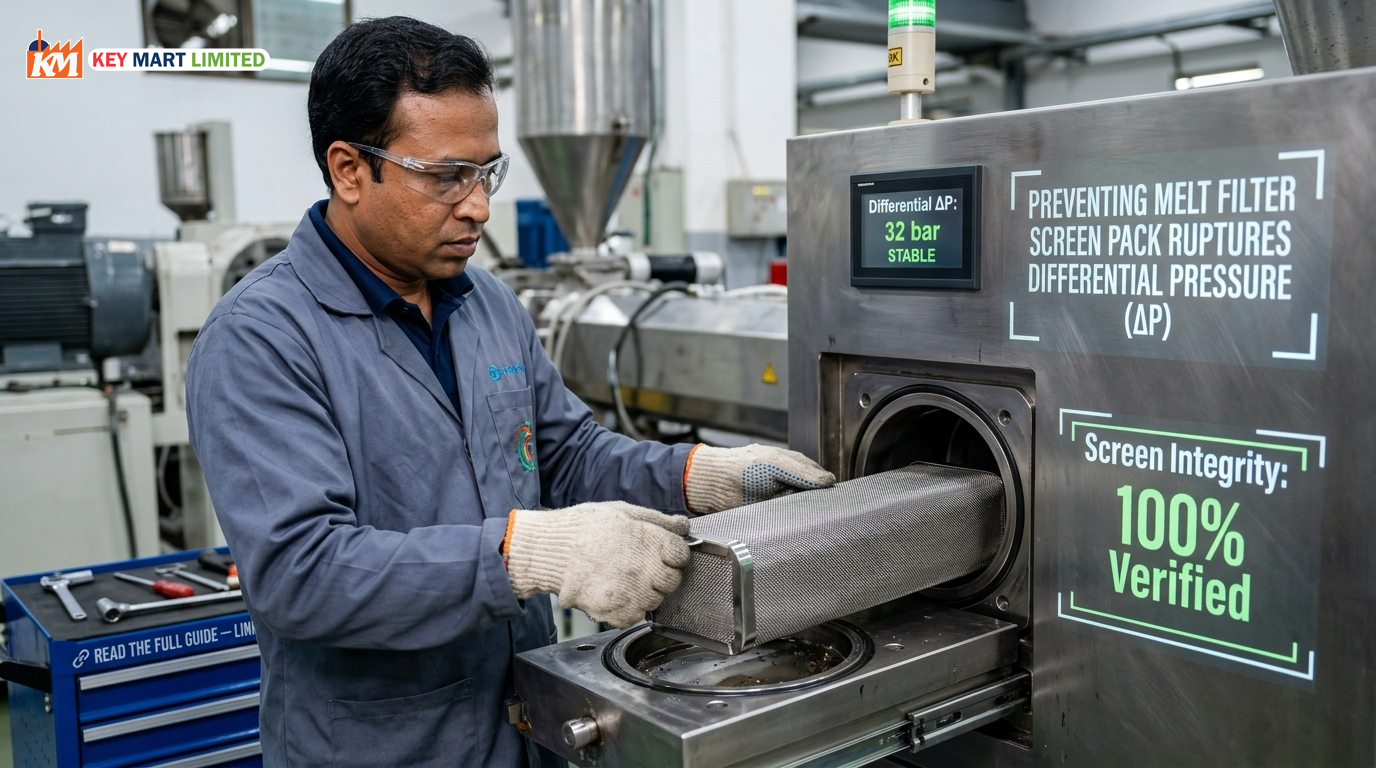
If you run a high-throughput sheet line, spin POY/FDY yarns, or extrude strapping from post-consumer recycled Polyethylene Terephthalate (pet flakes), you know the melt filter is your last line of defense. It protects your spinnerets, flat dies, and downstream tooling from foreign inclusions, unmelted gels, and carbonized char.
However, running high ratios of mechanical rPET puts immense physical demand on your filtration system.
As contaminants accumulate on the upstream side of the filter, the pressure differential ($\Delta P$) across the breaker plate climbs rapidly.
When incoming pressure spikes beyond structural design limits ($\Delta P > 80\text{–}120\text{ bar}$), the consequences are severe: filter wire mesh ruptures, screen blowout, and catastrophic die contamination.
Once a screen pack ruptures, unfiltered melt floods the die lips, causing web tears, filament snaps, and expensive emergency shutdowns.
Eliminating screen blowouts requires balancing extruder screen pack pressure rPET parameters.
By understanding the mechanics of differential pressure build-up, designing reinforced dutch-weave sandwich screen packs, and optimizing automated continuous backflush screen changers, extrusion operators can run fine filtration ($25\text{–}40\,\mu\text{m}$) without risking line stoppages.
This operational guide explains the mechanics of filter screen failure, provides practical backflush setup rules, and demonstrates how Key Mart Limited delivers low-dust, low-contamination rPET flakes that keep extruder melt pressure stable.
1. The Physics of Filter Screen Pack Ruptures: Why $\Delta P$ Spikes
Melt filtration relies on a reinforced sandwich of woven wire meshes supported by a heavy-duty perforated breaker plate:
Molten rPET Feed ➔ Coarse Guard Mesh (40 Mesh) ➔ Fine Filtration Screen (200–400 Mesh) ➔ Coarse Drainage Backing (20 Mesh) ➔ Perforated Breaker Plate ➔ Clean Melt Flow
A. Cake Filtration vs. Critical Pressure Thresholds
-
Contaminant Cake Formation: As melt flows through the wire mesh, microscopic foreign particles (residual label adhesives, micro-aluminum flecks, cross-linked gels, and airborne dust) collect on the upstream surface.
-
The Exponential $\Delta P$ Curve: This accumulation forms a dense “filter cake.” Fluid dynamics dictates that as the effective open area decreases, the differential pressure ($\Delta P = P_{\text{inlet}} – P_{\text{outlet}}$) increases exponentially:
$$\Delta P \propto \frac{\eta \cdot Q \cdot L}{A_{\text{open}}}$$Where $\eta$ is melt dynamic viscosity, $Q$ is volumetric flow rate, and $A_{\text{open}}$ is remaining filter porosity.
-
Mechanical Rupture (Blowout): If the screen changer is not indexed or backflushed before reaching the critical mechanical yield point of the wire alloy ($\Delta P > 100\text{–}120\text{ bar}$), the fine Dutch-weave wire tears away from its boundary frame. The trapped contaminants then flush directly into the downstream die block.
B. The Role of Feedstock Fines and Intrinsic Viscosity (IV) Surges
-
Unwashed Adhesive Gels: Residual EVA or hot-melt adhesives pyrolyze at extrusion temperatures ($270^\circ\text{C}\text{–}290^\circ\text{C}$), forming rubbery micro-gels that blind fine filter pores within minutes.
-
Dust and Micro-Fines ($< 500\,\mu\text{m}$): Electrostatic fines melt prematurely in the feed zone, generating oxidized, cross-linked particulate that rapidly clogs screens.
-
Viscosity Fluctuations: Processing unmanaged scrap with unstable $IV$ values ($< 0.70\text{ dL/g}$ mixed with $> 0.82\text{ dL/g}$) causes sudden melt viscosity surges that spike inlet pressures.
Melt Filtration Stability & Pressure Benchmark Table
Read More: A Step-by-Step Guide to Importing PET Flakes from Bangladesh via Chittagong Port
| Operational Parameter | Low-Grade Recycled Scrap | Standard Industrial rPET | Extrusion Filtration Grade (Key Mart Standard) |
| Max Pressure Differential ($\Delta P$) | Spikes to $> 120\text{ bar}$ (Blowout) | $60\text{–}80\text{ bar}$ | < 35 – 45 bar (Stable Continuous Flow) |
| Filter Screen Service Life | $< 4\text{–}8\text{ Hours}$ (Frequent stops) | $24\text{–}48\text{ Hours}$ | > 72 – 120+ Hours (Long Production Runs) |
| PVC Contamination Ceiling | $> 150\text{–}300\text{ PPM}$ | $50\text{–}100\text{ PPM}$ | < 25 – 50 PPM (Continuous Hot-Caustic) |
| Micro-Dust & Fines ($<500\,\mu\text{m}$) | $> 2.5\text{–}3.5\%$ (Rapid blinding) | $1.0\text{–}1.5\%$ | < 0.3% (Multi-Stage Air Elutriated) |
| Adhesive / Label Glue Residue | $> 200\text{ PPM}$ (Gel formation) | $50\text{–}100\text{ PPM}$ | < 10 PPM (Hot-Caustic Saponified) |
| Flake Intrinsic Viscosity (IV) | $0.65\text{–}0.70\text{ dL/g}$ | $0.72\text{–}0.75\text{ dL/g}$ | 0.78 – 0.82 dL/g (Tight ±0.02 Span) |
| Moisture Content at Sealing | $> 1.0\%$ (Hydrolysis risk) | $0.5\text{–}0.8\%$ | < 0.5% (Centrifugally & Heat Dried) |
| Chain-of-Custody Certification | Unverified | Self-Declared | GRS 4.0 Transaction Certified (TC)` |
2. Best Practices for Line Operators: Reinforcing Screens & Managing $\Delta P$
Extrusion line managers can prevent filter blowouts by implementing three standard mechanical protocols:
-
Build a Reinforced “Sandwich” Pack: Never place an unsupported fine wire mesh ($200\text{–}400\text{ mesh}$) directly against the breaker plate. Always use a balanced sandwich: a protective $40\text{ mesh}$ entry screen on the upstream side, the fine micron rating in the center, and a heavy-duty $20\text{ mesh}$ support screen on the downstream side to prevent the fine mesh from extruding through breaker plate holes.
-
Automate Continuous Backflush Triggers: Set screen changer automated indexing to trigger at a differential pressure of $\Delta P = 45\text{–}50\text{ bar}$, rather than waiting for time-based intervals. This provides a safety margin below the critical rupture pressure.
-
Control Moisture Below 0.5% to Prevent Hydrolytic Degradation: Processing damp flakes causes hydrolytic chain scission in the barrel, followed by solid-bed shear variations that generate irregular pressure pulses at the filter entrance.
3. How Key Mart Limited Protects Extruder Filtration Systems
Minimizing screen pack blinding starts with sourcing raw material from an established bangladesh pet flakes manufacturer that maintains clean source collection, hot-caustic washing, and dust elimination.
As a premier pet flakes company bangladesh and trusted pet flakes exporter, Key Mart Limited delivers low-contaminant, air-classified clear rPET flakes engineered to keep melt filtration running smoothly:
-
Source-Segregated Sourcing in Dhaka: Operating as a leading pet flakes manufacturer dhaka, Key Mart Limited exclusively processes 100% post-consumer clear beverage bottles, rejecting contaminated industrial scrap, multi-layer packaging, and PVC containers at intake gates.
-
Continuous Multi-Stage Caustic Washing ($85^\circ\text{C}-95^\circ\text{C}$): As an established bangladesh pet flakes manufacturer, our facility subjects flakes to continuous hot-caustic friction washing and automated NIR optical sorting, fully saponifying label glues and stripping organic residues to guarantee $\text{PVC} < 25\text{–}50\text{ PPM}$ and zero adhesive carryover.
-
Sub-0.3% Fines Removal via Air Elutriation: Serving as an experienced pet flakes exporter, Key Mart Limited passes every batch through automated multi-stage zig-zag air classifiers, keeping dust and fines strictly below $0.3\%$ to eliminate premature burning and filter screen blinding.
-
Tight IV Stability & Batch Traceability: Every export batch is tested in our Dhaka quality control laboratory for stable Intrinsic Viscosity ($0.78\text{–}0.82\text{ dL/g}$) and high luminance ($L^* \ge 74.0, b^* \le +1.2$), backed by batch-specific Certificates of Analysis (CoA) and Global Recycled Standard (GRS 4.0) Transaction Certificates (TC).
-
Maximized 25–26 MT Container Logistics: We pack 25–26 Metric Tons into every 40ft High Cube container with heavy-duty 100-micron PE inner liners to preserve feedstock dryness during transit under FOB Chittagong, CFR, or CIF shipping terms.
Partner with Key Mart Limited Today
Eliminate filter screen ruptures, stabilize your extruder head pressure, and secure high-purity rPET flakes from Bangladesh. Contact our Dhaka export management team today to request Technical Data Sheets, order commercial testing samples, or reserve monthly container allocations.
-
Company Name: Key Mart Limited
-
Head Office & Factory Address: Plot #31, Road #N-1, Block #K, Eastern Housing, Pallabi 2nd Phase, Rupnagar, Dhaka-1216, Bangladesh.
-
Official Website: www.keymartbd.com
-
Corporate Email: keymartltd@gmail.com | info@keymartbd.com
-
Direct Phone / WhatsApp: +8801760774499, +8801864935478
Join our community today and stay connected with the future of PET recycling.
 Visit our YouTube channel: Key Mart Limited on YouTube
Visit our Facebook Page: Key Mart Limited on Facebook
Subscribe to see our latest factory tours, production updates, and export success stories.