Views: 5
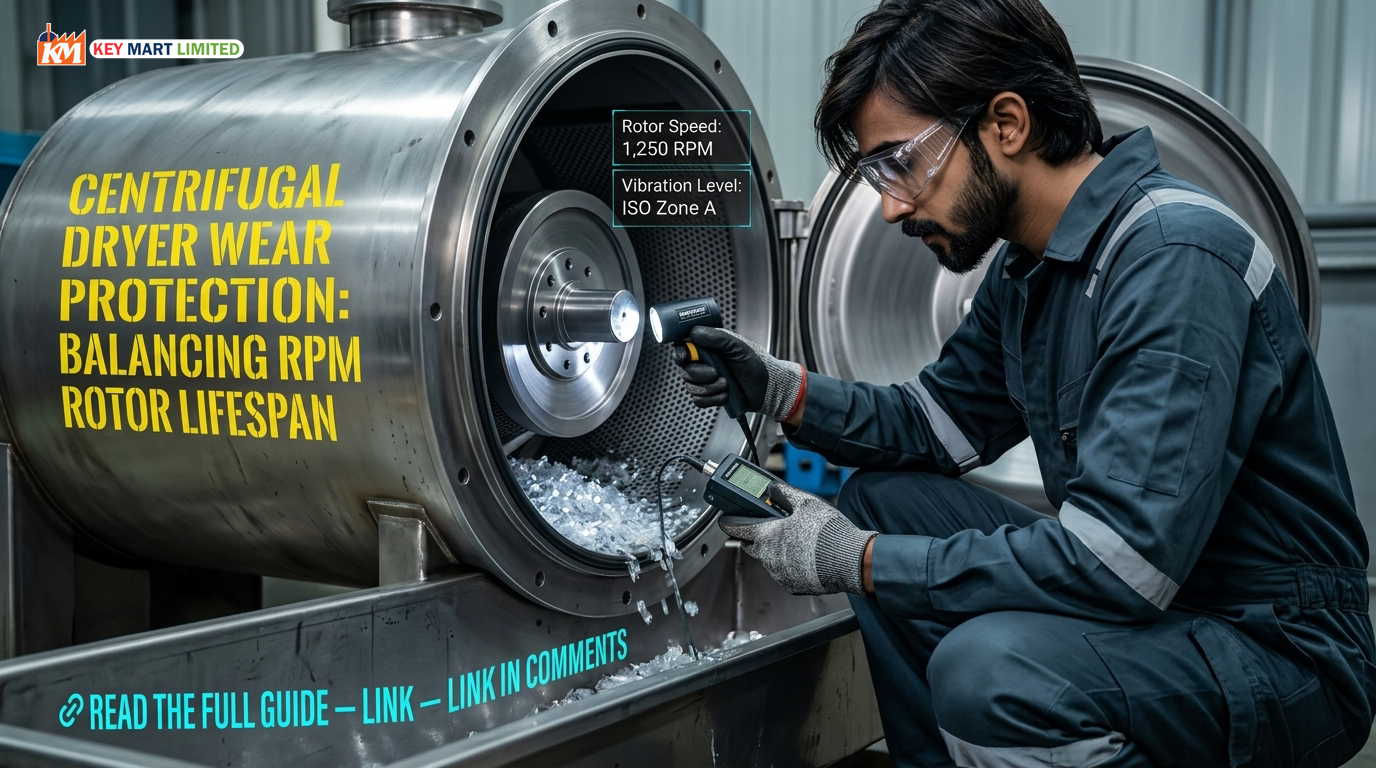
If you run a mechanical wash line for pet flakes, you know the centrifugal dryer is both your best friend and a potential maintenance nightmare. It’s the critical piece of kit for hitting that optimal dryness before extrusion or packaging, but it also takes some of the worst abuse in the entire plant.
Getting high-quality pet flakes means running your dryer efficiently. The high-speed rotor throws wet flakes against a screen, forcing water out through centrifugal force. But that same action makes it a centrifugal dryer plastic recycling maintenance hot zone. The fundamental problem is erosion. Those abrasive plastic flakes constantly grit against the rotor blades, the cage screen, and the casing itself, slowly eating away at the metal.
It’s a classic engineering trade-off: higher RPM means better dewatering, but it also creates a massive spike in kinetic energy and erosion rate. Understanding the mechanics is key to creating a truly sustainable and cost-effective maintenance strategy.
1. The Physics of Centrifugal Wear: Speed vs. Lifespan
We can simplify the complex fluid dynamics down to a core mechanical principle: kinetic energy and momentum transfer.
Wet Flake Feed ➔ Accelerator ➔ Main Rotor (high RPM) ➔ Centrifugal Impact ➔ Screening Zone ➔ Dewatered Flakes Exit
A. Higher RPM ➔ Faster Erosion
Wear isn’t linear. It grows exponentially with speed. Let’s look at the science: The kinetic energy ($KE$) of a single pet flakes particle traveling with the rotor is:$KE = \frac{1}{2}mv^2$
Since velocity ($v$) is directly proportional to rotor RPM ($\omega \times r$), even a slight increase in speed dramatically increases the force of impact when a flake strikes the screen or is accelerated by a blade.
$KE \propto \omega^2$
Double the RPM, and you quadruple the erosion energy. This high-speed impact breaks down the protective boundary layer, allowing abrasive plastic and micro-fines to grind directly against the base metal.
B. Optimal vs. Maximum Dewatering
There’s a clear limit. Beyond a certain “critical RPM,” adding more speed provides diminishing returns in moisture removal. In fact, running too fast can have the opposite effect. Excessive centrifugal force can compress the boundary layer on the screen, trapping micro-fines and actually clogging the dewatering apertures, leading to lower efficiency and increased maintenance downtime.
Technical Maintenance Matrix: Balancing RPM with Component Life
Read More: A Step-by-Step Guide to Importing PET Flakes from Bangladesh via Chittagong Port
To maximize the ROI of your centrifugal dryer plastic recycling maintenance budget, you need a strategy tailored to your specific feedstock and component metallurgy. This matrix helps you visualize the impact of operational choices.
| Component / Parameter | Utility-Grade Scrap | Unwashed Shredder Load | Premium pet flakes (Key Mart) |
| Optimal Rotor RPM | $1,100\text{–}1,300\text{ RPM}$ | $900\text{–}1,100\text{ RPM}$ (Heavy Fines) | 1,200 – 1,400+ RPM (Max Flow) |
| Dewatering Efficiency | Good ($> 95\%$) | Moderate ($88\text{–}92\%$) | Superior (> 98.5%) |
| Metal Erosion Rate | Moderate | High (Abrasive) | Lowest (Pristine Stream) |
| Blade Lifespan (Avg) | $2,000\text{–}3,000\text{ Hours}$ | $1,200\text{–}1,800\text{ Hours}$ | 3,500 – 5,000+ Hours |
| Purity Parameter (PVC/Glue) | Unmanaged | Elevated | < 25 – 50 PPM PVC |
| Bulk Density Stability | Low / Variable | Poor | Highest (Consistent) |
| Intrinsic Viscosity (IV) | Variable ($<0.70$) | Compromised | 0.78 – 0.82 (High-Tenacity) |
2. Strategic Maintenance: Best Practices for Component Longevity
Plant managers can proactively extend the life of their centrifugal dryers by implementing three operational protocols:
-
Precision VFD and Current Monitoring: Don’t run at maximum speed by default. Install a Variable Frequency Drive (VFD) and fine-tune your RPM based on your specific feedstock purity. Monitor the motor’s amperage draw. A sudden current spike often indicates uneven loading, screen blinding, or increased friction—all precursors to accelerated wear.
-
Implement Blade and Screen Rotation: Don’t let wear accumulate in one spot. Regularly rotate your rotor blades or paddles (if detachable) and flip or index your screen cages. This distributes the erosion evenly across the components, preventing premature failures in critical zones.
-
Control Abrasive Fines at the Infeed: The primary cause of “unexpected” high wear is residual contamination. Pre-cleaning your pet flakes and using a multi-stage air elutriation system to remove fines ($< 500\,\mu\text{m}$) before the dryer drastically reduces the erosive grit in the system.
3. How Key Mart Limited Guarantees Efficient, Low-Wear Dewatering
Minimizing centrifugal dryer plastic recycling maintenance costs starts with your feedstock. When you use inferior-grade material, you pay twice: once for the cheaper material, and again in accelerated equipment wear and lower yield.
As a premier bangladesh pet flakes manufacturer and trusted pet flakes exporter, Key Mart Limited delivers the clean, high-purity rPET flakes you need. Here’s how we fulfill your demand while protecting your equipment:
-
Pristine Source Segregation in Dhaka: Our process begins at collection gates. Operating as a leading pet flakes manufacturer dhaka, Key Mart Limited selectively processes only clear post-consumer beverage bottles, rejecting contaminated industrial scrap, multi-layer barriers, and non-PET plastics that introduce grit and chemical contaminants.
-
Continuous Hot-Caustic Washing ($85^\circ\text{C}-95^\circ\text{C}$): In our Dhaka facility, our pet flakes are subjected to continuous hot friction washing with automated caustic dosing. This process fully saponifies glues and strips organic residues, achieving a standard of $\text{PVC} < 25\text{–}50\text{ PPM}$ and zero adhesive carryover.
-
GRS 4.0 Traceability and COA: Every batch we produce is tested in our quality control laboratory for consistent IV ($0.78\text{–}0.82\text{ dL/g}$), high optical luminance ($L^* \ge 74.0$), and clean thermal profiles, backed by Global Recycled Standard (GRS 4.0) Transaction Certificates and batch-specific Certificates of Analysis.
-
Maximized 25–26 MT Container Logistics: Serving as an established pet flakes company bangladesh, we maximize our ocean container logistics, packing 25–26 Metric Tons into every 40ft High Cube container with heavy-duty PE liners to preserve flake dryness during transit. We manage FOB Chittagong, CFR, and CIF terms.
Partner with Key Mart Limited Today
Eliminate unexpected dryer wear, stabilize your dewatering process, and secure high-IV rPET flakes from Bangladesh. Contact our Dhaka export management team today to request Technical Data Sheets, order testing samples, or reserve a monthly container allotment.
-
Company Name: Key Mart Limited
-
Head Office & Factory Address: Plot #31, Road #N-1, Block #K, Eastern Housing, Pallabi 2nd Phase, Rupnagar, Dhaka-1216, Bangladesh.
-
Official Website: www.keymartbd.com
-
Corporate Email: keymartltd@gmail.com | info@keymartbd.com
-
Direct Phone / WhatsApp: +8801760774499, +8801864935478
Join our community today and stay connected with the future of PET recycling.
 Visit our YouTube channel: Key Mart Limited on YouTube
Visit our Facebook Page: Key Mart Limited on Facebook
Subscribe to see our latest factory tours, production updates, and export success stories.