Views: 4
If you manage logistics, warehouse receiving, or raw material procurement for an American manufacturing plant, few things sour an import program faster than an unexpected carrier invoice listing five-figure port storage fees. When importing bulk secondary raw materials like recycled Polyethylene Terephthalate (pet flakes), logistics margins can vanish on the dock before the container ever reaches your facility.
Operating through congested American gateways—like Los Angeles/Long Beach, New York/New Jersey, Savannah, or Houston—means dealing with unpredictable terminal velocity.
Between railcar shortages, chassis deficits, unannounced terminal gate appointment lockouts, and routine customs agricultural or Intensive VACIS exams, standard ocean carrier “free time” evaporates quickly.
Most ocean carriers provide a default free time window of just 4 to 5 calendar days before starting daily penalties.
Once that window closes, tiered demurrage fees kick in—often escalating from $175 to upwards of $375 per container, per day.
For a multi-container booking, a single documentation snag or trucking bottleneck can create a costly financial headache.
Protecting your operating margins requires executing a proactive container demurrage reduction US ports import strategy.
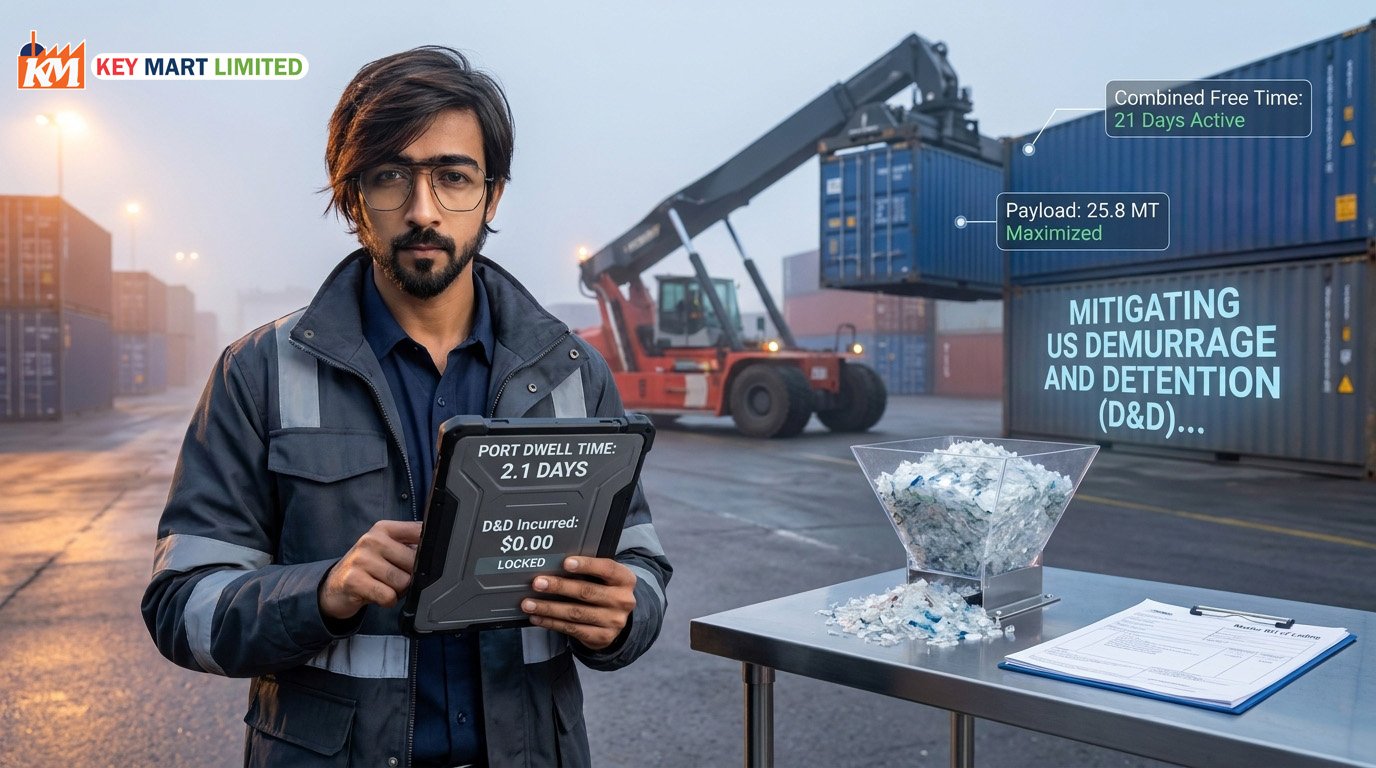
By contractually locking in 14 to 21 combined free days on your Master Bill of Lading, establishing near-dock off-terminal staging yards, and switching to instant electronic Bill of Lading (eBL) releases, import-export coordinators can eliminate terminal delays and keep shipments moving.
This logistics guide breaks down the legal framework of terminal free time, outlines operational strategies to avoid detention fees, and demonstrates how Key Mart Limited delivers container-optimized rPET shipments directly from Bangladesh.
1. Demurrage vs. Detention: Understanding the Port Clock
Navigating terminal fees effectively starts with distinguishing the two clocks ocean carriers run once a vessel berths:
Vessel Discharges Container ➔ Terminal Free Time (Days 1–5) ➔ Demurrage Accrues (Inside Terminal Gate)
                                                                       │
Consignee Drayman Gates Out Container ➔ Equipment Free Time ➔ Detention Accrues (Outside Terminal Depot)
                                                                       │
Empty Container Returned to Carrier Depot ➔ Clock Stops (Zero Financial Liability)
A. Demurrage (Inside the Port Gate)
-
The Definition: Demurrage accrues when a full, discharged import container remains inside the marine terminal yard beyond the allotted free days.
-
Common Triggers: Delayed arrival of original paper shipping documents, customs clearance holds, unpaid ocean freight invoices, or a lack of terminal appointment slots for local drayage drivers.
-
The Escalation Risk: Ports use tiered schedules to clear yard space. A rate of $150 per day for days 1–4 often doubles to $300 or more per day from day 5 onward, turning brief delays into substantial liabilities.
B. Detention / Per Diem (Outside the Port Gate)
-
The Definition: Detention charges accrue when the importer picks up the container from the pier but fails to return the empty equipment to the shipping line’s designated inland container yard within the agreed equipment free-time window.
-
Common Triggers: Warehouse unloading backlogs, plant receiving bottlenecks, long round-trip transit runs to inland facilities, or chassis shortages during the empty return leg.
US Port D&D Mitigation & Operational Benchmark Matrix
Read More: A Step-by-Step Guide to Importing PET Flakes from Bangladesh via Chittagong Port
| Strategic Logistics Metric | Standard Broker Booking | Freight Forwarder Spot Move | Key Mart Managed Export Standard |
| Destination Port Free Time | $4\text{–}5\text{ Calendar Days}$ (High Risk) | $7\text{–}10\text{ Days}$ (Marginal Window) | 14 – 21 Days Combined Free Time (Contracted) |
| MBL Free Time Clause | Absent / Unconfirmed | Email note only | Explicitly Endorsed on Master Bill of Lading |
| Bill of Lading Transmission | Physical Paper Courier ($7\text{–}10\text{ Days}$) | Standard Waybill | Electronic eBL / Express Telex Release (<48h) |
| Container Payload Density | $20\text{–}22\text{ MT}$ (Under-utilized) | $22\text{–}23\text{ MT}$ | 25.0 – 26.0 MT (Maximized 40ft High Cube) |
| Inland D&D Buffer Protocol | Direct to plant (High detention) | Direct to plant | Off-Dock Container Staging Yard Compatible |
| OSRA-22 Audit Readiness | No detention tracking logs | Manual notes | Time-Stamped Appointment & Release Audits |
| PVC Contamination Ceiling | $> 150\text{–}300\text{ PPM}$ | $50\text{–}100\text{ PPM}$ | < 25 – 50 PPM (Continuous Hot-Caustic) |
| Supply Chain Certification | Unverified Spot Dealer | Self-Declared | GRS 4.0 Transaction Certified (TC) |
2. Three Practical Tactics to Eliminate Port Penalties
International shipping coordinators and warehouse receiving teams can insulate import programs from carrier billing disputes by following three operational rules:
-
Mandate 14–21 Combined Free Days on the Booking Confirmation: Never rely on carrier default terms. Require your freight forwarder or supplier to secure “14 to 21 Days Combined Demurrage & Detention at Destination” during initial carrier booking, and ensure this clause is typed directly into the body of the carrier’s Master Bill of Lading (MBL).
-
Shift to Electronic Bills of Lading (eBL) and Express Releases: Eliminate paper-transit delays. Physical original documents sent via international couriers can get stuck in transit, leaving containers stranded on the dock while incurring daily demurrage fees. Using electronic Sea Waybills or digital eBL releases allows customs brokers to file 5-day pre-arrival entry summaries through the Automated Commercial Environment (ACE).
-
Use Off-Dock Container Yards (CY) to Avoid Pier Storage: When plant receiving docks are backed up, do not leave containers sitting at terminal berths. Have your drayage carrier pull the boxes to an off-dock, near-port staging depot before terminal free time expires. Off-dock drop yards charge a fraction of marine terminal demurrage rates, giving receiving warehouses breathing room to unpack raw materials without daily fee spikes.
3. How Key Mart Limited Protects US Importers from Terminal Delays
Avoiding maritime demurrage traps requires partnering with an established bangladesh pet flakes manufacturer that pairs high-volume manufacturing with proactive freight coordination and documentation management.
As a premier pet flakes company bangladesh and trusted pet flakes exporter, Key Mart Limited delivers dependable, container-optimized rPET flakes engineered to arrive smoothly at US destination ports:
-
Direct Multi-Hub Feeder Departures from Dhaka: Operating as a leading pet flakes manufacturer dhaka, Key Mart Limited manages bonded highway transfers from Dhaka to Chittagong Port, booking direct, priority feeder departures to premier regional transshipment hubs (Colombo, Singapore, Port Klang) to eliminate port rollovers.
-
Pre-Negotiated 14–21 Days Free Time on US Contracts: As an experienced pet flakes exporter, our shipping department partners with major international container lines (Maersk, MSC, CMA CGM, Hapag-Lloyd) to secure contractual agreements for 14 to 21 days combined free time endorsed on bills of lading for our North American accounts.
-
Maximized 25–26 MT Container Payloads: As an established bangladesh pet flakes manufacturer, our facility compresses packaging to pack 25–26 Metric Tons into every 40ft High Cube container with heavy-duty 100-micron PE inner liners, lowering your per-ton ocean freight cost while keeping moisture low ($<0.5\%$) under FOB Chittagong, CFR, or CIF shipping terms.
-
Sub-0.3% Fines Removal via Air Elutriation: Serving as an experienced pet flakes exporter, Key Mart Limited passes every batch through automated multi-stage zig-zag air classifiers, keeping dust and fines strictly below $0.3\%$ to eliminate premature burning and melt pressure surges during extrusion.
-
Sub-72-Hour Digital Documentation Clearance: Our export documentation desk generates and transmits complete digital import dossiers—including commercial invoices with certified HTS codes (3915.90.0000), verified packing lists, calibrated SOLAS VGM weight certificates, Certificates of Analysis (CoA), and GRS 4.0 Transaction Certificates—within 72 hours of vessel departure to ensure import brokers can clear customs early.
Partner with Key Mart Limited Today
Eliminate unexpected ocean terminal penalties, secure 14–21 days of port free time, and import high-purity rPET flakes from Bangladesh. Contact our Dhaka export management team today to request Technical Data Sheets, order commercial testing samples, or reserve monthly container allocations.
-
Company Name: Key Mart Limited
-
Head Office & Factory Address: Plot #31, Road #N-1, Block #K, Eastern Housing, Pallabi 2nd Phase, Rupnagar, Dhaka-1216, Bangladesh.
-
Official Website: www.keymartbd.com
-
Corporate Email: keymartltd@gmail.com | info@keymartbd.com
-
Direct Phone / WhatsApp: +8801760774499, +8801864935478
Join our community today and stay connected with the future of PET recycling.
 Visit our YouTube channel: Key Mart Limited on YouTube
Visit our Facebook Page: Key Mart Limited on Facebook
Subscribe to see our latest factory tours, production updates, and export success stories.