Views: 3
For North American supply chain planners, freight forwarders, and packaging converters sourcing recycled Polyethylene Terephthalate (pet flakes) from South Asia, ocean logistics is rarely a secondary concern. Getting competitive pricing per metric ton at the factory gate means little if long transit times, unexpected transshipment rollovers, or inland intermodal rail bottlenecks drive up your landed costs.
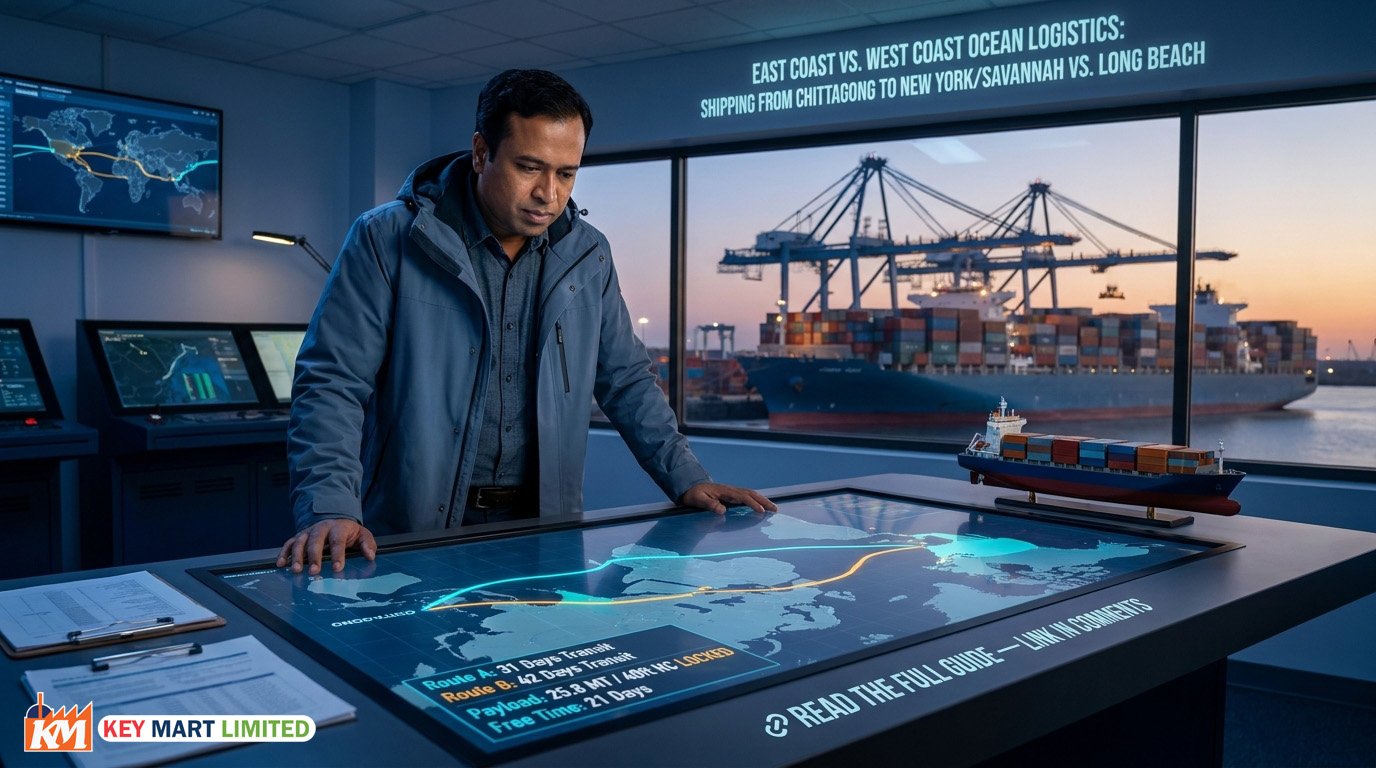
Moving containerized raw materials out of the Port of Chittagong (Chattogram) to North American industrial centers involves choosing between two very different maritime corridors: US West Coast (USWC) via transpacific lanes, or US East Coast (USEC) via the Mediterranean or Cape of Good Hope routes.
Choosing the wrong coast or carrier string can easily add 15 to 25 extra days to your supply chain, tie up working capital in afloat inventory, and trigger unexpected demurrage bills at congested marine rail terminals.
Streamlining your supply chain requires mastering ocean freight recycled plastic to US ports logistics.
By comparing real-world transit times across primary transshipment hubs (Colombo, Singapore, Port Klang), evaluating intermodal rail versus regional truck drayage economics, and locking in extended container free-time agreements, procurement teams can build dependable delivery pipelines into both the Atlantic and Pacific gateways.
This maritime logistics guide breaks down the routing differences between East Coast and West Coast lanes, analyzes per-ton freight economics, and illustrates how Key Mart Limited ships audit-ready, container-optimized rPET flakes directly from Bangladesh.
1. Maritime Routing Analysis: Chittagong to USWC vs. USEC
Because Chittagong is a riverine feeder port, all ocean export moves through a two-leg journey: a short feeder leg to a premier regional transshipment hub, followed by an ultra-large container vessel (ULCV) mother ship crossing:
Chittagong Feeder Port (Chattogram)
   ├──► Feeder Leg (3–5 Days) ──► Colombo / Singapore / Port Klang Hub
   │
   ├──► Transpacific Mother Vessel ──► US West Coast (Long Beach / Oakland) [Total: 28–35 Days]
   │
   └──► Atlantic / Cape Mother Vessel ──► US East Coast (New York / Savannah) [Total: 38–48 Days]
A. The West Coast Route (Via Singapore/Port Klang to Long Beach/Oakland)
-
Routing Path: Feeder out of Chittagong connects via the Strait of Malacca to Singapore, Port Klang, or Tanjung Pelepas, loading onto high-speed Transpacific strings terminating at Los Angeles/Long Beach or Oakland.
-
Transit Velocity: Typically 28 to 35 calendar days port-to-port.
-
Logistics Profile: Ideal for converters serving packaging clients in California, the Pacific Northwest, Nevada, and Arizona. It is the fastest route to North American soil, though inland rail intermodal moves (IPI) heading toward Chicago or the Midwest can be vulnerable to railcar shortages and terminal dwell spikes.
B. The East Coast Route (Via Colombo to New York/NJ or Savannah)
-
Routing Path: Feeder vessels head southwest to the deep-water hub of Colombo, Sri Lanka, connecting directly onto westbound services rounding South Africa (Cape of Good Hope) or via the Mediterranean/Suez into New York/New Jersey, Norfolk, Charleston, or Savannah.
-
Transit Velocity: Typically 38 to 48 calendar days port-to-port.
-
Logistics Profile: While transit times are longer, direct all-water discharge into Savannah or New York places heavy polymer containers within short-haul truck drayage distance (under 250 miles) of major thermoforming and carpet fiber clusters in Georgia, the Carolinas, Pennsylvania, and Ohio, avoiding expensive long-haul domestic rail freight.
US Coast-to-Coast Maritime Logistics Comparison Matrix
Read More: A Step-by-Step Guide to Importing PET Flakes from Bangladesh via Chittagong Port
| Logistics Parameter | US West Coast (Long Beach / Oakland) | US East Coast (New York / Savannah) | Key Mart Export Delivery Standard |
| Typical Port-to-Port Transit | $28\text{–}35\text{ Calendar Days}$ | $38\text{–}48\text{ Calendar Days}$ | Direct Priority Feeder Connection |
| Primary Transshipment Hub | Singapore / Port Klang | Colombo, Sri Lanka | Tier-1 Carrier Reserved Berths |
| Inland Freight Mode | Local Truck Dray or IPI Rail | Direct Regional Truck Drayage | Optimized Destination Routing |
| Container Payload Density | $20\text{–}22\text{ MT}$ (Standard Broker) | $22\text{–}23\text{ MT}$ | 25.0 – 26.0 MT (40ft High Cube) |
| Contracted Port Free Time | $4\text{–}7\text{ Days}$ (Carrier Default) | $5\text{–}7\text{ Days}$ | 14 – 21 Days Combined Free Time |
| PVC Contamination Ceiling | $> 150\text{–}300\text{ PPM}$ | $50\text{–}100\text{ PPM}$ | < 25 – 50 PPM (Continuous Hot-Caustic) |
| Dust & Fines Content ($<500\,\mu\text{m}$) | $> 2.5\text{–}3.5\%$ | $1.0\text{–}1.5\%$ | < 0.3% (Multi-Stage Air Elutriated) |
| Supply Chain Traceability | Unverified Spot Broker | Basic Packing List | GRS 4.0 Transaction Certified (TC) |
2. Managing Drayage Economics and Heavyweight Container Limits
Recycled PET flakes are a dense, heavy commodity. Lowering landed costs requires managing weight restrictions and inland transit logistics:
-
Maximized Container Payloads (25–26 Metric Tons): Sourcing underloaded containers (20 to 22 MT) wastes money on ocean freight. Packing 25.0 to 26.0 MT in each 40ft High Cube container maximizes freight efficiency and reduces shipping costs per pound of resin.
-
Heavyweight Corridor and Tri-Axle Chassis Planning: Because 25+ MT containers exceed standard US 80,000-lb gross vehicle highway weight limits, forwarders must arrange dedicated tri-axle chassis and permitted overweight drayage routes for local delivery to converting facilities.
-
Contractually Mandated 14–21 Days Combined Free Time: Whether discharging in Long Beach or Savannah, standard 4-to-7-day free time windows evaporate quickly during customs exams or terminal congestion. Requiring extended combined demurrage and detention (D&D) endorsed directly on the Master Bill of Lading (MBL) prevents costly terminal penalties.
3. How Key Mart Limited Protects US Polymer Supply Chains
Building a dependable international resin pipeline requires partnering with an established bangladesh pet flakes manufacturer that pairs industrial manufacturing scale with experienced maritime logistics execution.
As a premier pet flakes company bangladesh and trusted pet flakes exporter, Key Mart Limited delivers audit-proof, high-IV clear rPET flakes engineered to arrive at US ports on schedule and without hidden costs:
-
Direct Multi-Hub Feeder Booking from Dhaka: Operating as a leading pet flakes manufacturer dhaka, Key Mart Limited transports containers via bonded highway transit from Dhaka to Chittagong Port, booking direct, priority feeder departures to Colombo, Singapore, and Port Klang to avoid transshipment dwell times.
-
Maximized 25–26 MT Container Payloads: As an established bangladesh pet flakes manufacturer, our facility compresses packaging to pack 25–26 Metric Tons into every 40ft High Cube container with heavy-duty 100-micron PE inner liners, lowering your per-ton ocean freight cost while keeping moisture low ($<0.5\%$) under FOB Chittagong, CFR, or CIF shipping terms.
-
Continuous Multi-Stage Caustic Washing ($85^\circ\text{C}-95^\circ\text{C}$): In our Dhaka plant, our pet flakes undergo continuous hot friction washing and automated NIR optical sorting, fully saponifying label glues and stripping organic residues to guarantee $\text{PVC} < 25\text{–}50\text{ PPM}$ and zero adhesive carryover.
-
Sub-0.3% Fines Removal via Air Elutriation: Serving as an experienced pet flakes exporter, Key Mart Limited passes every batch through automated multi-stage zig-zag air classifiers, keeping dust and fines strictly below $0.3\%$ to eliminate premature burning and melt pressure surges during downstream extrusion.
-
Sub-72-Hour Export Documentation Clearance: Our export trade desk generates and dispatches complete import documentation dossiers—including commercial invoices with verified HTS codes (3915.90.0000), certified packing lists, calibrated SOLAS VGM weight certificates, Certificates of Analysis (CoA), and GRS 4.0 Transaction Certificates—within 72 hours of vessel departure to ensure import brokers can clear customs early.
Partner with Key Mart Limited Today
Optimize your ocean shipping schedules, eliminate unexpected demurrage costs, and secure high-viscosity rPET flakes from Bangladesh. Contact our Dhaka export management team today to request Technical Data Sheets, order commercial testing samples, or reserve monthly container allocations.
-
Company Name: Key Mart Limited
-
Head Office & Factory Address: Plot #31, Road #N-1, Block #K, Eastern Housing, Pallabi 2nd Phase, Rupnagar, Dhaka-1216, Bangladesh.
-
Official Website: www.keymartbd.com
-
Corporate Email: keymartltd@gmail.com | info@keymartbd.com
-
Direct Phone / WhatsApp: +8801760774499, +8801864935478
Join our community today and stay connected with the future of PET recycling.
 Visit our YouTube channel: Key Mart Limited on YouTube
Visit our Facebook Page: Key Mart Limited on Facebook
Subscribe to see our latest factory tours, production updates, and export success stories.