Views: 3
When analytical lab directors and quality assurance managers at major US consumer brands vet recycled Polyethylene Terephthalate (pet flakes), visual clarity and physical melt flow are only the first hurdle. The real make-or-break assessment happens in the analytical testing lab.
Mechanical recycling relies on post-consumer feedstocks, meaning collected bales inherently carry risks of chemical cross-contamination.
Whether it is volatile organic compounds (VOCs) absorbed from post-consumer misuse, trace heavy metal catalysts, or thermal degradation byproducts formed during high-heat reprocessing, chemical impurities can shut down procurement qualification immediately.
US regulatory bodies and enterprise brand owners enforce strict chemical thresholds.
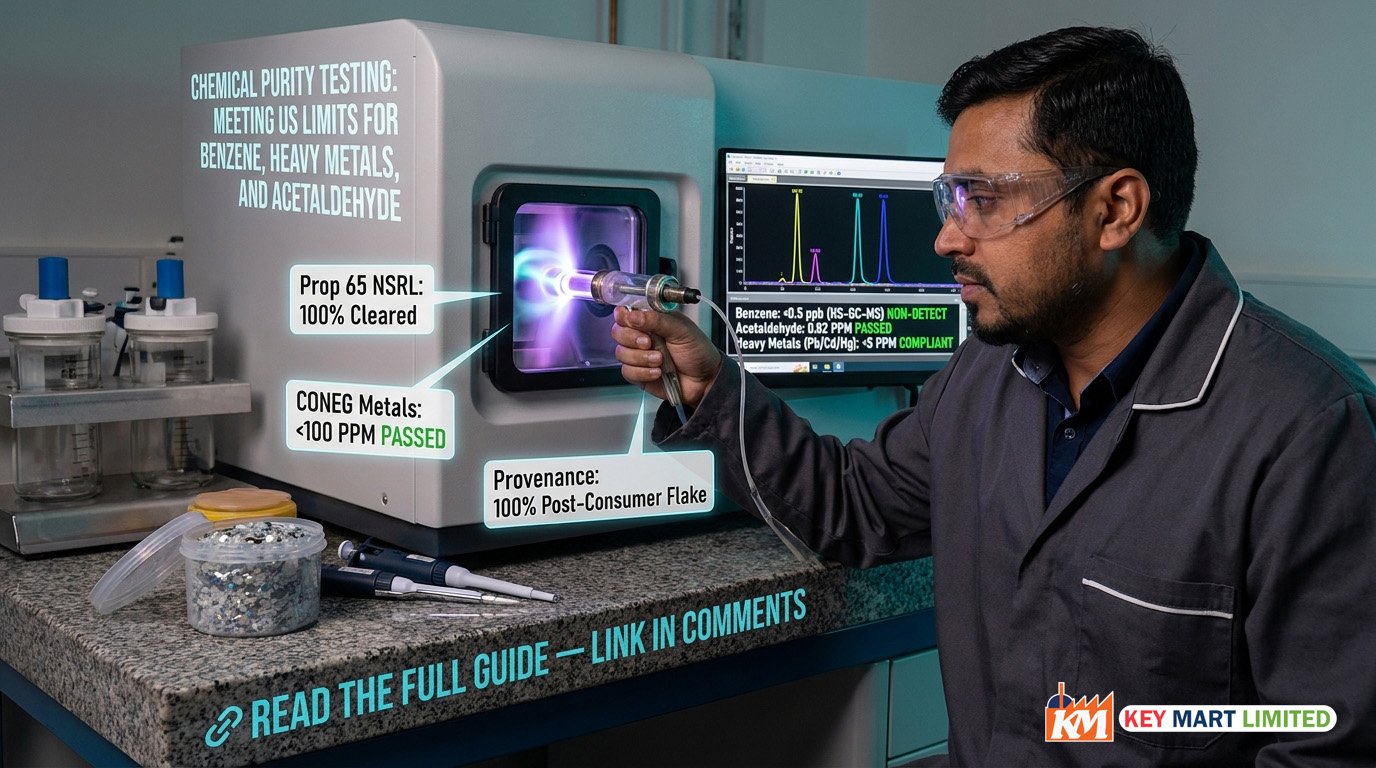
The US Food and Drug Administration (FDA), California Proposition 65, and major beverage bottlers maintain tight limits on carcinogenic aromatics like benzene ($< 1.0\text{ ppb}$), toxic heavy metals like antimony, lead, and cadmium, and flavor-altering aldehydes like acetaldehyde ($< 1.0\text{–}1.5\text{ PPM}$).
Meeting these specifications requires adhering to rigorous chemical testing standards rPET flakes US protocols.
By combining headspace Gas Chromatography-Mass Spectrometry (GC-MS) with Inductively Coupled Plasma Mass Spectrometry (ICP-MS), testing teams can verify that industrial hot-caustic decontamination and air elutriation strip harmful volatiles well below US action levels.
This analytical guide examines testing protocols for benzene, heavy metals, and acetaldehyde, details laboratory detection thresholds, and explains how Key Mart Limited delivers chemically pure rPET flakes to safety-conscious American converters.
1. Key Chemical Impurities: Toxicological Limits & Analytical Testing
Analytical testing of post-consumer rPET focuses on three primary chemical categories:
Clear Bottle Flake Infeed ➔ Static Headspace Extraction ➔ GC-MS Analysis (Benzene / Acetaldehyde)
                          └──► Closed-Vessel Microwave Acid Digestion ➔ ICP-MS (Heavy Metals)
                               └──► Analytical CoA Verification ➔ US Market Clearance
A. Benzene ($< 1.0\text{ ppb}$ / Prop 65 Action Level)
-
The Risk: Benzene is a known human carcinogen. In post-consumer plastics, trace benzene typically originates from consumer misuse (storage of petroleum solvents, gasoline, or degreasers in bottles) or severe thermal degradation of additives.
-
Testing Protocol: Analyzed via Static Headspace Gas Chromatography coupled with a Mass Selective Detector (HS-GC-MS) in accordance with EPA Method 5021A / 8260D.
-
The Threshold: To satisfy California Proposition 65 “No Significant Risk Levels” (NSRL) and FDA migration safety baselines, free benzene in clear rPET flakes must stay strictly below $1.0\text{ ppb}$, with leading converters requiring non-detectable levels ($< 0.5\text{ ppb}$).
B. Acetaldehyde ($AA < 1.0\text{–}1.5\text{ PPM}$)
-
The Risk: Acetaldehyde is formed by the thermal degradation of the polyester chain during hot washing, drying, and extrusion. While non-toxic at trace levels, it has a low sensory odor threshold, imparting a sweet, fruity off-taste to mineral water and sensitive beverages.
-
Testing Protocol: Measured via high-temperature dynamic headspace GC with a Flame Ionization Detector (GC-FID) following ASTM F2013 standards.
-
The Target: Quality-controlled clear bottle flakes must register below $1.0\text{–}1.5\text{ PPM}$ residual $AA$ to prevent flavor scalping in blow-molded preforms.
C. Heavy Metals: Antimony (Sb), Lead (Pb), and Cadmium (Cd)
-
The Risk: Antimony trioxide is the standard polymerization catalyst used in virgin PET production, resulting in baseline antimony concentrations ($150\text{–}250\text{ PPM}$). Lead and cadmium may enter the stream via colored masterbatches, non-food packaging, or contaminated printing inks.
-
Testing Protocol: Flakes undergo closed-vessel microwave-assisted nitric acid digestion (EPA 3052) followed by Inductively Coupled Plasma Mass Spectrometry (ICP-MS) (EPA 6020B).
-
The Limits: Toxic heavy metals (Pb, Cd, Hg, $\text{Cr}^{VI}$) must register an aggregate sum below $100\text{ PPM}$ under CONEG / TPCH legislation, with migration into food stimulants strictly below $0.04\text{ mg/kg}$ for Antimony under FDA dietary guidelines.
US Chemical Purity & Toxicological Benchmark Matrix
Read More: A Step-by-Step Guide to Importing PET Flakes from Bangladesh via Chittagong Port
| Chemical Parameter | General Scrap Flakes | Standard Reprocessed rPET | US Chemical Purity Grade (Key Mart Standard) |
| Benzene Content (HS-GC-MS) | $> 5.0\text{ ppb}$ (Prop 65 Risk) | $1.5\text{–}3.0\text{ ppb}$ | < 0.5 – 1.0 ppb (Non-Detectable / Prop 65 Clear) |
| Acetaldehyde (ASTM F2013) | $> 4.0\text{–}8.0\text{ PPM}$ (Off-Flavor) | $2.0\text{–}3.5\text{ PPM}$ | < 1.0 – 1.5 PPM (Neutral Sensory Profile) |
| Sum of Heavy Metals (Pb, Cd, Hg, Cr) | $> 150\text{ PPM}$ (Fail) | $40\text{–}80\text{ PPM}$ | < 10 PPM Total (Far Below CONEG 100 PPM Limit) |
| Antimony Migration (ICP-MS) | Marginal ($> 0.03\text{ mg/kg}$) | $0.02\text{ mg/kg}$ | < 0.01 mg/kg (Safe Food Migration Envelope) |
| PVC Contamination Ceiling | $> 150\text{–}300\text{ PPM}$ | $50\text{–}100\text{ PPM}$ | < 25 – 50 PPM (Continuous Hot-Caustic) |
| Micro-Dust & Fines ($< 500\,\mu\text{m}$) | $> 2.5\text{–}3.5\%$ | $1.0\text{–}1.5\%$ | < 0.3% (Multi-Stage Air Elutriated) |
| Intrinsic Viscosity (IV) Baseline | $0.65\text{–}0.70\text{ dL/g}$ | $0.72\text{–}0.75\text{ dL/g}$ | 0.78 – 0.82 dL/g (Stable Baseline) |
| Chain-of-Custody Certification | Unverified | Self-Declared | GRS 4.0 Transaction Certified (TC) |
2. Industrial Decontamination: Eliminating VOCs on the Wash Line
Keeping volatile chemical levels below US action levels requires three core industrial decontamination steps:
-
Continuous High-Temperature Caustic Saponification ($85^\circ\text{C}-95^\circ\text{C}$): Hot alkaline solutions break down fatty oils, strip organic surface films, and dissolve residual solvent residues before they can diffuse into the polymer bulk.
-
Multi-Stage Fresh Water Counter-Current Rinsing: Flakes pass through sequential freshwater wash stages to remove saponified surfactant layers, keeping surface conductivity low ($\le 12\,\mu\text{S/cm}$) and eliminating chemical carryover.
-
Controlled Thermal Pre-Drying and Air Elutriation: Passing washed flakes through heated centrifugal dryers and counter-current air classifiers strips residual volatile organics while removing dust fines ($< 500\,\mu\text{m}$) that generate excess acetaldehyde during melt processing.
3. How Key Mart Limited Meets US Chemical Safety Standards
Supplying safety-conscious American packaging converters requires working with an established bangladesh pet flakes manufacturer that has pristine source segregation, automated chemical washing, and comprehensive lab testing.
As a premier pet flakes company bangladesh and trusted pet flakes exporter, Key Mart Limited supplies verified, chemically pure clear rPET flakes engineered for direct compliance with US standards:
-
100% Post-Consumer Beverage Bottle Collection: Operating as a leading pet flakes manufacturer dhaka, Key Mart Limited selectively processes 100% post-consumer clear water and soft drink containers, rejecting mixed industrial scrap, agrochemical containers, and colored plastics at intake gates.
-
Continuous Multi-Stage Caustic Washing ($85^\circ\text{C}-95^\circ\text{C}$): As an established bangladesh pet flakes manufacturer, our facility subjects flakes to continuous hot-caustic friction washing and automated NIR optical sorting, fully saponifying label glues and stripping organic residues to guarantee $\text{PVC} < 25\text{–}50\text{ PPM}$ and zero adhesive carryover.
-
Sub-0.3% Fines Removal via Air Elutriation: Serving as an experienced pet flakes exporter, Key Mart Limited passes every batch through automated multi-stage zig-zag air classifiers, keeping dust and fines strictly below $0.3\%$ to eliminate premature burning and volatile smoke during high-heat extrusion.
-
Laboratory Chemical Profiling & Traceability: Every export batch is tested in our Dhaka quality control laboratory for stable Intrinsic Viscosity ($0.78\text{–}0.82\text{ dL/g}$), high optical luminance ($L^* \ge 74.0, b^* \le +1.2$), and trace volatile purity, supported by batch-specific Certificates of Analysis (CoA) and official Global Recycled Standard (GRS 4.0) Transaction Certificates (TC).
-
Maximized 25–26 MT Container Logistics: We pack 25–26 Metric Tons into every 40ft High Cube container with heavy-duty 100-micron PE inner liners to preserve feedstock dryness during transit under FOB Chittagong, CFR, or CIF shipping terms, with contractually secured extended free time at major US ports.
Partner with Key Mart Limited Today
Satisfy strict US toxicological standards, eliminate benzene and heavy metal contamination risks, and source certified rPET flakes from Bangladesh. Contact our Dhaka export management team today to request Technical Data Sheets, order commercial testing samples, or reserve monthly container allocations.
-
Company Name: Key Mart Limited
-
Head Office & Factory Address: Plot #31, Road #N-1, Block #K, Eastern Housing, Pallabi 2nd Phase, Rupnagar, Dhaka-1216, Bangladesh.
-
Official Website: www.keymartbd.com
-
Corporate Email: keymartltd@gmail.com | info@keymartbd.com
-
Direct Phone / WhatsApp: +8801760774499, +8801864935478
Join our community today and stay connected with the future of PET recycling.
 Visit our YouTube channel: Key Mart Limited on YouTube
Visit our Facebook Page: Key Mart Limited on Facebook
Subscribe to see our latest factory tours, production updates, and export success stories.