Views: 5
For high-volume thermoforming operations producing fresh produce clamshells, deli trays, and bakery containers for the US market, balancing regulatory compliance with raw material economics is an ongoing challenge. While brand owners demand higher post-consumer recycled content to hit aggressive sustainability targets, food safety under Title 21 of the Code of Federal Regulations (21 CFR § 177.1630) remains strictly non-negotiable.
Direct food contact with post-consumer recycled Polyethylene Terephthalate (pet flakes) traditionally requires expensive solid-state polycondensation (SSP) treatments and comprehensive Letter of No Objection (LNO) challenge tests.
For many custom sheet extruders, dedicating an entire mono-layer line to high-cost food-grade resin tightens operating margins beyond comfort.
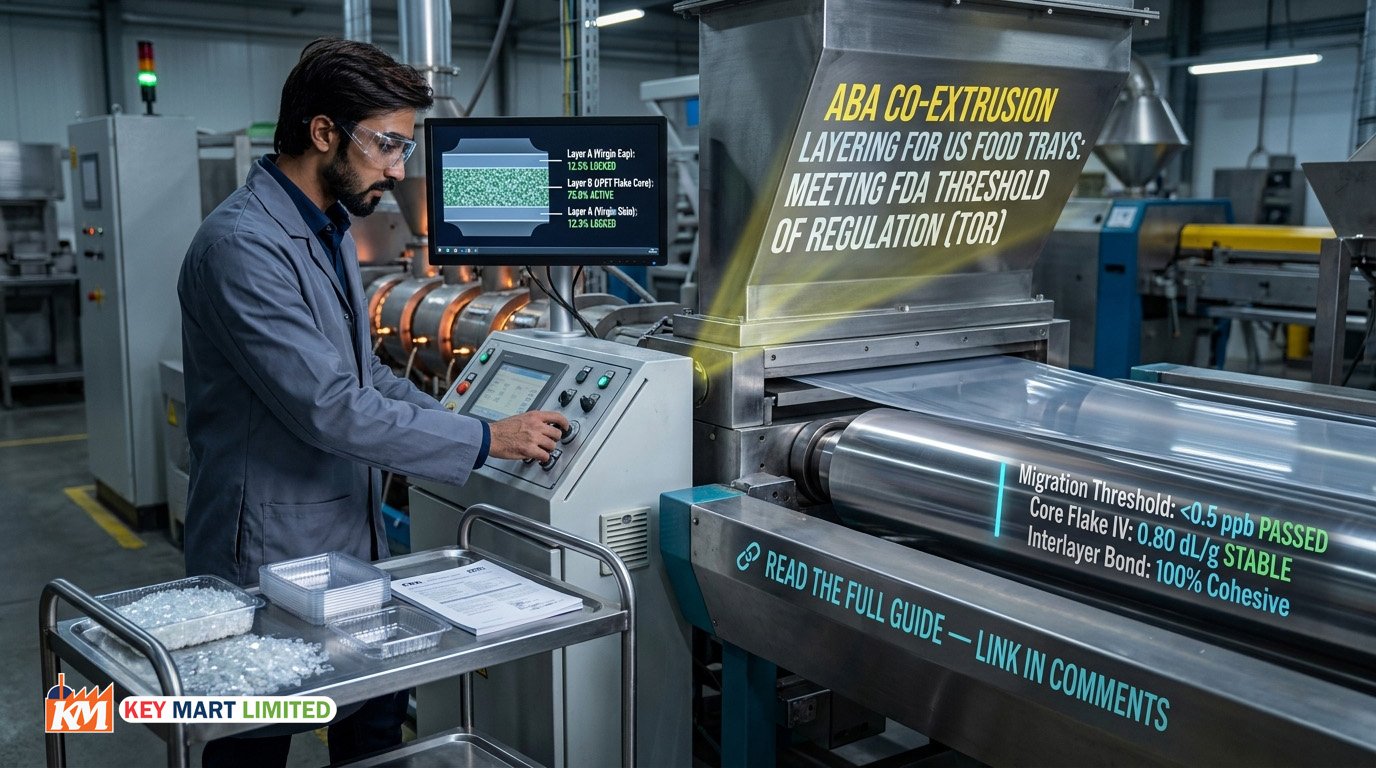
The industry standard for solving this cost-compliance paradox is ABA co-extrusion layering.
By encasing a high-percentage core of mechanical rPET flakes between two protective outer skin layers of virgin PET, sheet manufacturers create an effective functional barrier.
This multi-layer architecture prevents chemical migrants from leaching into food, keeping migration levels comfortably below the US Food and Drug Administration’s stringent Threshold of Regulation (TOR) limit of $0.5\text{ ppb}$ ($1.5\,\mu\text{g/person/day}$) without requiring prime virgin resin across the entire sheet thickness.
Achieving this safely requires dialing in your ABA sheet extrusion FDA food packaging line parameters.
This technical converting guide breaks down the physical mechanics of functional barriers under FDA TOR guidelines, details critical skin layer thickness ratios, and explains how Key Mart Limited delivers low-dust, high-viscosity rPET flakes engineered for stable co-extrusion.
1. The Physics of Functional Barriers: How the ABA Structure Locks In Migrants
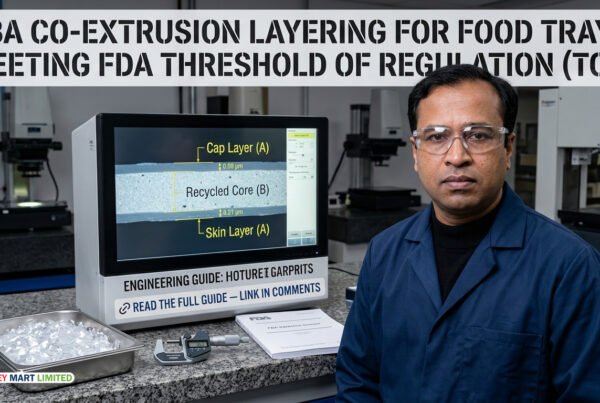
The ABA co-extrusion structure functions as a multi-stage diffusion barrier where the virgin skin layers shield food products from the post-consumer core:
[Layer A: Virgin Cap (10–15%)] ──► Direct Food Contact / Migration Barrier
[Layer B: Recycled Flake Core (70–80%)] ──► Structural Rigidity / High PCR Content
[Layer A: Virgin Skin (10–15%)] ──► Outer Sealing Surface / Optical Gloss
A. Fickian Diffusion Kinetics and the TOR Threshold
Under the FDA Center for Food Safety and Applied Nutrition (CFSAN) Threshold of Regulation policy (21 CFR § 170.39), a dietary concentration of an uncharacterized migrant is deemed safe for food contact if it does not exceed $0.5\text{ ppb}$.
In an ABA sheet, the migration of volatile and semi-volatile organic compounds from the recycled core follows Fick’s Second Law of Diffusion:
Where $C$ represents migrant concentration, $t$ is shelf-life storage time, $x$ is diffusion distance (skin layer thickness), and $D$ is the diffusion coefficient of the migrant in amorphous PET.
Because PET has a rigid macromolecular backbone and a relatively high glass transition temperature ($T_g \approx 78^\circ\text{C}$), diffusion coefficients ($D$) are exceptionally low at room and refrigerated temperatures (typically $10^{-14}\text{ to }10^{-16}\text{ cm}^2/\text{s}$).
A co-extruded virgin PET cap layer with a nominal thickness of $25\text{ to }50\,\mu\text{m}$ (10%–15% of total sheet thickness) acts as an impenetrable functional barrier over a standard 6- to 12-month commercial shelf life, keeping migrant levels far below the $0.5\text{ ppb}$ TOR threshold.
ABA Co-Extrusion Layer Distribution & Migration Performance Matrix
Read More: A Step-by-Step Guide to Importing PET Flakes from Bangladesh via Chittagong Port
| Processing & Quality Parameter | Mono-Layer Mechanical Flake | Sub-Optimized ABA Structure | Optimized ABA Structure (Key Mart Standard) |
| Layer Thickness Configuration | $100\%$ Recycled Mono-Layer | $5\% \text{ A} / 90\% \text{ B} / 5\% \text{ A}$ | 10%–15% A / 70%–80% B / 10%–15% A |
| Virgin Skin Layer Caliper | None ($0\,\mu\text{m}$) | $< 15\,\mu\text{m}$ (Micro-pinhole risk) | 35 – 50 µm (Impenetrable Functional Barrier) |
| FDA TOR Migration Status | Exceeds $0.5\text{ ppb}$ limit | Marginal / Inconsistent | < 0.5 ppb Dietary Exposure (Compliant) |
| Flake Intrinsic Viscosity (IV) | $0.65\text{–}0.70\text{ dL/g}$ | $0.72\text{–}0.75\text{ dL/g}$ | 0.78 – 0.82 dL/g (Matched Melt Viscosity) |
| Interlayer Delamination Risk | N/A | High (Viscosity mismatch) | Zero Delamination (Rheologically Balanced) |
| PVC Contamination Ceiling | $> 150\text{–}300\text{ PPM}$ | $50\text{–}100\text{ PPM}$ | < 25 – 50 PPM (Continuous Hot-Caustic) |
| Dust & Fines Content ($<500\,\mu\text{m}$) | $> 2.5\text{–}3.5\%$ | $1.0\text{–}1.5\%$ | < 0.3% (Multi-Stage Air Elutriated) |
| Optical Clarity ($L^ \ge 74, b^ \le 1.2$)** | Cloudy / Yellow | Hazy Outer Web | Crystal Clear Glass-Like Finish |
| Chain-of-Custody Certification | Unverified | Self-Declared | GRS 4.0 Transaction Certified (TC) |
2. Preventing Interlayer Delamination and Viscosity Mismatch
Running an ABA co-extrusion feedblock requires precise rheological balance. If the melt viscosity of the recycled core diverges from the virgin skins, sheet quality drops rapidly:
-
Match Extruder Intrinsic Viscosities ($\vert{}\Delta IV\vert{} \le 0.04\text{ dL/g}$): Virgin bottle-grade APET typically enters the primary extruder with an $IV$ of $0.80\text{–}0.84\text{ dL/g}$. If the secondary extruder melting the pet flakes core is fed low-grade scrap with an $IV$ below $0.72\text{ dL/g}$, shear rate disparities at the co-extrusion feedblock interface cause interfacial instability, wave patterns, and post-thermoforming delamination.
-
Control Core Moisture ($< 30\text{ PPM}$): Feeding un-dried or poorly dried recycled flakes into the main extruder triggers hydrolytic chain cleavage, instantly dropping core viscosity and generating steam micro-bubbles that rupture the thin virgin skin layer.
-
Eliminate Micro-Fines at Infeed: Electrostatic fines ($< 500\,\mu\text{m}$) pyrolyze inside the core extruder barrel, creating carbonized black specks that break through the $35\,\mu\text{m}$ virgin cap and create pinpoint pinholes in the functional barrier.
3. How Key Mart Limited Supplies Co-Extrusion Core-Grade rPET Flakes
Maintaining a stable ABA co-extrusion process requires sourcing from an established bangladesh pet flakes manufacturer that delivers tight viscosity control, deep hot-wash decontamination, and clean air classification.
As a premier pet flakes company bangladesh and trusted pet flakes exporter, Key Mart Limited delivers low-dust, high-IV clear rPET flakes engineered specifically for multi-layer sheet extrusion lines:
-
100% Post-Consumer Beverage Bottle Intake: Operating as a leading pet flakes manufacturer dhaka, Key Mart Limited selectively processes 100% post-consumer clear water and carbonated soft drink bottles, rejecting industrial composite scrap, multi-layer colored packaging, and non-PET materials at collection gates.
-
Continuous Multi-Stage Caustic Washing ($85^\circ\text{C}-95^\circ\text{C}$): As an established bangladesh pet flakes manufacturer, our facility subjects flakes to continuous hot-caustic friction washing and automated NIR optical sorting, fully saponifying label glues and stripping organic residues to guarantee $\text{PVC} < 25\text{–}50\text{ PPM}$ and zero adhesive carryover.
-
Sub-0.3% Fines Removal via Air Elutriation: Serving as an experienced pet flakes exporter, Key Mart Limited passes every batch through automated multi-stage zig-zag air classifiers, keeping dust and fines strictly below $0.3\%$ to prevent feed-throat bridging and prevent gel formations in the core layer.
-
Tight IV Stability & Batch Traceability: Every export batch is tested in our Dhaka quality control laboratory for stable Intrinsic Viscosity ($0.78\text{–}0.82\text{ dL/g}$) and high luminance ($L^* \ge 74.0, b^* \le +1.2$), supported by batch-specific Certificates of Analysis (CoA) and official Global Recycled Standard (GRS 4.0) Transaction Certificates (TC).
-
Maximized 25–26 MT Container Logistics: We pack 25–26 Metric Tons into every 40ft High Cube container with heavy-duty 100-micron PE inner liners to preserve feedstock dryness during transit under FOB Chittagong, CFR, or CIF shipping terms, with contractually secured extended free time at major US ports.
Partner with Key Mart Limited Today
Optimize your ABA sheet co-extrusion formulations, satisfy FDA Threshold of Regulation migration standards, and secure high-viscosity rPET flakes from Bangladesh. Contact our Dhaka export management team today to request Technical Data Sheets, order commercial testing samples, or reserve monthly container allocations.
-
Company Name: Key Mart Limited
-
Head Office & Factory Address: Plot #31, Road #N-1, Block #K, Eastern Housing, Pallabi 2nd Phase, Rupnagar, Dhaka-1216, Bangladesh.
-
Official Website: www.keymartbd.com
-
Corporate Email: keymartltd@gmail.com | info@keymartbd.com
-
Direct Phone / WhatsApp: +8801760774499, +8801864935478
Join our community today and stay connected with the future of PET recycling.
 Visit our YouTube channel: Key Mart Limited on YouTube
Visit our Facebook Page: Key Mart Limited on Facebook
Subscribe to see our latest factory tours, production updates, and export success stories.