Views: 9
In retail packaging, appearance drives sales. Whether thermoforming clear clamshells for fresh produce, clear electronics blister packs, or high-end cosmetic containers, visual transparency is non-negotiable. For decades, converters counted on virgin APET to deliver glass-like clarity.
Today, brand owners face strict sustainability mandates and consumer pressure to integrate high ratios of post-consumer recycled Polyethylene Terephthalate (pet flakes).
However, moving to recycled resin often introduces an unwelcome defect: optical cloudiness, low light transmission, and yellow-grey discoloration.
When a customer examines a product on a store shelf, milky haze or dull packaging immediately lowers perceived product quality.
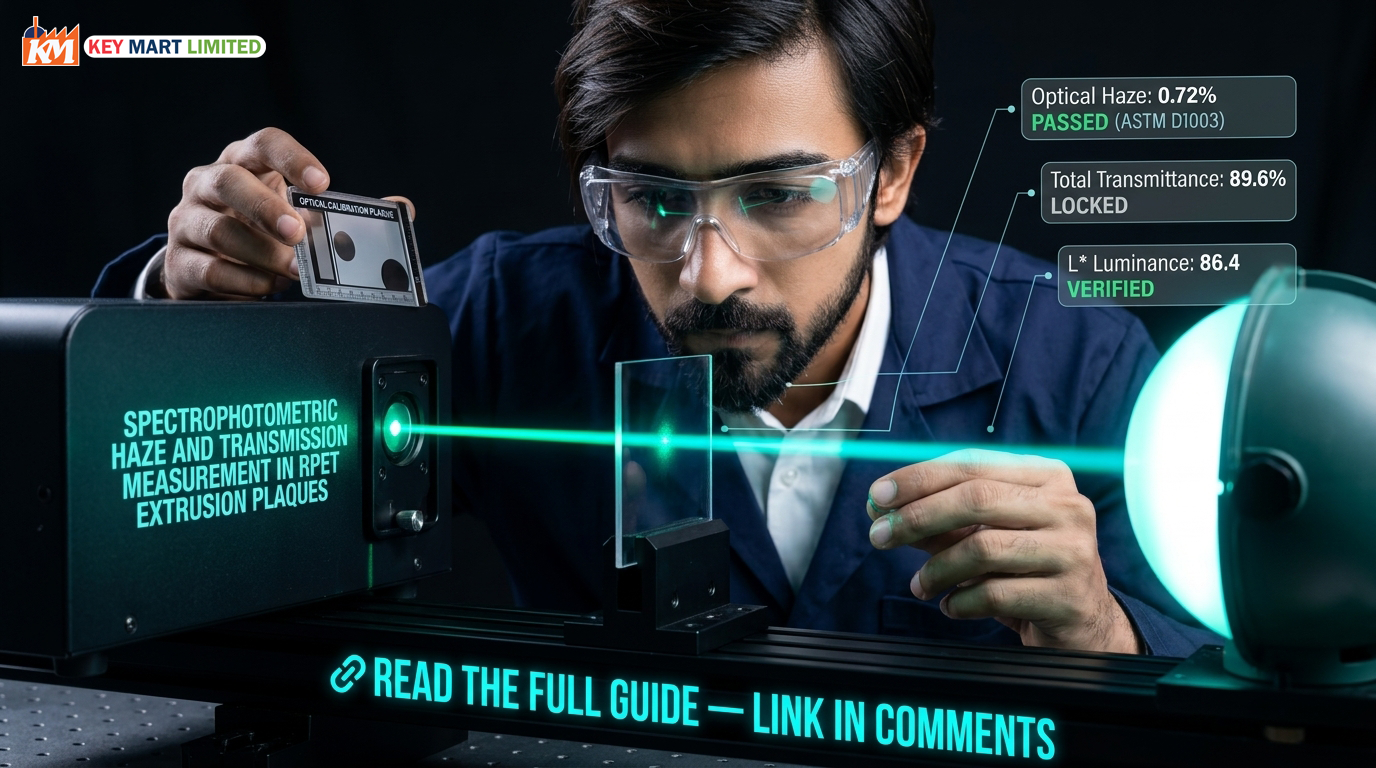
Securing premium optical clarity requires mastering rPET haze measurement ASTM D1003 protocols.
By molding standardized compression plaques and running precision spectrophotometric analysis with integrating spheres, converters and testing labs can quantify total luminous transmittance ($T_t$), narrow diffuse scatter ($Haze < 1.0\%$), and identify trace contaminants before running commercial extrusion lines.
This technical converting guide breaks down the optics of ASTM D1003 haze testing, explores the root causes of light scattering in rPET, and illustrates how Key Mart Limited delivers the clean, low-haze flakes needed for crystal-clear thermoforming.
1. The Physics of Optical Transparency: Luminous Transmission vs. Wide-Angle Haze
Optical performance in clear polymer sheets is governed by how light passes through or scatters within the amorphous matrix:
Clear Flake Batch ➔ Desiccant Drying (<30 PPM H₂O) ➔ Compression Plaque Molding (1.0 mm) ➔ Dual-Beam Spectrophotometer (Integrating Sphere) ➔ Total Transmittance (Tt) & Haze Calculation ➔ Defect-Free Thermoformed Sheet
A. Total Luminous Transmittance ($T_t$) vs. Diffuse Light Scatter ($T_d$)
Under standard ASTM D1003 (CIE Illuminant C / D65), optical quality is defined by two primary values:
-
Total Luminous Transmittance ($T_t$): The total fraction of transmitted light passing directly through the plaque without absorption. High-clarity rPET should achieve $T_t \ge 88.0\%\text{ to }90.0\%$.
-
Optical Haze Percentage ($Haze$): The percentage of transmitted light that deviates from the incident beam by more than an angle of $2.5^\circ$ through forward scattering:
$$\text{Haze } (\%) = \left( \frac{T_d}{T_t} \right) \times 100$$For food-grade and electronics blister packaging, target haze must remain strictly below $1.0\%\text{ to }1.5\%$ at a nominal $1.0\text{ mm}$ plaque thickness.
B. What Causes Light Scattering in Recycled PET?
When light encounters foreign inclusions or structural variations inside the rPET matrix, it refracts and scatters:
-
Cross-Polymer Immiscibility: Insoluble polyolefins (PP/PE from bottle caps) have a refractive index ($n \approx 1.49\text{–}1.50$) that differs from PET ($n \approx 1.57$). Even $50\text{ PPM}$ of cap plastic creates microscopic spherical domains that disperse light, generating a cloudy, milky haze.
-
Organic Char and Black Specks: Residual label adhesives (EVA/acrylic) and starch residues carbonize at $280^\circ\text{C}$, forming light-absorbing black specks that drop overall transmittance ($T_t$).
-
Secondary Spherulitic Crystallization: Slow cooling after extrusion allows polymer chains to organize into spherulites larger than the wavelength of visible light ($400\text{–}700\text{ nm}$), creating internal crystalline cloudiness.
Spectrophotometric Optical Quality Benchmark Matrix
Read More: A Step-by-Step Guide to Importing PET Flakes from Bangladesh via Chittagong Port
| Optical Parameter | Utility-Grade Recycled Flakes | Standard Industrial rPET | Optical Thermoforming Grade (Key Mart Standard) |
| Optical Haze (ASTM D1003, 1.0mm) | $> 4.5\text{–}6.5\%$ (Visible cloudiness) | $1.8\text{–}2.5\%$ | < 0.8% – 1.0% (Crystal Glass Clarity) |
| Total Luminous Transmittance ($T_t$) | $< 78.0\%$ (Dull / Dark) | $82.0\text{–}85.0\%$ | 88.5% – 91.0% (High Light Transmission) |
| Lightness Coordinate ($L^*$) | $68.0\text{–}72.0$ | $76.0\text{–}80.0$ | 84.0 – 87.0+ (Neutral Brightness) |
| Yellowness Index ($b^*$) | $> +4.0\text{–}+6.0$ (Yellow shift) | $+2.0\text{–}+3.0$ | +0.5 – +1.2 (Neutral Clear) |
| PVC Contamination Ceiling | $> 150\text{–}300\text{ PPM}$ | $50\text{–}100\text{ PPM}$ | < 25 – 50 PPM (Continuous Hot-Caustic) |
| Polyolefin Content (PP/PE) | $> 250\text{ PPM}$ | $50\text{–}100\text{ PPM}$ | < 25 PPM (Zero Dispersed Haze Domains) |
| Micro-Dust & Fines ($<500\,\mu\text{m}$) | $> 2.5\text{–}3.5\%$ | $1.0\text{–}1.5\%$ | < 0.3% (Multi-Stage Air Elutriated) |
| Flake Intrinsic Viscosity (IV) | $0.65\text{–}0.70\text{ dL/g}$ | $0.72\text{–}0.75\text{ dL/g}$ | 0.78 – 0.82 dL/g (Stable Baseline) |
| Chain-of-Custody Certification | Unverified | Self-Declared | GRS 4.0 Transaction Certified (TC)` |
2. Factory-Floor Practices for Defect-Free Sheet Extrusion
To achieve consistent optical clarity when converting pet flakes into flat APET sheets, extrusion managers should follow three primary processing controls:
-
Precision Plaque Compression Testing on Incoming Lots: Before feeding a bulk container into main extrusion silos, compression-mold a $1.0\text{ mm}$ test plaque and scan it on a haze meter. This provides immediate proof of optical purity without risking commercial line downtime.
-
Rapid Chill Roll Quenching ($15^\circ\text{C}\text{–}25^\circ\text{C}$): Passing the molten extruded web over mirror-finished, chrome-plated chill rolls freezes the polymer in an amorphous state ($X_c < 5\%$), preventing spherulitic crystallization that induces post-extrusion haziness.
-
Melt Filtration Down to 25–40 $\mu\text{m}$: Running fine multi-stage backflush screen changers filters out un-melted cross-linked gels and microscopic PVC char particles before the melt enters the flat T-die lips.
3. How Key Mart Limited Supplies Optical-Grade rPET Flakes
Delivering low-haze rPET requires partnering with an established bangladesh pet flakes manufacturer that maintains clean source collection, hot-caustic decontamination, and automated optical sorting.
As a premier pet flakes company bangladesh and trusted pet flakes exporter, Key Mart Limited delivers low-dust, high-clarity clear rPET flakes engineered for high-end thermoforming:
-
Source-Segregated Dhaka Collection: Operating as a leading pet flakes manufacturer dhaka, Key Mart Limited exclusively processes 100% post-consumer clear beverage bottles, rejecting tinted scrap, opaque packaging, and non-PET plastics at intake gates.
-
Continuous Multi-Stage Caustic Washing ($85^\circ\text{C}-95^\circ\text{C}$): As an established bangladesh pet flakes manufacturer, our facility subjects flakes to continuous hot-caustic friction washing and automated NIR sorting, fully eliminating label glues and stripping organic residues to guarantee $\text{PVC} < 25\text{–}50\text{ PPM}$ and zero adhesive carryover.
-
Sub-0.3% Fines Removal via Air Elutriation: Serving as an experienced pet flakes exporter, Key Mart Limited passes every batch through automated multi-stage zig-zag air classifiers, keeping dust and fines strictly below $0.3\%$ to eliminate premature burning and black specks in extruded sheet webs.
-
Laboratory Optical Profiling & Batch Traceability: Every export batch is tested in our Dhaka quality control laboratory using spectrophotometric plaque analysis to certify low haze ($< 1.0\%$), high luminance ($L^* \ge 84.0$), and stable Intrinsic Viscosity ($0.78\text{–}0.82\text{ dL/g}$), backed by batch-specific Certificates of Analysis (CoA) and Global Recycled Standard (GRS 4.0) Transaction Certificates (TC).
-
Maximized 25–26 MT Container Logistics: We pack 25–26 Metric Tons into every 40ft High Cube container with heavy-duty 100-micron PE inner liners to preserve feedstock dryness during transit under FOB Chittagong, CFR, or CIF shipping terms.
Partner with Key Mart Limited Today
Eliminate optical haze, achieve glass-clear thermoforming displays, and secure high-purity rPET flakes from Bangladesh. Contact our Dhaka export management team today to request Technical Data Sheets, order commercial testing samples, or reserve monthly container allocations.
-
Company Name: Key Mart Limited
-
Head Office & Factory Address: Plot #31, Road #N-1, Block #K, Eastern Housing, Pallabi 2nd Phase, Rupnagar, Dhaka-1216, Bangladesh.
-
Official Website: www.keymartbd.com
-
Corporate Email: keymartltd@gmail.com | info@keymartbd.com
-
Direct Phone / WhatsApp: +8801760774499, +8801864935478
Join our community today and stay connected with the future of PET recycling.
 Visit our YouTube channel: Key Mart Limited on YouTube
Visit our Facebook Page: Key Mart Limited on Facebook
Subscribe to see our latest factory tours, production updates, and export success stories.