Views: 6
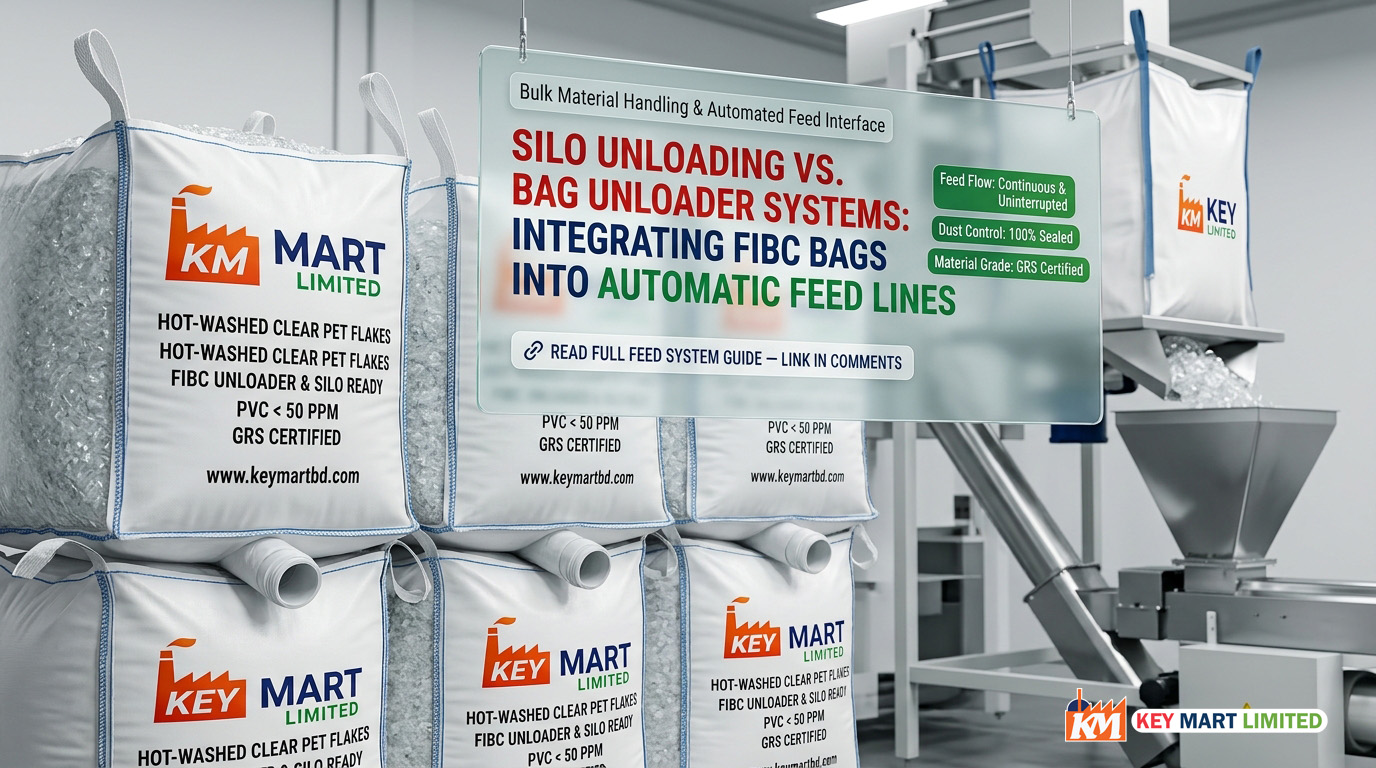
In high-capacity plastics manufacturing, transitioning recycled Polyethylene Terephthalate (pet flakes) from raw material storage into continuous extrusion or fiber spinning lines requires efficient bulk material handling. As extrusion throughput rates scale up to several metric tons per hour, processing facilities must choose the most effective material feeding infrastructure: bulk storage silo unloading systems or automated FIBC Big Bag unloader stations (Bulk Bag Discharge Stations).
Selecting the right unloading architecture directly impacts facility capital expenditure (CapEx), operational flexibility, airborne dust control, and feed throat consistency. This article provides a technical comparison between silo unloading and FIBC bag unloader systems, helping plant managers optimize bulk material integration for recycled PET flake processing.
1. Silo Unloading Systems: Continuous High-Volume Automation
Bulk storage silos—constructed from welded aluminum or stainless steel—are designed for high-throughput processing plants receiving raw materials via bulk railcars or specialized pneumatic bulk trucks.
Pneumatic Bulk Transfer ➔ Storage Silo ➔ Air-Assisted Discharge Cone ➔ Rotary Airlock / Pneumatic Feed Line
Advantages of Silo Systems
-
Fully Automated Material Flow: Eliminates manual forklift handling and continuous operator intervention during production runs.
-
Maximum Storage Footprint Efficiency: Vertical silos store $50 \text{ to } 150+ \text{ Metric Tons}$ of PET flakes within a compact outdoor footprint, saving valuable indoor factory floor space.
-
Pneumatic Line Integration: Directly connects to centralized pneumatic conveying systems, feeding multiple extruder hoppers simultaneously.
Technical Challenges with PET Flakes
Unlike uniform virgin resin pellets, recycled PET flakes exhibit irregular particle geometry, flat aspect ratios, and varying bulk densities ($350 – 450 \text{ kg/m}^3$). Inside large silos, these physical characteristics often lead to bridging, ratholing, and material compaction at the discharge cone. Overcoming flake bridging requires installing expensive vibrating bin activators, fluidizing air pads, or rotary sweep agitators.
Read More: A Step-by-Step Guide to Importing PET Flakes from Bangladesh via Chittagong Port
2. FIBC Bag Unloader Systems: Flexibility & Quick Grade Transitions
FIBC Bag Unloaders (also known as Bulk Bag Dischargers) are engineered to receive 1.0 to 1.5 Metric Ton jumbo bags delivered on pallets. A forklift or integrated electric hoist positions the jumbo bag over a sealed discharge hopper.
Forklift / Hoist Positioning ➔ Pneumatic Bag Clamping ➔ Spout Access Chamber ➔ Agitation Paddles ➔ Screw Conveyor / Vacuum Receiver
Advantages of FIBC Bag Unloader Stations
-
Lower Initial Capital Expenditure (CapEx): Bag discharge stations require a fraction of the capital investment of outdoor silo systems and do not demand heavy civil foundation work.
-
Rapid Material & Grade Switching: Switching between different material grades (e.g., clear flakes, light-blue flakes, or custom IV batches) takes minutes—operators simply swap jumbo bags rather than purging a 100-ton silo.
-
Controlled Dust Suppression: Modern discharge stations feature dust-tight pneumatic spout seals and dust extraction ports, preventing airborne plastic fines and dust from escaping into the factory environment.
-
Elimination of Flake Bridging: Equipped with pneumatic massage paddles or side agitators, bag unloaders actively flex the bottom of the FIBC bag, ensuring continuous flake flow into the feed hopper without bridging.
Technical & Operational Comparison Matrix
| Evaluation Parameter | High-Capacity Bulk Silo Systems | Automated FIBC Bag Unloader Stations |
| Initial Capital Expenditure | High (Heavy civil foundations, pneumatic blowers) | Low to Moderate (Plug-and-play installation) |
| Footprint Requirement | External outdoor vertical space | Compact indoor production floor area |
| Flake Bridging Risk | High (Requires vibrators & fluidizers) | Low (Pneumatic bag massage paddles prevent bridging) |
| Grade Change Flexibility | Low (Purging large silos takes hours) | High (Quick bag swaps in under 10 minutes) |
| Dust Control Level | Sealed pneumatic system | Sealed spout chamber with active dust collection |
| Ideal Throughput Scale | $> 3,000 \text{ kg/hour}$ continuous single grade | 500 – 2,500 kg/hour flexible/multi-grade lines |
3. Optimizing FIBC Bags for Automatic Discharge Lines
To ensure smooth operation when using FIBC bag unloaders, the physical properties of the jumbo bags and the pet flakes inside must adhere to strict packaging benchmarks:
-
Form-Stable Baffle FIBC Construction: Baffle bags feature internal fabric stays that maintain a square profile, preventing the bag from rounding out or slumping during hoisting and discharge.
-
Bottom Discharge Spout with Protection Rose: A standardized bottom discharge spout ($35–45 \text{ cm}$ diameter) with a dust-tight tie drawstring ensures clean docking into the unloader’s clamping mechanism.
-
Low Fines & Uniform Sizing: Flakes containing high dust or fine content ($< 500\,\mu\text{m}$) cause static cling and dust packing inside the spout. Using flakes with fines content below $0.5\%$ ensures rapid gravity discharge.
4. How Key Mart Limited Fulfills Global Buyer Demand
Whether your manufacturing facility utilizes large bulk storage silos or automated FIBC bag discharge stations, securing consistent, high-purity recycled PET feedstock is essential for maintaining uninterrupted production.
As a premier pet flakes company bangladesh and trusted pet flakes exporter, Key Mart Limited delivers export-grade feedstock engineered for seamless integration into automated feed lines:
-
Advanced Industrial Processing in Dhaka: Operating as a leading pet flakes manufacturer dhaka, Key Mart Limited processes post-consumer PET bottles using automated Near-Infrared (NIR) optical sorting, continuous caustic hot-washing ($85^\circ\text{C}-95^\circ\text{C}$), and Z-Box air elutriation to yield ultra-pure, dust-free clear flakes.
-
Unloader-Ready FIBC Packaging: As an established bangladesh pet flakes manufacturer, our flakes are packed in form-stable Baffle FIBC jumbo bags fitted with standardized bottom discharge spouts and $100\,\mu\text{m}$ PE liners, ensuring dust-free docking and rapid discharge into automated bag unloader hoppers.
-
Controlled Granulation & Low Fines: Our precision rotary granulators produce uniform 8–12 mm flakes with an optimized bulk density ($400 – 450 \text{ kg/m}^3$) and fines content below $0.5\%$, preventing feed-throat bridging and flow blockages.
-
Full Batch Traceability & High Payload: Functioning as an experienced pet flakes exporter, Key Mart Limited loads up to 25–26 Metric Tons per 40ft High Cube container under FOB Chittagong or CFR/CIF terms, backed by batch-specific Certificates of Analysis (CoA) and Global Recycled Standard (GRS 4.0) certification.
Partner with Key Mart Limited Today
Streamline your bulk material handling, eliminate feeding bottlenecks, and secure certified high-purity rPET flakes from Bangladesh. Contact our Dhaka export management team today to request Technical Data Sheets, order commercial samples, or reserve container allocation schedules.
-
Company Name: Key Mart Limited
-
Head Office & Factory Address: Plot #31, Road #N-1, Block #K, Eastern Housing, Pallabi 2nd Phase, Rupnagar, Dhaka-1216, Bangladesh.
-
Official Website: www.keymartbd.com
-
Corporate Email: keymartltd@gmail.com | info@keymartbd.com
-
Direct Phone / WhatsApp: +8801760774499, +8801864935478
Join our community today and stay connected with the future of PET recycling.
👉 Visit our YouTube channel: Key Mart Limited on YouTube
👉 Visit our Facebook Page: Key Mart Limited on Facebook
Subscribe to see our latest factory tours, production updates, and export success stories.