Views: 4
In high-speed flat sheet extrusion and thermoforming, surface quality defines the final product. When processing post-consumer recycled Polyethylene Terephthalate (pet flakes), plant operators often encounter unexpected rheological instability: surface waviness, sharkskin roughness, or uneven gauge thickness as the molten web exits the die lips.
Unlike virgin resin with a uniform molecular weight distribution, recycled PET exhibits distinct pseudoplastic non-Newtonian behavior under stress.
If the shear rate inside the die exceeds the critical shear stress threshold of the melt, the laminar flow fractures at the die exit wall.
This melt fracture causes severe optical distortion, gauge variation, and structural weaknesses in finished APET and CPET sheets.
Eliminating these flow defects requires mastering rPET melt shear viscosity.
By understanding how shear thinning impacts melt flow index (MFI), adjusting die gap geometries ($h$), and optimizing backpressure via gear pump synchronization, extrusion managers can maintain a stable laminar flow without sacrificing production throughput.
This engineering guide analyzes the rheology of shear-sensitive rPET melts, provides practical die and pressure adjustment parameters, and demonstrates how Key Mart Limited delivers uniform, rheologically stable rPET feedstock to sheet converters worldwide.
1. The Rheological Mechanics of rPET Shear Thinning
Molten PET is a shear-thinning fluid: its apparent dynamic viscosity decreases as the applied shear rate ($\dot{\gamma}$) increases:
Stable Melt Feed ➔ Gear Pump Pressure Stabilization ➔ Die Manifold Distribution ➔ Die Land Shear Zone (h) ➔ Controlled Die Exit ➔ Defect-Free Optical Sheet
A. Critical Shear Stress and Melt Fracture
Inside the extrusion die, the shear rate is inversely proportional to the square of the die gap height ($h$):
Where $Q$ is volumetric flow rate and $W$ is die width.
-
The Sharkskin Trigger: When extrusion speeds increase through a narrow die gap, wall shear stress ($\tau_w$) spikes beyond the critical limit ($> 0.1\text{–}0.2\text{ MPa}$).
-
Flow Separation: The molten polymer slips and sticks cyclically against the metal die land, creating microscopic surface tears (sharkskin) and macroscopic waves across the sheet surface.
B. The Influence of Molecular Weight and IV Variations
Inconsistent raw material with fluctuating Intrinsic Viscosity ($IV$) causes erratic shear response:
-
High-IV Surges: Higher $IV$ fractions ($> 0.82\text{ dL/g}$) demand greater shear stress, causing sudden die pressure spikes.
-
Low-IV Fluidity: Lower $IV$ degraded fractions ($< 0.70\text{ dL/g}$) drop in viscosity too quickly under shear, leading to localized die drool, edge bead surging, and thickness variation.
Read More: A Step-by-Step Guide to Importing PET Flakes from Bangladesh via Chittagong Port
Rheological Behavior & Extrusion Die Setup Benchmark
| Extrusion Parameter | Unstable Utility Scrap Feed | Standard Reprocessed rPET | Rheology-Stable Grade (Key Mart Standard) |
| Melt Flow Index Stability | Unpredictable ($\pm 35\%$ MFI variance) | Moderate ($\pm 15\%$) | Tight Tolerance (±5% Stable Rheology) |
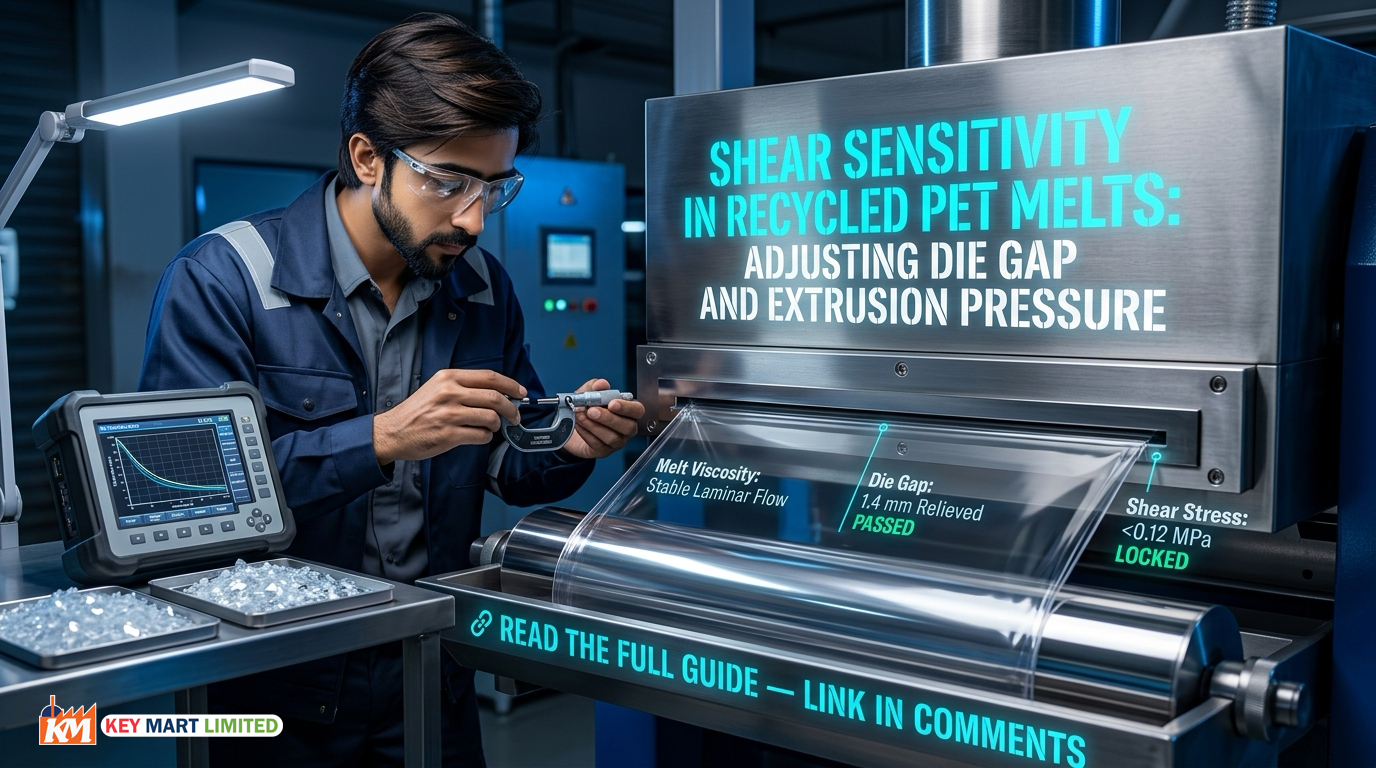
| Die Wall Shear Stress ($\tau_w$) | Exceeds critical threshold ($>0.22\text{ MPa}$) | Borderline ($0.15\text{–}0.18\text{ MPa}$) | < 0.12 MPa (Stable Laminar Flow) |
| Surface Finish (Optical APET) | Wavy / Sharkskin / Gels | Minor gauge banding | Zero Melt Fracture (Glass-Clear Surface) |
| Die Gap Setting ($h$) | Narrow ($0.6\text{–}0.8\text{ mm}$, high shear) | Standard ($1.0\text{–}1.2\text{ mm}$) | Optimized (1.2 – 1.6 mm Relieved Land) |
| Intrinsic Viscosity (IV) Baseline | $0.65\text{–}0.70\text{ dL/g}$ | $0.72\text{–}0.75\text{ dL/g}$ | 0.78 – 0.82 dL/g (Stable Baseline) |
| PVC Contamination Ceiling | $> 150\text{–}300\text{ PPM}$ | $50\text{–}100\text{ PPM}$ | < 25 – 50 PPM (Continuous Hot-Caustic) |
| Dust & Fines Content ($<500\,\mu\text{m}$) | $> 2.5\text{–}3.5\%$ | $1.0\text{–}1.5\%$ | < 0.3% (Multi-Stage Air Elutriated) |
| Moisture Content at Sealing | $> 1.0\%$ (Hydrolysis risk) | $0.5\text{–}0.8\%$ | < 0.5% (Centrifugally & Heat Dried) |
2. Die Gap and Pressure Calibration Strategies for Sheet Converters
Maintaining uniform laminar melt flow across wide sheet dies requires three primary machine adjustments:
-
Widen Die Gap and Increase Draw-Down Ratio: Opening the die lips by $15\%\text{–}25\%$ significantly reduces wall shear rates ($\dot{\gamma} \propto 1/h^2$). Drawing down the sheet onto temperature-controlled cast rolls balances thickness without stressing the melt inside the die land.
-
Synchronize Gear Pump with Melt Pressure Transducers: Running an inline melt pump upstream of the die maintains steady head pressure ($\pm 1\text{ bar}$), eliminating pressure pulses that trigger cyclic surface waviness.
-
Streamline Die Land Temperature Profiling: Setting die lip temperatures $3^\circ\text{C}\text{–}5^\circ\text{C}$ higher than the main adapter reduces boundary layer friction at the metal-melt interface, preventing surface shear tears.
3. How Key Mart Limited Supplies Rheologically Stable rPET Flakes
Eliminating melt instability on your extrusion line starts with sourcing from an established bangladesh pet flakes manufacturer that maintains strict viscosity control, high-temperature washing, and dust elimination.
As a premier pet flakes company bangladesh and trusted pet flakes exporter, Key Mart Limited delivers low-dust, rheologically uniform rPET flakes engineered for high-precision sheet extrusion:
-
Source-Segregated Collection in Dhaka: Operating as a leading pet flakes manufacturer dhaka, Key Mart Limited exclusively processes 100% post-consumer clear beverage bottles, rejecting mixed post-industrial scrap and degraded polymers at our intake gates.
-
Continuous Hot-Caustic Washing ($85^\circ\text{C}-95^\circ\text{C}$): As an established bangladesh pet flakes manufacturer, our facility subjects flakes to continuous hot-caustic friction washing and automated NIR optical sorting, fully saponifying label glues and stripping organic residues to guarantee $\text{PVC} < 25\text{–}50\text{ PPM}$ and zero glue carryover.
-
Sub-0.3% Fines Removal via Air Elutriation: Serving as an experienced pet flakes exporter, Key Mart Limited passes every batch through automated multi-stage zig-zag air classifiers, keeping dust and fines strictly below $0.3\%$ to eliminate premature burning and melt pressure surges.
-
Tight IV Stability & Batch Traceability: Every export lot is tested in our Dhaka quality control laboratory for stable Intrinsic Viscosity ($0.78\text{–}0.82\text{ dL/g}$) and high luminance ($L^* \ge 74.0, b^* \le +1.2$), backed by batch-specific Certificates of Analysis (CoA) and Global Recycled Standard (GRS 4.0) Transaction Certificates (TC).
-
Maximized 25–26 MT Container Logistics: We pack 25–26 Metric Tons into every 40ft High Cube container with heavy-duty 100-micron PE inner liners to preserve feedstock dryness during transit under FOB Chittagong, CFR, or CIF shipping terms.
Partner with Key Mart Limited Today
Eliminate melt fracture, stabilize your die pressures, and secure high-purity, rheologically consistent rPET flakes from Bangladesh. Contact our Dhaka export management team today to request Technical Data Sheets, order commercial testing samples, or reserve monthly container allocations.
-
Company Name: Key Mart Limited
-
Head Office & Factory Address: Plot #31, Road #N-1, Block #K, Eastern Housing, Pallabi 2nd Phase, Rupnagar, Dhaka-1216, Bangladesh.
-
Official Website: www.keymartbd.com
-
Corporate Email: keymartltd@gmail.com | info@keymartbd.com
-
Direct Phone / WhatsApp: +8801760774499, +8801864935478