Views: 5
For plastics convertors and polyester yarn spinning mills importing post-consumer recycled Polyethylene Terephthalate (pet flakes), preserving raw material quality during long-distance maritime shipping is a major operational challenge. A shipment of rPET flakes may leave the manufacturing facility within optimal specifications, but during 30 to 45 days of ocean transit, cargo is exposed to extreme environmental swings.
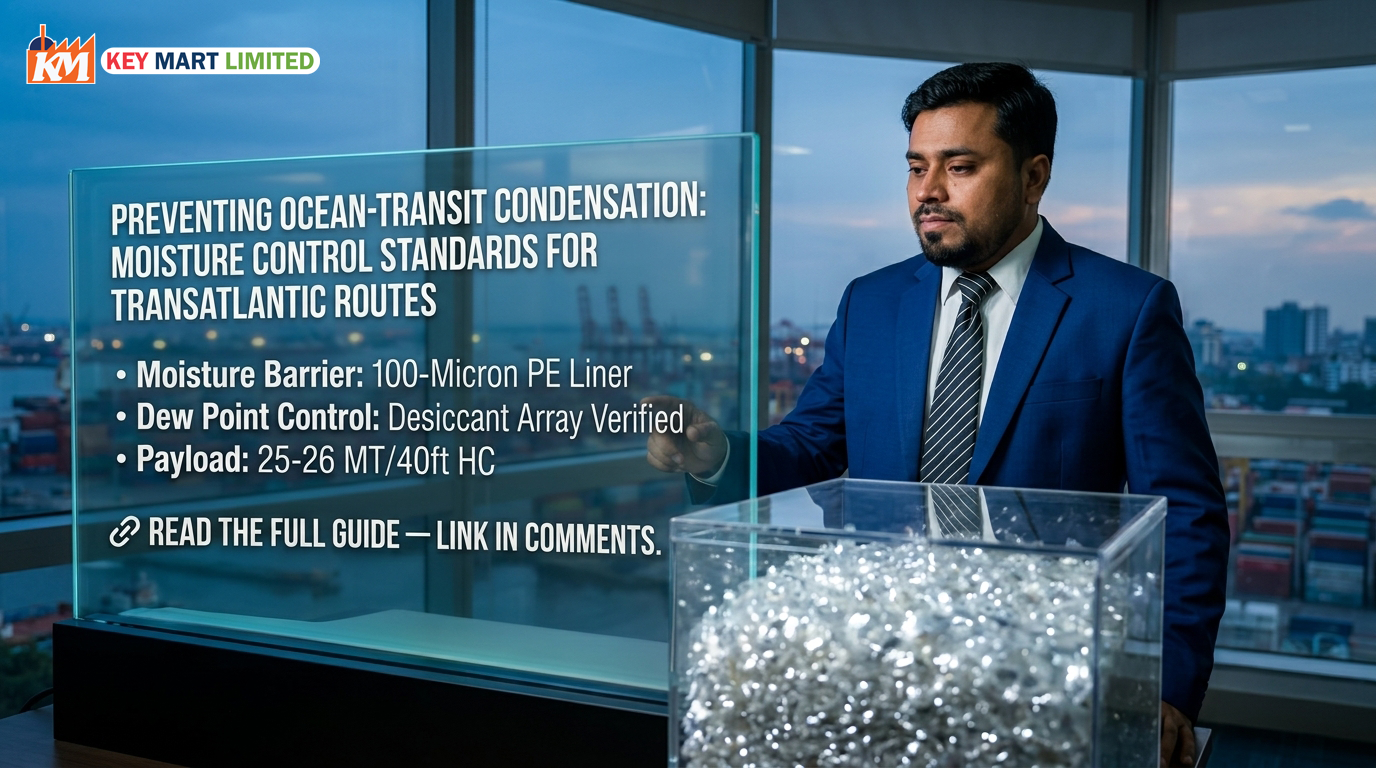
When shipping from tropical manufacturing hubs across transatlantic and transoceanic routes, containers endure rapid temperature drops and high ambient humidity. This dynamic triggers container rain (cargo sweat), causing moisture absorption and mold contamination.
When water-saturated flakes enter an extrusion line without extensive drying, moisture causes severe hydrolytic degradation, Intrinsic Viscosity (IV) drops, and brittle final products.
This engineering guide analyzes the physics of ocean-transit condensation, outlines moisture-barrier packaging standards, and demonstrates how Key Mart Limited protects transoceanic shipments of technical-grade rPET flakes.
1. The Physics of “Container Rain” and Cargo Sweat
Ocean shipping containers are sealed steel boxes subject to constant thermal cycles between day and night, as well as transitions from tropical ports to cold northern climates.
Tropical Port Loading (32°C, 85% RH) ➔ Ocean Transit Cooling (10°C) ➔ Air Reaches Dew Point ➔ Condensation on Ceiling ("Container Rain") ➔ Hydrolytic Damage to Feedstock
A. The Dew Point Transition
Air holds less water vapor as temperatures drop. When a container loaded in a warm, humid environment enters cold ocean waters, the internal steel walls and ceiling cool rapidly. Once the temperature drops below the dew point, airborne moisture condenses into liquid water droplets on the ceiling and drips directly onto the cargo—a phenomenon known as “container rain.”
B. Hygroscopic Moisture Uptake in rPET
While PET is not as hygroscopic as polyamide, post-consumer flakes possess a large surface area. Under prolonged exposure to condensation, flakes absorb surface and interstitial moisture up to $1.5\%\text{–}2.0\%$.
C. The Cost of Hydrolytic Degradation
During extrusion ($260^\circ\text{C}\text{–}280^\circ\text{C}$), even trace moisture ($> 0.005\%$ or $50\text{ PPM}$) causes water molecules to react with the polymer backbone. This breaks the ester bonds (hydrolysis), lowering Intrinsic Viscosity, causing melt fracture, and reducing tensile strength in strapping, sheet, and fiber applications.
Read More: A Step-by-Step Guide to Importing PET Flakes from Bangladesh via Chittagong Port
Moisture Control and Transit Packaging Benchmark Table
| Transit Protection Variable | Standard Export Packaging (High Risk) | Key Mart Limited Export Standard | Impact on Buyer Processing Line |
| Pre-Packing Moisture | Uncontrolled ($> 1.0\%$) | < 0.5% (Controlled Pre-Dryer Target) |
Minimizes internal humidity within the packaging |
| Primary Bag Barrier | Standard unlined woven PP bag | 100-Micron PE Moisture-Barrier Inner Liner |
Prevents external moisture and humidity ingress |
| Container Protection | None / Single silica gel pouch | High-Absorption Calcium Chloride Desiccant Poles |
Actively suppresses container air dew point |
| Container Floor Protection | Bare wood flooring | Heavy-Duty PE Floor Barrier Layer |
Blocks moisture migration from treated container floors |
| Payload Optimization | Unoptimized ($18\text{–}20\text{ MT}$) | Maximized 25–26 Metric Tons / 40ft HC |
Minimizes air pocket volume inside the container |
| Quality Verification | Standard CoA at factory gate | Batch-Specific Pre-Shipment Moisture Titration |
Guarantees feedstock enters transit under spec |
2. Engineering Multi-Layer Moisture Defense for Long-Haul Routes
Eliminating moisture contamination across transatlantic and long-haul shipping lanes requires a multi-stage packaging protocol:
-
Pre-Packing Desiccation: Flakes must pass through hot-air rotary drying or centrifugal dewatering to ensure core and surface moisture is below $0.5\%$ prior to bagging.
-
Hermetic 100-Micron Inner Liners: Standard woven polypropylene FIBC bags are porous. Inserting heavy-duty, heat-sealed 100-micron polyethylene (PE) inner liners creates an impermeable physical barrier against liquid drips and humid air.
-
Active Humidity Desiccants: Installing calcium chloride ($\text{CaCl}_2$) desiccant poles inside container corrugations continuously absorbs ambient moisture, maintaining the internal container air well below its dew point.
-
Optimized Headspace Logistics: Maximizing container payload to 25–26 Metric Tons limits the volume of warm, humid air sealed inside the container box, reducing total condensable water volume.
3. How Key Mart Limited Protects Global Shipments Against Transit Moisture
Safeguarding feedstock quality across long-distance ocean voyages requires an experienced, export-oriented bangladesh pet flakes manufacturer with proven packaging protocols.
As a premier pet flakes company bangladesh and trusted pet flakes exporter, Key Mart Limited implements multi-layered moisture barrier standards for all export shipments:
-
Controlled De-Watering & Drying in Dhaka: Operating as a leading pet flakes manufacturer dhaka, Key Mart Limited subjects all washed flakes to multi-stage mechanical and thermal drying, guaranteeing residual moisture below 0.5% before bagging begins.
-
Heavy-Duty Barrier Packaging: As an established bangladesh pet flakes manufacturer, our facility packs materials into form-stable Baffle FIBC Jumbo Bags fitted with continuous 100-micron virgin PE inner liners, protecting flakes from humidity absorption throughout ocean transit.
-
Maximized 25–26 MT Container Density: Serving as an experienced pet flakes exporter, Key Mart Limited loads 25–26 Metric Tons into every 40ft High Cube container, optimizing ocean freight costs per ton under FOB Chittagong, CFR, or CIF shipping terms while minimizing container air headspace.
-
Full Chain-of-Custody Certification: Every shipment is backed by Global Recycled Standard (GRS 4.0) Transaction Certificates (TC), laboratory-tested $\text{PVC} < 25\text{–}50\text{ PPM}$ guarantees, and batch-specific Certificates of Analysis (CoA).
Partner with Key Mart Limited Today
Protect your extrusion lines from hydrolytic degradation, eliminate container rain risks, and secure high-purity rPET flakes from Bangladesh. Contact our Dhaka export management team today to request Technical Data Sheets, order commercial samples, or reserve monthly container allocations.
-
Company Name: Key Mart Limited
-
Head Office & Factory Address: Plot #31, Road #N-1, Block #K, Eastern Housing, Pallabi 2nd Phase, Rupnagar, Dhaka-1216, Bangladesh.
-
Official Website: www.keymartbd.com
-
Corporate Email: keymartltd@gmail.com | info@keymartbd.com
-
Direct Phone / WhatsApp: +8801760774499, +8801864935478
Join our community today and stay connected with the future of PET recycling.
 Visit our YouTube channel: Key Mart Limited on YouTube
Visit our Facebook Page: Key Mart Limited on Facebook
Subscribe to see our latest factory tours, production updates, and export success stories.