Views: 10
In automated plastics manufacturing, moving post-consumer recycled Polyethylene Terephthalate (pet flakes) from storage silos or FIBC bag unloaders to extruder feed hoppers relies heavily on pneumatic conveying systems. While transporting uniform virgin resin pellets is straightforward, handling recycled PET flakes presents distinct bulk material handling challenges.
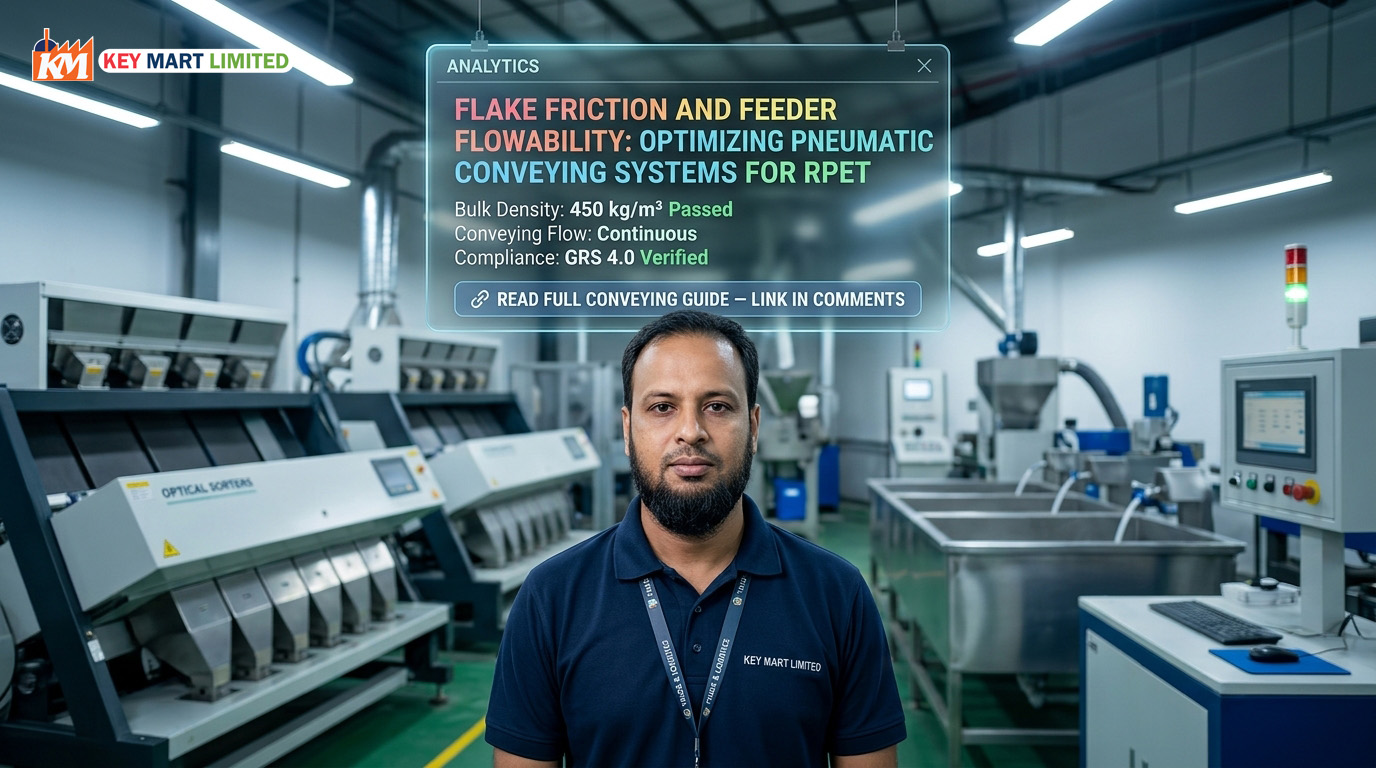
Unlike spherical pellets, post-consumer PET flakes feature irregular 2D geometry, variable aspect ratios, sharp edges, and inconsistent bulk densities ($350 – 450 \text{ kg/m}^3$). These physical characteristics create high particle-to-wall friction, inter-particle interlocking, and static electricity buildup inside transfer piping.
Understanding how flake friction and flowability impact pneumatic conveying lines allows plant engineers to optimize air velocities, prevent line plugging, and maintain steady extruder throat feeding.
1. Mechanics of Flake Friction and Pipe Line Plugging
Pneumatic conveying systems operate primarily in dilute-phase (high velocity, lower pressure) or dense-phase (low velocity, higher pressure) modes. When conveying irregular flakes, several physical phenomena can disrupt material flow:
Flake Feed Entry ➔ Inter-Particle Interlocking ➔ Pipeline Friction Loss ➔ Air Velocity Drop ➔ Material Saltation & Line Plugging
A. Inter-Particle Interlocking & Angle of Repose
Flakes with jagged edges and thin aspect ratios interlock mechanically as they pass through feeder valves and bends. This increases the material’s angle of repose and internal friction angle, requiring higher initial energy to fluidize the bulk stream.
B. Wall Friction & “Angel Hair” Formation
As flakes travel at high velocities through aluminum or stainless steel piping, friction against the pipe wall generates localized frictional heat. This heat softens polymer edges, leading to thin plastic ribbons—commonly known as “angel hair” or “snake skins”—that accumulate at elbows and blind off receiver filters.
C. Fines Accumulation & Static Cling
Fines and dust particles ($< 500\,\mu\text{m}$) generated during bottle grinding create electrostatically charged dust layers inside conveying lines. This restricts pipe cross-sectional areas, increases pressure drop ($\Delta P$), and causes volumetric feed fluctuations at the extruder hopper.
2. Technical Parameters for Optimizing Conveying Lines
To maintain continuous pneumatic transport without pipeline blockages or material degradation, system designers and plant managers must manage key physical variables:
Air Velocity and Pick-Up Speed
Dilute-phase lines require a minimum pick-up air velocity of $18 – 22 \text{ m/s}$ ($3,500 – 4,300 \text{ fpm}$) to keep low-density flakes suspended in the airstream. Excessive velocity increases pipe abrasion and angel hair formation, while insufficient velocity leads to particle saltation (falling out of suspension).
Rotary Airlock Feeder Clearance & Air Purging
Rotary valves feeding flakes into pressurized lines must feature active pocket air purging and flexible, wear-resistant rotor tips. Standard rigid clearance tolerances can trap thin flakes between the rotor and housing, causing mechanical jamming or shearing.
Read More: A Step-by-Step Guide to Importing PET Flakes from Bangladesh via Chittagong Port
Technical Flowability Benchmark Table for Pneumatic Conveying
| Physical Parameter | Standard Scrap Flake Range | Conveying-Optimized Flake Benchmark | Impact on Pneumatic System |
| Bulk Density | $< 350 \text{ kg/m}^3$ | 400 – 450 kg/m³ |
Ensures predictable air-to-material ratio & stable lift |
| Flake Sizing Range | Irregular ($2 – 18 \text{ mm}$) | Uniform 8 – 12 mm |
Reduces interlocking, bridge formation & pipe friction |
| Fines Content (<500 µm) | $> 1.5\%$ | < 0.3% – 0.5% |
Minimizes static cling & receiver filter blind-off |
| PVC Contamination | $< 100 \text{ PPM}$ | < 25 – 50 PPM |
Prevents acidic degradation & sticky melt inclusions |
| Moisture Content | Variable ($> 1.0\%$) | < 0.5% (Pre-Dryer Target) |
Prevents clumping inside hoppers & vacuum receivers |
3. How Key Mart Limited Fulfills Global Buyer Demand
Achieving reliable feeder flowability in pneumatic conveying systems requires a raw material partner that controls flake geometry, bulk density, and fines content during primary processing.
As a premier pet flakes company bangladesh and trusted pet flakes exporter, Key Mart Limited delivers hot-washed feedstock engineered specifically for smooth pneumatic conveying and automated plant integration:
-
Controlled Granulation in Dhaka: Operating as a leading pet flakes manufacturer dhaka, Key Mart Limited utilizes precision rotary granulators to produce uniform 8–12 mm clear flakes. This tight size distribution prevents inter-particle interlocking and reduces wall friction inside transfer lines.
-
Continuous De-Dusting & Fines Removal: As an established bangladesh pet flakes manufacturer, our facility employs multi-stage Z-Box air elutriation and cyclonic dust extraction, keeping fine content below $0.5\%$. This reduces electrostatic static cling and receiver filter clogging.
-
Optimized Bulk Density ($400 – 450 \text{ kg/m}^3$): Our controlled hot-washing and elutriation process yields stable bulk density levels, enabling pneumatic conveying systems to operate at lower, energy-efficient air-to-material ratios.
-
High-Payload Export Logistics: Functioning as an experienced pet flakes exporter, Key Mart Limited packs materials in moisture-resistant Baffle FIBC jumbo bags with $100\,\mu\text{m}$ PE liners, loading up to 25–26 Metric Tons per 40ft High Cube container under FOB Chittagong or CFR/CIF terms. Every order includes a batch-specific Certificate of Analysis (CoA) and Global Recycled Standard (GRS 4.0) documentation.
Partner with Key Mart Limited Today
Eliminate pneumatic conveying blockages, stabilize extruder feeding, and secure high-purity rPET flakes from Bangladesh. Contact our Dhaka export management team today to request Technical Data Sheets, order commercial samples, or reserve container allocation schedules.
-
Company Name: Key Mart Limited
-
Head Office & Factory Address: Plot #31, Road #N-1, Block #K, Eastern Housing, Pallabi 2nd Phase, Rupnagar, Dhaka-1216, Bangladesh.
-
Official Website: www.keymartbd.com
-
Corporate Email: keymartltd@gmail.com | info@keymartbd.com
-
Direct Phone / WhatsApp: +8801760774499, +8801864935478
Join our community today and stay connected with the future of PET recycling.
👉 Visit our YouTube channel: Key Mart Limited on YouTube
👉 Visit our Facebook Page: Key Mart Limited on Facebook
Subscribe to see our latest factory tours, production updates, and export success stories.