Views: 7
As international sustainability targets and statutory extended producer mandates accelerate, global packaging converters and brand owners are under intense pressure to incorporate high percentages of post-consumer recycled Polyethylene Terephthalate (pet flakes) into direct food-contact packaging.
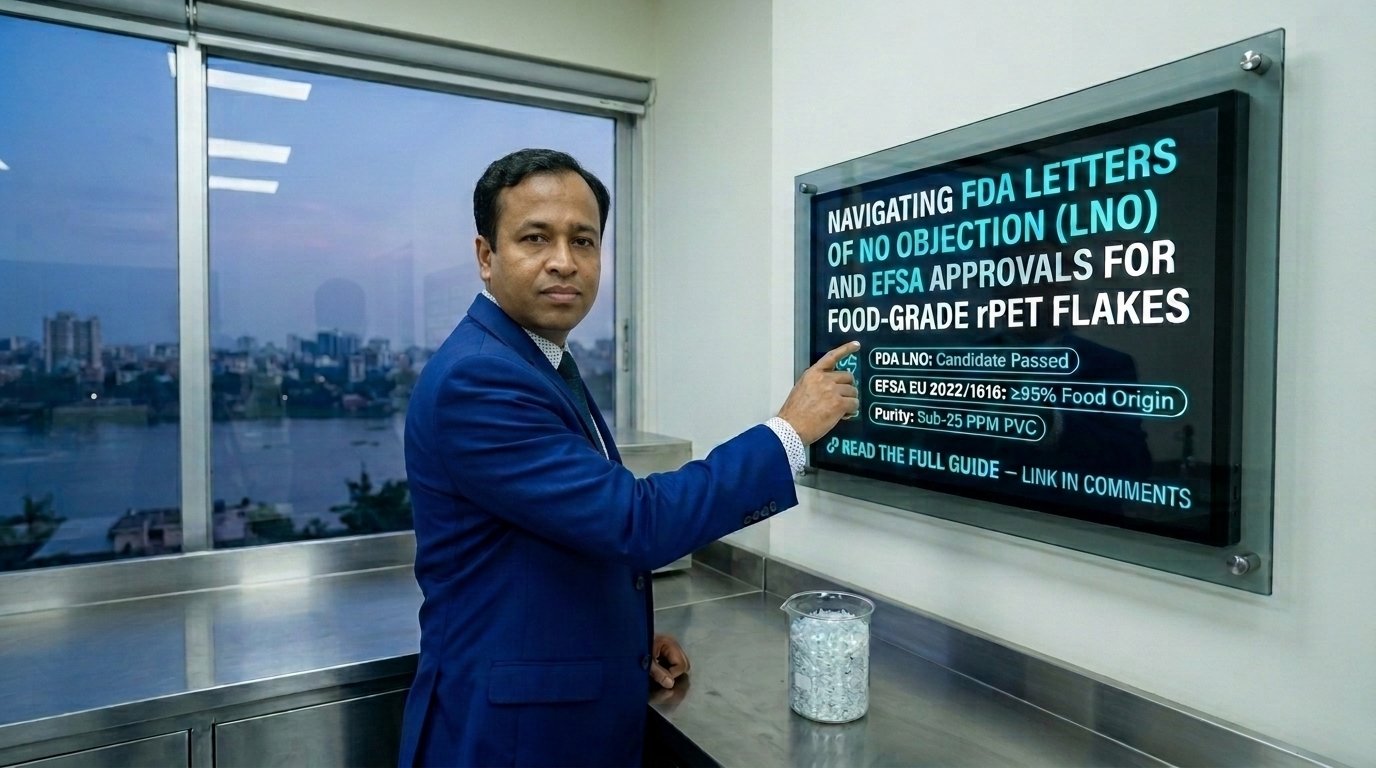
However, transforming post-consumer waste into food-safe packaging requires navigating strict regulatory frameworks. Direct food contact is governed by two regulatory benchmarks: the U.S. Food and Drug Administration (FDA) and the European Food Safety Authority (EFSA) under Commission Regulation (EU) 2022/1616.
Failing to source compliant, decontaminated feedstock introduces significant toxicological and regulatory risks, including chemical migration into food, non-compliance fines, and product recalls.
This technical guide outlines the regulatory pathways for FDA Letters of No Objection (LNO) and EFSA compliance, details the role of challenge testing in chemical decontamination, and explains how Key Mart Limited supplies candidate feedstock engineered for food-grade super-cleaning lines.
1. Regulatory Frameworks: FDA LNO vs. EFSA (EU 2022/1616)
While both regulatory authorities aim to prevent non-intentionally added substances (NIAS) and hazardous contaminants from migrating into food matrices, their evaluation protocols differ:
Post-Consumer Sourcing (≥95% Food Origin) ➔ Intensive Hot Washing ➔ NIR Sorting ➔ Super-Clean Decontamination (Vacurema/SSP) ➔ FDA LNO / EFSA DoC Compliance
A. U.S. FDA Letter of No Objection (LNO) Protocol
The FDA evaluates recycling processes on a case-by-case basis under 21 CFR regulations:
-
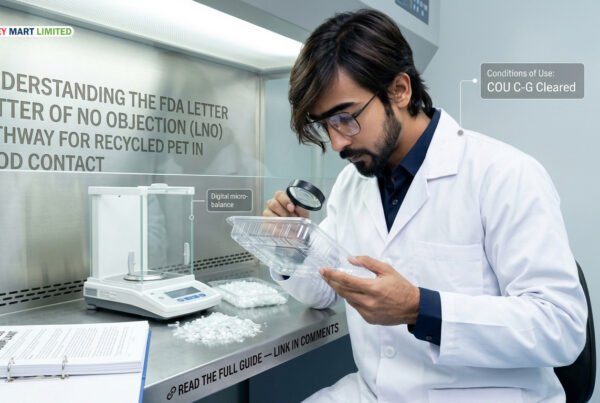
The Nature of LNO: An FDA LNO is not a formal material “approval” but an official confirmation that the agency has no safety objections to using a specific mechanical recycling process for food packaging under defined Conditions of Use (ranging from Condition A for high-temperature retort down to Condition H for frozen storage).
-
Challenge Testing (Surrogate Contaminants): The recycler or technology provider must execute a “Challenge Test,” intentionally spiking virgin resin with chemical surrogates (representing volatile, semi-volatile, polar, and non-polar contaminants like toluene, chloroform, and lindane) to demonstrate that the washing and thermal decontamination systems remove them below toxicological thresholds.
B. EFSA & European Commission Regulation (EU) 2022/1616
In Europe, Regulation (EU) 2022/1616 establishes strict oversight of food-contact recycled plastics:
-
Suitable Technologies & Input Control: Mechanical recycling of post-consumer PET is recognized as a “suitable technology,” provided the input feedstock originates from separate, traceable collections with at least 95% food-contact origin.
-
Mandatory Union Register & DoC: Facilities must maintain third-party certification of their collection loops, operate under accredited decontamination processes evaluated by EFSA, and issue a batch-specific Declaration of Compliance (DoC) detailing critical processing limits.
Technical Purity and Regulatory Compliance Benchmark Table
| Regulatory & Quality Parameter | Non-Food Industrial Grade | FDA LNO / EFSA Food-Grade Benchmark | Technical Impact on Food Packaging |
| Input Source Control | Mixed post-consumer scrap | ≥ 95% Food-Contact Beverage Bottles |
Complies with EU 2022/1616 separate collection rules |
| PVC Contamination | $< 150 – 300 \text{ PPM}$ | < 25 – 50 PPM (Target < 25 PPM) |
Prevents acid-induced degradation, black specks, and toxic chlorides |
| Chemical Migration Limit (LML) | Not evaluated | < 0.01 mg/kg (10 ppb) in food matrix |
Guarantees toxicological safety per EFSA & FDA migration rules |
| Intrinsic Viscosity (IV) | $0.65 – 0.72 \text{ dL/g}$ | 0.78 – 0.82 dL/g (High Stability) |
Preserves melt strength for preforms, bottles, and thermoformed sheet |
| Moisture Content (Pre-Dryer) | $< 1.0\%$ | < 0.5% (Target < 0.3%) |
Prevents hydrolytic IV scission during solid-state polycondensation (SSP) |
| Polyolefin (Cap & Label) | $< 200 \text{ PPM}$ | < 25 PPM |
Eliminates visual haze, optical clouding, and migration voids |
2. Preparing Feedstock for Super-Cleaning and Decontamination
Before secondary super-cleaning systems (such as EREMA VACUREMA, Starlinger recoSTAR, or Buhler SSP reactors) can effectively decontaminate flakes to food-grade quality, the incoming raw pet flakes must meet strict physical and chemical purity standards:
-
Eliminating PVC Catalysts: PVC breaks down at extrusion temperatures ($> 160^\circ\text{C}$), generating hydrochloric acid ($\text{HCl}$) which ruins downstream vacuum filters and causes severe Intrinsic Viscosity degradation. Feedstock must be sorted below $25\text{–}50\text{ PPM}$ PVC.
-
Thermal Glue & Surface Decontamination: Multi-stage continuous hot-caustic washing ($85^\circ\text{C}-95^\circ\text{C}$) dissolves water-soluble and hot-melt adhesives, removing surface volatile organic compounds (VOCs) before they can diffuse into the polymer matrix.
-
Optimized Flake Morphology: Uniform $8 – 12 \text{ mm}$ flake sizing with sub-0.3% fines ensures predictable residence time and uniform vacuum degassing across continuous solid-state decontamination reactors.
Read More: A Step-by-Step Guide to Importing PET Flakes from Bangladesh via Chittagong Port
3. How Key Mart Limited Fulfills Global Buyer Demand for Food-Grade Candidate Feedstock
Supplying raw material suitable for FDA LNO-approved and EFSA-compliant decontamination lines requires an experienced bangladesh pet flakes manufacturer with strict operational controls.
As a premier pet flakes company bangladesh and trusted pet flakes exporter, Key Mart Limited delivers candidate rPET feedstock engineered specifically for food-contact bottle-to-bottle and thermoforming sheet extrusion:
-
Source-Segregated Collection in Dhaka: Operating as a leading pet flakes manufacturer dhaka, Key Mart Limited selectively sources clear post-consumer beverage and water bottles, maintaining the $\ge 95\%$ food-origin threshold essential for European and North American regulatory compliance.
-
Continuous Hot-Caustic Washing & NIR Sorting: As an established bangladesh pet flakes manufacturer, our facility subjects crushed bottles to multi-stage caustic friction washing and high-resolution NIR optical sorting to guarantee PVC $< 25 – 50 \text{ PPM}$, zero label glue residues, and moisture dried below $0.5\%$.
-
Batch Traceability & GRS 4.0 Certification: Serving as an experienced pet flakes exporter, Key Mart Limited provides complete chain-of-custody documentation, Global Recycled Standard (GRS 4.0) Transaction Certificates (TC), and batch-specific Certificates of Analysis (CoA) to support your downstream EFSA Declaration of Compliance and FDA filings.
-
Maximized 25–26 MT Container Loading: We pack 25–26 Metric Tons into every 40ft High Cube container using heavy-duty 100-micron PE inner liners, preserving dryness and protecting against transoceanic contamination under FOB Chittagong, CFR, or CIF shipping terms.
Partner with Key Mart Limited Today
Secure compliant, food-grade candidate rPET flakes from Bangladesh for your FDA LNO and EFSA decontaminating lines. Contact our Dhaka export management team today to request Technical Data Sheets, order commercial laboratory samples, or reserve container allocation schedules.
-
Company Name: Key Mart Limited
-
Head Office & Factory Address: Plot #31, Road #N-1, Block #K, Eastern Housing, Pallabi 2nd Phase, Rupnagar, Dhaka-1216, Bangladesh.
-
Official Website: www.keymartbd.com
-
Corporate Email: keymartltd@gmail.com | info@keymartbd.com
-
Direct Phone / WhatsApp: +8801760774499, +8801864935478
Join our community today and stay connected with the future of PET recycling.
 Visit our YouTube channel: Key Mart Limited on YouTube
Visit our Facebook Page: Key Mart Limited on Facebook
Subscribe to see our latest factory tours, production updates, and export success stories.