Views: 3
If you manufacture rigid plastic beverage containers, thermoformed packaging, or preforms sold in California, meeting state post-consumer recycled (PCR) targets is no longer just a voluntary corporate sustainability goal. It is an enforceable statutory requirement with direct bottom-line consequences.
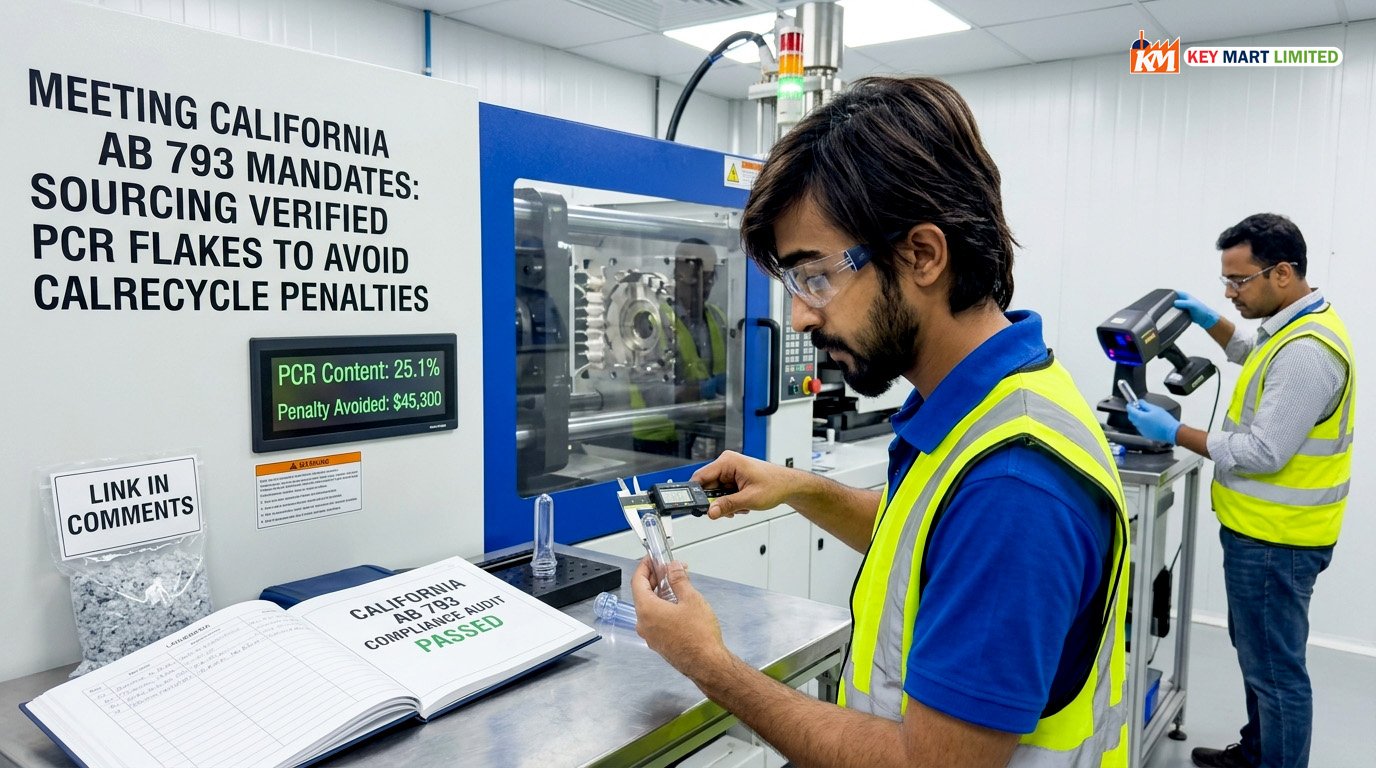
Under California Assembly Bill 793 (AB 793), the state enacted the most aggressive mandatory recycled-content schedule for plastic beverage containers in the United States.
Administered by the California Department of Resources Recycling and Recovery (CalRecycle), the law mandates that all plastic beverage containers subject to the California Beverage Container Recycling and Litter Reduction Act (CRV) incorporate increasing minimum percentages of post-consumer resin:
-
2022: $15\%$ post-consumer recycled content
-
2025 onwards: $25\%$ post-consumer recycled content
-
2030 onwards: $50\%$ post-consumer recycled content
Falling short is financially punitive. Under CalRecycle statutory rules, beverage manufacturers face administrative shortfall penalties of $0.20 per pound for every pound of virgin resin used in place of required post-consumer material:
For a mid-to-large bottling line processing 20 million pounds of resin annually, a 10% PCR deficit triggers a direct $400,000 annual fine, on top of brand exposure and audit scrutiny.
Meeting California AB 793 PCR compliance while maintaining plant efficiency requires sourcing dependable, clean, single-origin post-consumer recycled Polyethylene Terephthalate (pet flakes) backed by certified mass-balance accounting.
This operational guide details the mechanics of CalRecycle audit filings, outlines technical hurdles in high-PCR preform injection molding, and explains how Key Mart Limited delivers audit-ready, high-viscosity rPET flakes to packaging converters across North America.
1. The Mechanics of CalRecycle Audits: How Compliance Is Enforced
CalRecycle does not rely on self-declared vendor statements. Compliance tracking uses detailed mass-balance reporting across three regulatory checkpoints:
[Inbound Clear Post-Consumer Bottles] ➔ [Mechanical Hot-Caustic Decontamination] ➔ [Annual CalRecycle PCR Filing] ➔ [GRS 4.0 Transaction Mass-Balance Audit] ➔ [Zero Shortfall Penalty ($0.20/lb Avoided)]
A. Annual Manufacturer Reporting Mandates
Every year by March 1, beverage manufacturers must report:
-
The total weight of virgin plastic used in CRV beverage containers sold into California during the previous calendar year.
-
The total post-consumer recycled plastic weight incorporated into those containers.
-
Batch-level provenance documentation proving that recycled resin originated strictly from verified post-consumer collection streams, excluding industrial post-industrial scrap (PIR).
B. The Audit Defense: GRS 4.0 Chain of Custody
CalRecycle auditors cross-reference reported PCR tonnage against third-party transaction records.
If an overseas supplier claims material is “recycled” without accredited third-party certification, state auditors can disqualify the volume, reclassify the material as virgin, and assess the full $0.20/lb shortfall fee retroactively.
To withstand an audit, brands must hold Global Recycled Standard (GRS 4.0) Transaction Certificates (TC) tracking feedstock directly from local bottle collection through final export loading.
California AB 793 Compliance & Material Quality Matrix
| Regulatory & Technical Parameter | Unverified Broker Scrap | Standard Regional rPET | Key Mart Certified AB 793 Grade |
| CalRecycle Audit Status | High Risk of Disqualification | Partial Acceptance | 100% CalRecycle Audit Compliant |
| Shortfall Penalty Risk ($0.20/lb) | Severe Financial Exposure | Variable Exposure | Zero Liability (Full Volume Credited) |
| Feedstock Provenance | Mixed Industrial / Scrap | Mixed Municipal Scrap | 100% Post-Consumer Beverage Bottles |
| Chain-of-Custody Certification | None / Self-Declared | Scope Certificate Only | GRS 4.0 Transaction Certified (TC) |
| Intrinsic Viscosity (IV – ASTM D4603) | $0.65\text{–}0.70\text{ dL/g}$ (Unstable) | $0.72\text{–}0.75\text{ dL/g}$ | 0.78 – 0.82 dL/g (Preform & Sheet Grade) |
| PVC Contamination Ceiling | $> 150\text{–}300\text{ PPM}$ | $50\text{–}100\text{ PPM}$ | < 25 – 50 PPM (Continuous Hot-Caustic) |
| Fines Content ($< 500\,\mu\text{m}$) | $> 2.5\text{–}3.5\%$ (Burn Risk) | $1.0\text{–}1.5\%$ | < 0.3% (Multi-Stage Air Elutriated) |
| Container Payload Efficiency | $18\text{–}20\text{ MT}$ | $21\text{–}23\text{ MT}$ | 25.0 – 26.0 MT Maximized 40ft High Cube |
2. Preventing Preform Defects When Blending 25%–50% PCR Flakes
Increasing PCR blend ratios to meet 25% and 50% benchmarks introduces distinct processing challenges on injection molding and blow molding lines:
-
Maintain Strict IV Consistency ($0.78\text{–}0.82\text{ dL/g}$): Virgin bottle-grade resin typically carries an IV around $0.80\text{–}0.84\text{ dL/g}$. Blending low-grade recycled flakes ($< 0.72\text{ dL/g}$) drops overall melt viscosity, leading to parison sag, uneven wall distribution, and preform gate crystallization. Using flakes with a uniform IV baseline ensures even cycle times and uniform bottle blowability.
-
Control Electrostatic Fines ($< 0.3\%$): High concentrations of dust fines ($< 500\,\mu\text{m}$) cause problems in dryer hoppers and extruder feed throats. Fines burn prematurely in the feed zone, generating black specks that weaken preform walls and cause blowouts under high stretch-blow pressure. Thorough multi-stage air elutriation eliminates fine particles before material hits your dryers.
-
Eliminate PVC Contamination ($< 25\text{–}50\text{ PPM}$): At PET melt temperatures ($270^\circ\text{C}-290^\circ\text{C}$), PVC thermal degradation releases hydrochloric acid gas, causing yellowing, polymer hazing, and screw barrel corrosion. Continuous hot-caustic friction washing saponifies adhesives and floats out chlorinated plastics, preserving preform clarity and structural integrity.
Read More: A Step-by-Step Guide to Importing PET Flakes from Bangladesh via Chittagong Port
3. How Key Mart Limited Supplies Audit-Ready PCR Flakes
Fulfilling California’s escalating recycled-content targets without risking administrative penalties requires partnering with an established bangladesh pet flakes manufacturer that pairs industrial throughput with verified chain-of-custody documentation.
As a premier pet flakes company bangladesh and trusted pet flakes exporter, Key Mart Limited delivers low-dust, high-viscosity clear rPET flakes engineered to satisfy CalRecycle audits and high-speed packaging lines:
-
100% Post-Consumer Beverage Bottle Intake: Operating as a leading pet flakes manufacturer dhaka, Key Mart Limited selectively processes 100% post-consumer clear beverage bottles, rejecting industrial composite scrap, colored plastics, and non-PET materials at intake gates.
-
Continuous Multi-Stage Caustic Washing ($85^\circ\text{C}-95^\circ\text{C}$): In our Dhaka plant, our pet flakes undergo continuous hot friction washing and automated NIR optical sorting, fully saponifying label glues and stripping organic residues to guarantee $\text{PVC} < 25\text{–}50\text{ PPM}$ and zero adhesive carryover.
-
Sub-0.3% Fines Removal via Air Elutriation: Serving as an experienced pet flakes exporter, Key Mart Limited passes every batch through automated multi-stage zig-zag air classifiers, keeping dust and fines strictly below $0.3\%$ to eliminate premature burning and melt pressure surges during extrusion.
-
GRS 4.0 Audited Mass-Balance Traceability: Every export batch is tested in our Dhaka quality control laboratory for stable Intrinsic Viscosity ($0.78\text{–}0.82\text{ dL/g}$), high bulk density ($330\text{–}370\text{ kg/m}^3$), and low moisture ($< 0.5\%$), backed by lot-specific Certificates of Analysis (CoA) and official Global Recycled Standard (GRS 4.0) Transaction Certificates (TC) that satisfy state audit discovery.
-
Maximized 25–26 MT Container Logistics: We pack 25–26 Metric Tons into every 40ft High Cube container with heavy-duty 100-micron PE inner liners to preserve feedstock dryness during transit under FOB Chittagong, CFR, or CIF shipping terms, with contractually secured extended free time at major US ports (Long Beach, Oakland, Houston, Savannah, Newark).
Partner with Key Mart Limited Today
Satisfy California AB 793 mandates, avoid CalRecycle’s $0.20/lb shortfall penalties, and secure high-viscosity rPET flakes from Bangladesh. Contact our Dhaka export management team today to request Technical Data Sheets, order commercial testing samples, or reserve monthly container allocations.
-
Company Name: Key Mart Limited
-
Head Office & Factory Address: Plot #31, Road #N-1, Block #K, Eastern Housing, Pallabi 2nd Phase, Rupnagar, Dhaka-1216, Bangladesh.
-
Official Website: www.keymartbd.com
-
Corporate Email: keymartltd@gmail.com | info@keymartbd.com
-
Direct Phone / WhatsApp: +8801760774499, +8801864935478
Join our community today and stay connected with the future of PET recycling.
 Visit our YouTube channel: Key Mart Limited on YouTube
Visit our Facebook Page: Key Mart Limited on Facebook
Subscribe to see our latest factory tours, production updates, and export success stories.